Released 2nd August 1915
Rags (1915)
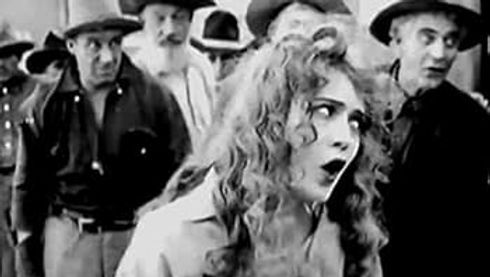
Mary Pickford swiftly established a regimented work routine while working for Adolph Zukor – the rapid, unceasing treadmill he had her on called for it. In 1914 she made seven features; in 1915, she made eight. She would rise be 7am each morning, and after a light breakfast she would set off to the studio. She allowed herself only half-an-hour for lunch, and filled dead time between camera set-ups by keeping up to date with her correspondence. Pickford would rarely return home before 7pm, where she would recount the day’s events with her mother, Charlotte. Her work ethic earned Zukor’s respect: “She taught me a great deal,” he recalled. “I was only an apprentice then; she was an expert workman.”
January 1915 had seen her renegotiate her contract with Zukor’s Famous Players Company, increasing her weekly pay from $1,000 to $2,000 plus fifty per cent of the profits from her films. While this rise in income provided financial stability, it drove the wedge deeper between her and her husband, Owen Moore. Already drinking heavily, Moore resented the fact that his career had plateaued while Pickford’s had skyrocketed so that her income far outstripped his. As a result, for emotional support, Pickford continued to rely on James Kirkwood, the director of six of her films - including Rags – in 1915.
Her leading man in Rags was Marshall Neilan, who had written the scenario for Pickford’s previous film, Little Pal (1915), and would become one of her favourite directors. A native of San Bernardino, Neilan lucked into a movie career in 1912 when he delivered an automobile to director Allan Dwan while working as a car salesman. He started as an actor but added directing to his resume while working for Kalem.
The plot, written for Pickford once again by her close friend Frances Marion, couldn’t be more perfunctory. The actress plays two roles. First, she is Alice McCloud, a demure lady who coyly accepts bank clerk Paul Ferguson’s (J. Farrell MacDonald) marriage proposal after first refusing bank president John Hardesty’s (Joseph Manning). Unfortunately, she chose the wrong suitor: Ferguson spirals into a life of alcoholism after being fired for embezzling the bank, and Alice dies giving birth in a shack to their baby girl. With her dying breath, she asks that her daughter be named Glory, but her drunken father declares it would be better to call her Rags “because that’s all she’ll ever have.”

Fast-forward sixteen years, and Ferguson’s prediction is proven right. Young Glory, also played by Pickford, wears rags, and is introduced through a patchwork hole as she wrestles with a goat. It seems like she is fighting the entire world in these introductory scenes. After the goat, she fights a gang of urchins she finds tying tin cans to her dog’s tail; next, she fights the saloon patron giving her father a beating for trying to steal his money, and then she cuffs her old man. Finally, she takes on the whole saloon.
This introduction presents Rags as a feisty heroine more than capable of taking care of herself, so it’s odd that she spends the rest of the movie having the course of her life decided for her by the men in her life. Her father abuses her and leaves her in the care of John Hardesty when he dies during a bungled robbery; Hardesty stipulates in his will (there are a lot of ‘dying breath’ bequests in Rags) that his nephew will only receive his inheritance if he marries Rags – whom, unknown to him, she has already met and fallen in love with – apparently giving her no say in the matter, and the nephew’s willingness to marry her saves her from returning to a life of rural poverty.
It’s clear that Adolph Zukor knew Pickford was a big enough attraction to make even the most perfunctory material profitable, and little effort was made to add depth to the characters or spice to the plot. Everyone behaves as you expect, and everything turns out as anticipated. Only Pickford’s screen presence – which she had in abundance – elevates Rags above the ordinary, and Kirkwood allows the camera to linger on her face as she runs through the expressions 1915 audiences found adorable. And adorable she is; those who share the screen with her simply fade into the background, dimmed by her radiance. But it’s doubtful that Pickford’s career would have been so successful had she continued with material as lacklustre as this.
In her biography, Sunshine and Shadow, Pickford recalled driving past the Strand on Broadway and noticing the crowds queuing to see Rags. The following week she passed the same theatre at the same time on the same day and noticed that nobody was queueing to see a different Famous Players movie playing at the theatre. Intrigued, she instructed her chauffeur to drop her off and bought a ticket to the screening. Inside, she found that more than half the seats were empty. The following day, she and her mother quizzed Zukor, asking how much rental they received from the Strand for Rags and how much Famous Players received for the picture that was currently playing. Zukor admitted that they received $3,000 for Rags and only $200 less for the other movie. After discussing the situation with her mother, Pickford, ever the canny businesswoman, decided that, come the next contract negotiations, she would insist that Famous Players sold her pictures separately, and not packaged with their other films.