Released January 1915
The Italian (1915)

George Beban is today just another forgotten name from a long-past era; the many thousands who flocked to see him on the Broadway stage are long dead and most of the films he made from 1915 to his premature death after falling from a horse in 1928 no longer exist. Born in San Francisco in 1873 to an Italian father and Irish mother, Beban started performing at 8 with a minstrel show. After building a reputation as a vaudeville comedian, he found regular work with George M. Cohan’s company, often playing a French Count. Like most stage actors, Beban was uninterested in acting in films. In 1909 he co-wrote The Sign of the Rose with Broadway playwright Charles Turner Dazey. He performed the play throughout America and travelled to England before Robert G. Vignola adapted it for the screen in 1915 as The Alien.
Before making that film, however, Beban debuted in The Italian. The tale of an Italian immigrant to the United States bears similarities to The Sign of the Rose, although the plot was more likely based on the 1913 short The Wop. The Independent Motion Picture Company (IMP), which formerly employed Thomas H. Ince, the producer and credited co-writer of The Italian, made that film. It’s doubtful Ince played any part in writing the scenario – he was well known for taking the credit for works in which he played only a supervisory role. He was long believed to have directed The Italian, which was actually the work of the talented Canadian-born Scottish director Reginald Barker. It is probable that C. Garner Sullivan wrote the screenplay alone, taking elements from the IMP film and William C. de Mille’s playlet, The Land of the Free.
Ince started his film career as a director for IMP after working for Biograph as a production coordinator. He filmed Mary Pickford and Owen Moore in Cuba, far from the reach of the Motion Picture Patents Company. In 1911, Ince moved to California to make westerns for the New York Motion Picture Company’s Bison Studios. There, he built the Miller 101 Bison Ranch Studio – more commonly known as Inceville – on a vast tract of land in the Santa Ynez canyon. It was there, and in San Francisco that Barker shot most of the scenes for The Italian.
By 1915, Beban had gained a reputation for his portrayal of Italian immigrants, whom he had studied closely for The Sign of the Rose. The actor spent weeks observing Italian labourers constructing a tunnel between Manhattan and New Jersey. He noted their mannerisms and language, but never learned to speak their language. In his quest for authenticity, he even bought clothes from a labourer for $10. By the time Ince offered him the part of the tragic immigrant Beppo, the movies had shaken off their undesirable reputation as a last resort for actors unable to find ‘proper’ work on the stage, but Beban was still reluctant to take part in them.
Ince travelled to New York in the late summer of 1914 to entice him, accosting him on the street two hours after arriving in the city. “He pictured for me every imaginable luxury I would have if I would make just one five-reeler for him as my vacation at his expense, and then go on with my dramatic career as if nothing had happened – ocean view from my dressing room, sets built for me in the mountains, luncheon served by a stream, glorious sunsets on the Pacific… (All of these were rather difficult to avoid at Inceville, but he threw in a fine horse and groom).
“Then, after the matinee, with me in the shadows and himself under the light, reversing Belasco’s tactics, Ince told me, without dialect, the story of that picture he wanted me for. He was all worked up to convince, crying like a baby… never in his career did he play a part like he played that! From beginning to end I was spellbound… All I was able to say was three words: ‘I’ll do it!’”
Beban requested – and received – an unusually high salary of $7,000 and a percentage of the film’s profit. He also requested that Ince change the film’s title from The Dago to The Italian.
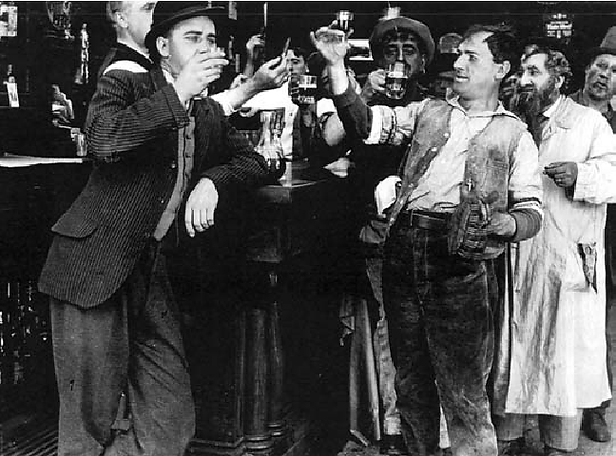
Although Sullivan set the film in Manhattan’s Lower East Side, Barker shot the city scenes in San Francisco. Some reports at the time claimed a small crew also travelled to Italy to film Beban as a gondolier, but this is doubtful. The shoot wasn’t without its problems. Moving Picture World reported that a San Francisco streetcar almost hit Beban while shooting a scene in which he is thrown from a moving car (two weeks later, the New York Clipper claimed the incident took place on North Main Street in Los Angeles). Regardless of the location, Ince promptly insured Beban for $25,000 against accidental injury or death. Another report in Reel Life magazine revealed that the taste of the beer substitute made from diluted ginger ale and soap suds used in one scene so disgusted Ince he delayed filming for thirty minutes so that an assistant could fetch a keg of beer from Santa Monica.
Spoilers ahead
The story opens and closes with Beban wearing a smoking jacket in a plush apartment, reading a book written by Ince and Sullivan called The Italian. Presumably, this is to show that although a cultured man, the respected actor also cares about lowly immigrants such as the one he plays in the film.
His character, Beppo, travels to America not in search of a better life, but because he must prove himself to the father of Annette (Clara Williams), the woman he loves. The movie depicts the USA not as the land of opportunity but as a brutal and unforgiving metropolis. Its people are brusque and unwelcoming and look out only for themselves. By contrast, his native land is shown as a happy community working together in a near-idyllic rural landscape that enjoys majestic sunsets. It’s a romanticised depiction, but it serves well to emphasise the almost inhuman environment Beppo finds when he disembarks at Ellis Island.
He finds a place for himself in the city and earns enough as a shoeshine to send for his beloved. Their modest marriage marks the point where the film switches from comedy to tragedy. A year after they are married, Annette gives birth to a baby boy. That year, however, the city roasts under a fierce heatwave that threatens their ailing baby’s life, and Beppo is mugged by a couple of thugs when he goes to buy milk for him with the last of his money.
The Italian is an incredibly powerful movie for 1915, thanks to Beban’s remarkable performance and Barker’s unflinching observation of the tragedy that consumes him. Beban’s emotions range from delirious ecstasy over the birth of his son to murderous rage when he encounters by chance the ruffians who robbed him. The contrast between comedy and tragedy should jar; instead, it reinforces the brutal fate that befalls the blameless Beppo. Barker doesn’t even offer hope for the future, ending the film with the inconsolable Beppo grieving over his little son’s grave.
End of Spoilers
The Italian received scant attention upon its release, receiving reviews in only the New York Dramatic Mirror and Variety. It also fared poorly at the box office (it wasn’t even released in Italy). The Mirror’s reviewer said, “The production is notable. More than that, one might safely name it as unique among the pictures scheduled on the Paramount programme – a programme confessedly aimed at a more cultivated public than has been reached by that useful trinity, bathos, sentimentality and melodrama.” Vachel Lindsay also singled it out for praise in his seminal work, The Art of the Moving Picture, considering it “a strong piece of work.” Francis Ford Coppola constantly referred to the film when recreating turn-of-the-century New York for The Godfather Part II (1974).