His Picture in the Papers (1916)
Released 13th February 1916

Charles Butler, Douglas Fairbanks and Loretta Blake in John Emerson's His Picture in the Papers (1916)
His Picture in the Papers (1916)
Running Time: 62m, Comedy, Production Company: Fine Arts Film Co.
Director: John Emerson.
Writer: John Emerson, Anita Loos, Cinematography: Victor Fleming
Cast: Douglas Fairbanks, Clarence Handyside, Rene Boucicault, Jean Temple, Charles Butler, Loretta Blake, Homer Hunt.
Just two pictures into his movie career, Douglas Fairbanks was already creating a place for himself as one of American cinema’s biggest stars. While in early 1916, he might not have quite ranked alongside Charlie Chaplin and Mary Pickford, he was catching up fast. Fairbanks embodied the breathless pace of early 20th Century American life. The world was changing, casting off its Victorian shackles and marching towards a future filled with promise. Social reform and industrialisation were transforming the country, and at the forefront of change was Fairbanks, an irrepressible powerhouse charging forward, the positive embodiment of healthy masculinity.
Fairbanks’ third film, His Picture in the Papers (1916), helped to crystallise the essence of both the man and the performer – unlike many stars, the two personas were virtually interchangeable. It was written by twenty-six-year-old Anita Loos, a precocious talent who sold her first scenario to Lubin – an unproduced short called The Earl and the Tomboy – while barely out of her teens. Griffith based his 1912 short The New York Hat on her scenario, which Biograph had bought for $25. After working for Biograph, she followed Griffith to Mutual and then to Triangle. There she met her future husband, the director John Emerson.
Loos’ recollections of her early years in Hollywood are notoriously unreliable: she claimed to have sold her first scenario when she was twelve. Film historians have comprehensively discredited many of her claims, and that which has not we must regard with a pinch of salt. In her biography, Kiss Hollywood Good-by, Loos recalled that her future husband happened upon a stack of her un-filmed scenarios and admired what she described as their ‘refreshing impudence’. She continued: “Presently he came across a story that poked fun at our American aristocracy. It had been inspired by Hollywood’s neighboring community of Pasadena, a winter resort for snobbish families whose lineage had been established by brand names such as Heinz Pickles, Smith Brothers’ Cough Drops, and Chalmers underwear.”
Emerson took the script to Griffith, saying he wanted to make it into a picture for Fairbanks. He and the actor were friends; they knew each other when Fairbanks was on Broadway and were both members of the Lambs, a New York theatrical club. The eminent director warned Emerson against it: “If you study it,” he said, “you’ll notice that most of the laughs are in the dialogue which can’t be photographed.” When Emerson asked why Griffith had bought the scripts, the director replied, “Because they make me laugh!” Griffith eventually agreed to Emerson’s request, with a warning, according to Loos, to complete the film before Fairbanks’ option was due, as it was not to be renewed. In fact, Fairbanks had by then already signed a three-year contract with Triangle for $2,000 per week, rising by $500 every six months.
They filmed His Picture in the Papers at Fine Arts’ studio in Yonkers, New York, far from Griffith, who was immersed in making Intolerance (1916). Fairbanks had been keen to return East: Hollywood offered little in the way of nightlife, and he may have sensed that Griffith didn’t like him. He arrived in New York with his wife, Beth, and son Douglas Jr., on Saturday, 2nd October 1915. Emerson also felt more comfortable in New York, away from the Californian heat and surrounded by his friends at the Lambs and the Friars clubs. He once again engaged as an assistant Erich von Stroheim, who had worked as an advisor and assistant director on Emerson’s Old Heidelberg, and took pleasure in introducing the young Austrian to such leading theatrical figures as the Barrymores, David Belasco, George M. Cohan and Charles Frohman. In addition to his role as assistant director on His Picture in the Papers, von Stroheim played a menacing gang member, complete with an eye patch, paralysed arm, and single black glove. With his closely cropped hair and sombre countenance, von Stroheim looked every inch the villain – so much, in fact, that while sitting in the lobby of the Hotel Astor, he was invited to the manager’s office by a plain-clothes detective who had mistaken him for an escapee from Sing Sing! In a letter to his biographer Peter Noble, he later recalled filming the scene in which he was thrown from a train by Fairbanks. Von Stroheim had recruited six artillery men from a nearby munitions factory to run alongside the train with a net to break his fall. Conscious that his name and shaven head often caused him problems while the war in Europe was ongoing, the Austrian bought them drinks to get into their good graces. Unfortunately, the men drank so much that they failed to catch him, and he was knocked unconscious. Emerson insisted on several takes, and von Stroheim told Noble, “I was practically out of action for many days afterwards. Naturally Emerson used only the first take. Directors are such queer people.”
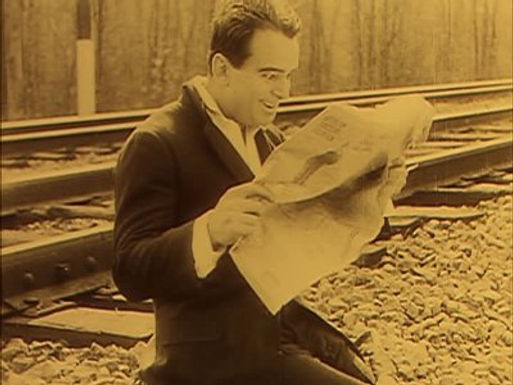
Douglas Fairbanks in John Emerson's His Picture in the Papers (1916)
Fairbanks’ leading lady in His Picture in the Papers was Loretta Blake. She was only eighteen, but the camera made her look older than her true age. As Fairbanks’s importance and influence grew, he would play a greater part in selecting his leading ladies, and would ensure they possessed youthful looks appropriate to his boyish persona.
The twenty-six-year-old former stuntman (and future director) Victor Fleming also worked on the picture as cameraman according to anecdotal evidence cited by Michael Sragow in his biography Victor Fleming: the Life and Work of an American Movie (some sources cite George W. Hill). He and Fairbanks were to become firm friends, making twelve films together over the next two years. They were cut from the same cloth. “Uncle Vic had the kind of charisma that arrived in the room ahead of him and lingered for a while after he left,” recalled Fleming’s cousin, Edward Hartman. “Fairbanks and I both preferred laughter and fun at any cost,” Fleming remembered. “He was the sort who would play leapfrog over the stuffed furniture in a Broadway hotel lobby and I was likely to join him, although it was never possible for me to jump so high, or to shinny up a polished marble pillar with equal agility.”
The film took three months to produce at a cost of $42,599.94. Exteriors were filmed on Riverside Drive and in Atlantic City. A boxing match in which Fairbanks’ character takes part was filmed at Sharkey's Athletic Club. Several of Fairbanks’ theatrical acquaintances were among the spectators, including Nat Goodwin and George Beban. Championship boxer Terry McGovern refereed the bout. Another scene was shot without permission outside the Vanderbilt mansion on Fifth Avenue. Fairbanks’ character was supposed to be visiting a society friend. With the camera rolling, Fairbanks sprinted up the steps to the imposing property and rang the bell. A butler answered and ushered him in. Once inside, Fairbanks apologised, explaining that he must have the wrong address and beat a hasty retreat.
Fairbanks departed from Loos’ witty scenario on occasion. Besides omitting the then-everyday offensive references towards people of colour from the script, he also improvised while filming. One scene called for Loretta Blake to call him from an upstairs window of her father’s house and rush down to hand him an umbrella. In the film, Fairbanks scales the side of the building to retrieve the umbrella from her. He also improvised the comic moment in which, after deliberately steering a car he has purchased over a cliff, he places the wrecked car’s “Take me home for $83.99” sign over his chest before faking injury.
Fairbanks played Peter Prindle, the only son of Proteus Prindle (Clarence Handyside), a wealthy manufacturer of vegetarian food. Prindle Sr., markets 27 varieties with such edifying names as Gluton Globules, Predigested Prunes and Desiccated Dumplings. The black sheep of the family, Peter avoids work as much as he can and prefers a juicy steak to his father’s products. It’s while revitalising himself at a restaurant after a healthy vegetarian dinner with his family and his father’s major client (Charles Butler) that he becomes friendly with Christine Cadwalader (Loretta Blake), the client’s daughter. A romance blossoms, but Christine’s father, aware of Peter’s attitude, decrees he can only her when he can claim half of his father’s business. Peter’s father tells him that to achieve this he must publicise Prindle’s 27 Vegetarian Varieties by getting his picture in the papers. Thus begins a frantic quest to attract the attention of the press – a feat that, in publicity-hungry 1916, proves unexpectedly difficult.

Poster for John Emerson's His Picture in the Paper (1916)
After his uncertain screen beginnings with The Lamb and Double Trouble, the Douglas Fairbanks persona so familiar to moviegoers at last emerges with His Picture in the Papers. Fairbanks’ infectious enthusiasm and zest for life radiate from every scene. His casual, loose-limbed athleticism is a marvel to behold even today, and his sinewy physique betrays no sign of effort. He scales Loretta Blake’s townhouse with unhesitating fluency, a fluid motion that transports him from sidewalk to boudoir in an instant. The film provides him every opportunity to show off his physicality, whether he’s clambering over a speeding, driverless car or simply hurdling over a bed from a standing start. Publicity for the film played up Fairbanks performing his own stunts. The Triangle revealed that, “Each morning Emerson says: “Now, Doug, the scenario calls for this, that or the other. It can’t be done.” “I can do it,” replies the actor. “Bet you $5 on each stunt.” And at night Emerson usually owes his star $10 or $15.”
Loos’ sublime intertitles complement Fairbanks’ physicality. Almost every one is a gem. Introducing Proteus Prindle, they declare he is “a self-made man who adores his maker.” When a hungover Peter dives overboard from a boat headed for Puerto Rico, the captain recalls crew members planning to rescue him, assuring them, “His empty head will keep him afloat.” And when a cop tries to arrest him on the beach, Peter indignantly declares, “I refuse to be arrested. These are perfectly respectable pajamas!”
In her autobiography Kiss Hollywood Good-By, Anita Loos created a story about His Picture in the Papers – later repeated as fact by the historian Richard Schickel – that was every bit as fanciful as the events that took place within the picture. She told of her and Emerson’s despair upon receiving D. W. Griffith’s verdict that “Your idea doesn’t work, Mr. Emerson. We’ll have to shelve the picture.” According to Loos, the studio’s shipping department had already shipped a print to the New York Exchange. They, in turn, had issued a copy to S. L. Rothapfel, manager of the Roxy Movie Palace. He screened the picture, even though he had been expecting another title, and was astounded to hear the audience’s booming laughter. When the correct film arrived, Rothapfel climbed onto the stage to ask the audience if they wanted him to halt projection of the Fairbanks film and show the advertised one. “‘No! No! No!" came a reply that sounded like thunder,” Loos claimed.
Loos’ recollections were pure bunkum. Fairbanks had already established himself on the screen by the time His Picture in the Papers was released, and had Loos carried out some basic research, she would have realised that the Roxy didn’t even exist until twelve years later.
She was, however, correct that His Picture in the Papers was a massive hit. Variety reported, “Douglas Fairbanks again forcibly brings to mind that he is destined to be one of the greatest favorites with the film seeing public. The manner in which he works in this picture will surely endear him to those who have already seen him in pictures and those that are seeing him for the first time.” Motion Picture World’s reviewer wrote, “That Douglas Fairbanks has risen to the ranks of undisputed film favorites is clearly evident by the applause which heralds his appearance in a picture. Picturegoers have accepted Mr. Fairbanks as ‘Doug,’ the familiar nom de plume by which he is known to stage first nighters, and Doug as a screen comedian produces the feeling of familiarity that such a nickname embodies.”
Following its showing at the Knickerbocker Theatre, Fairbanks received telegrams of congratulation from John Barrymore, Irving Berlin, George M. Cohan, Rex Beach, Billie Burke, Elsie Janis, Orrin Johnson, and Irvin S. Cobb, among others.
Sources: Kiss Hollywood Good-By, Anita Loos; Douglas Fairbanks and the American Century, John C. Tibbetts, James M. Welsh; Douglas Fairbanks, Jeffrey Vance; The Kindergarten of the Movies: a History of the Fine Arts Company, Anthony Slide; The First King of Hollywood: the Life of Douglas Fairbanks, Tracey Goessel; Mary Pickford and Douglas Fairbanks, Booton Herndon; 100 Essential Silent Film Comedies, James Roots; Victor Fleming: the Life and Work of an American Movie Master, Michael Sragow; Hollywwod Scapegoat: the Biography of Erich von Stroheim, Peter Noble; Von Stroheim, Thomas Quinn Curtiss; His Picture in the Papers, Richard Schickel.