The Golden Chance (1916)
Released 31st January 1916
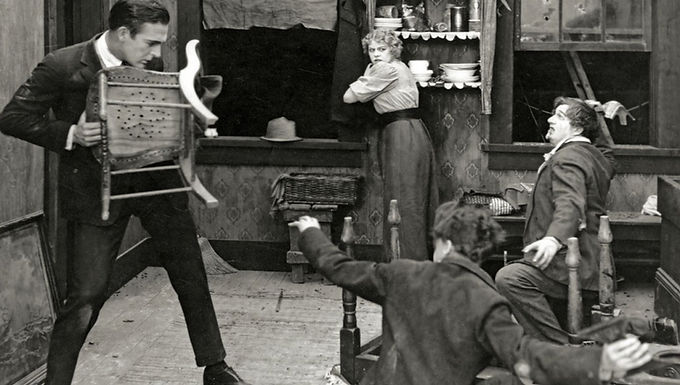
Wallace Reid, Cleo Ridgely, Raymond Hatton, and Horace B. Carpenter in Cecil B. DeMille's The Golden Chance (1916)
The Golden Chance (1916)
Running Time: 78m, Drama, Production Company: Jesse L. Lasky Feature Play Co., Inc.
Director: Cecil B. DeMille.
Writer: Jeanie Macpherson, Cinematography: Alvin Wyckoff
Cast: Cleo Ridgely, Wallace Reid, Ernest Joy, Edythe Chapman, Raymond Hatton, Horace B. Carpenter.
Cecil B. DeMille had intended to make ‘only’ one film a month in 1915, but scheduling pressures meant he had to add another film to his roster in late October. He had just started shooting The Cheat when Jesse Lasky informed him he also wanted to release The Golden Chance before the end of the year. The problem was, he didn’t have an available director. Some historians suggest the film’s initial director was taken off the project, others that problems with the scenario resulted in the studio suspending filming until 5th November. By then, shooting on The Cheat was well underway, so DeMille took on the mammoth task of shooting both films at once.
He managed by directing The Cheatfrom 9am to 5pm. Then, after eating dinner at his office desk and resting until 8pm he would work on The Golden Chance for six hours, until 2am. He would usually sleep in his office between shifts, only occasionally going home to his wife, Constance. To make matters worse, much of The Golden Chancehad to be reshot after DeMille fired original leading lady Edna Goodrich.
The flamboyant Floradora chorus girl had won fame for her role in the sensational 1906 Hary Kendall Thaw murder trial—dubbed ‘the trial of the century’ by the press—before marrying the comic Nat Goodwin, with whom she packed theatres across the United States. However, her weakness for alcohol cost her the lead in DeMille’s picture when she turned up on set one night in a drunken stupor. The director escorted her off the set and told her she was through. In a letter to Sam Goldfish (Goldwyn) on 2nd November 1915, Jesse Lasky wrote, “Edna Goodrich will not be with us after her ten weeks have expired. She is hopelessly bad and, as far as Cecil is concerned, I don’t believe he could ever be persuaded to direct her again. On Sunday Cecil sent for me and wanted to leave Goodrich out, pay her off and put someone in her picture which is already half finished. Cecil has a fine story but he claims she is killing it. She cannot act and also screens very poorly.” Lasky passed the actress’s contract on to the Oliver Morosco Photoplay Company, and from there she bounced around a few production companies before retiring from movies in 1918.
Her replacement was twenty-two-year-old Cleo Ridgely, a former chorus girl at New York’s Hippodrome Theatre, who made her start in films in 1910 with Kalem. After signing with Lasky early in 1915, she had appeared with Wallace Reid, leading man of The Golden Chance, in Chorus Lady, and they would star together in another five films in the following twelve months.

Horace B. Carpenter, Cleo Ridgely and Raymond Hatton in Cecil B. DeMille's The Golden Chance (1916)
The Golden Chance also marked the first appearance in a DeMille movie of Edythe Chapman, an actress who made her first movie at fifty-one after a stage career dating back to 1898. Together with her husband, James Neill, she would become a member of DeMille’s stock company, making eleven films with him during the silent era. Despite her late start, she would make over 100 movies in sixteen years and earn the sobriquet ‘Hollywood’s Mother.’
The film tells the story of Mary Denby (Ridgely), the wife of unemployed alcoholic Steve Denby (Horace B. Carpenter), who takes a job as a seamstress to the wealthy Mrs Hillary (Chapman). Mr Hillary (Ernest Joy) is trying to keep millionaire business executive Roger Manning (Reid) in town long enough to interest him in a lucrative business deal. Mrs Hillary entices him to stay over for dinner, where she promises he will meet the most beautiful woman in the city. Manning accepts, but the woman Mrs Hillary had in mind is ill. Because Mary is a judge’s daughter who married beneath her and therefore possesses a sophisticated manner far above her station in life, Mrs Hillary offers her money to pose as a socialite and charm Manning into staying in town. However, Mary and Manning fall in love. Meanwhile, her wastrel husband plans to burgle the Hillary’s home, not realising that Mary is a guest…
Jeanie Macpherson wrote the scenario for The Golden Chance in response to Jesse Lasky’s call to his staff writers for original material in return for a $250 payment. The box office success of this film and The Cheat, written by Hector Turnbull and doctored by Macpherson, prompted DeMille to work more closely with her on future works. Drawing on the fairy tale Cinderella for inspiration, Macpherson included elements from earlier DeMille films, Chimmie Fadden and Kindling in the plot of The Golden Chance. In Chimmie Fadden Victor Moore played a New York tough whose brother robs the home of a society matron who befriends him; in Kindling, the contrast between rich and poor is illustrated when a wealthy dowager employs an impoverished seamstress to sew a wardrobe for her pampered pet dog. However, while the disparity enrages the heroine of Kindling, in The Golden Chance Mary Denby is seduced by its many temptations. Sumiko Higashi, in her book, Cecil B. DeMille and American Culture—The Silent Era, noted, “the two films are comparable in that the moral dilemma represented by women as consumers is displaced onto lower-class and racial components in the body politic… The Golden Chance serves as an exercise in middle-class voyeurism with the heroine in the mediatory role of a tourist. As such, it draws a moral lesson from a conventional juxtaposition of urban rich and poor, whereas The Cheatnot only focuses on the problematic intersection of race and gender but also prefigures consumption as Jazz Age spectacle.”
The Golden Chance received praise from critics—but, unlike The Cheat, it was quickly forgotten. DeMille once again received praise for his use of light and shadow. Writing in Motion Picture News, reviewer Peter Milne said, “the countenances of the players are clearly defined by rays of light that strike them full in the face, leaving the backgrounds totally dark… aiding the suspense of the story beyond measure.” W. Stephen Bush, reviewing for Moving Picture World on 8th January 1916, was even more generous with his praise: “Never before have the lighting effects, i.e. the skillful play with light and shade, been used to such marvelous advantage. The highly critical spectators who saw the first display of the film were betrayed into loud approval by the many and novel effects…. If the paintings in a Rembrandt gallery or a set of Titians or Tintorettos were to come to life . . . and transferred to the moving picture screen the effect could not have been more startling.”

Wallace Reid and Cleo Ridgely in Cecil B. DeMille's The Golden Chance (1916)
The existing prints of The Golden Chance are missing the last title card, which has led some to speculate that the film’s final scene is missing because of its rather ambiguous ending. Instead of a customary clinch between the leads, they turn away from each other, both preoccupied by their thoughts. However, the original music cue sheets issued in January 1916 show that DeMille intended the film to end in this unusual way.
DeMille revisited the property five years later when he remade it as Forbidden Fruit (1921) with Agnes Ayres and Clarence Burton. For the new version, he softened the original’s hard edges and added a fantasy sequence and a happy ending. Forbidden Fruitachieved nothing like the scale of profit enjoyed by its predecessor, which returned $83,504.03 from a cost of $18,710.81.
Sources: Cecil B. DeMille: Empire of Dreams, Scott Eyman; Cecil B. DeMille’s Hollywood, Robert S. Birchard; Cecil B. DeMille: A Life in Art, Simon Louvish; Cecil B. DeMille and American Culture—The Silent Era, Sumiko Higashi.