Alice Guy-Blaché
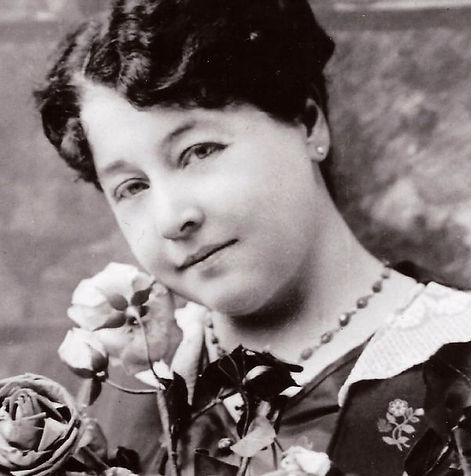
Alice Guy-Blaché
I proposed to Monsieur Gaumont that I shoot some scenes. He told me, "Well it's a young girl's thing indeed. Well, you can try. But on the condition, don't let the mail suffer."
Alice Guy
Birth name:
Alice Guy
Born:
1st July 1873, Saint-Mandé, Paris, France
Died:
24th March 1968, New Jersey, USA
Years active:
1896 - 1920
A true pioneer in every sense of the word, Alice Guy-Blaché was for many years probably the world’s only female film director. Her career spanned more than two decades, outlasting those of many of the male pioneers operating in the film industry from its earliest commercial exploitation in 1896.
Early life
Alice Guy was born on July 1, 1873, in Saint-Mandé, a suburb of Paris. Her heavily pregnant mother, Mariette, had endured a seven-week voyage to France from Santiago, Chile, with her family so that one of her five children would be French. Guy’s parents returned to Chile shortly after, leaving their baby daughter and her siblings in the care of her maternal grandmother in Switzerland.
Her mother returned in 1877 to take Guy to meet her father Émile, who owned bookstores in Santiago, for the first time. Two years later, Émile brought her back to France. He enrolled her in the Convent of the Sacred Heart, at Viry, on the Swiss border, where she was reunited with her three sisters.
In 1884, earthquakes, fire, and theft bankrupted Guy’s father. He returned once more to France and placed Guy and her sisters in a less expensive convent at Ferney. Her mother returned to France later, following the death of Guy’s older brother. Her father died soon after, at the age of 51. Following his death, her mother became involved in charitable work, during which she made the acquaintance of the Gaumont family.
Gaumont
In 1893, having trained as a typist and stenographer, Guy was hired by Leon Gaumont to work for Felix Richard’s still-photography company, the Comptoir de Générale Photographie. Shortly after, in 1894, Richard went out of business after losing a patent suit. Gaumont bought Richard’s inventory and took Guy on. She proved a reliable and competent worker and over time was given greater responsibility. She was present when Georges Demeny, a young professor of Physical Education at the School of Arts et Métiers demonstrated his phonoscope and offered Gaumont the patent for his 60mm motion picture camera, the biographe.
Guy also accompanied Gaumont to a presentation by the Lumière brothers of their 35mm motion picture camera, the cinématographe at the Société d’encouragement à l’industrie nationale on March 22, 1895. Enthused by this invention, Guy persuaded Gaumont to allow her to write a few scenes and use the camera to make a film.
Guy had rented a small house behind Gaumont’s photographic studio, and it was there that she shot her first film, La Fée aux choux (The Cabbage Fairy). Impressed both with the result and Guy’s dedication, Gaumont made her his head of film production, a position she held until 1906.
In 1902, Gaumont demonstrated his Chronophone, an early synchronised sound system, and over the following four years, Guy produced more than 100 short sketches to be shown on it.
In 1906, Guy travelled to Saintes-Maries-de-la-Mer, where she planned to film Mirielle (1906) with Louis Feuillade. When Feuillade fell ill, Gaumont told her to take Herbert Blaché, who was training at the studio before going on to become assistant manager of the company’s Berlin branch. They were reunited a few weeks later, when Gaumont sent Guy to Berlin to resolve complaints regarding the Chronophone from German clients. A romance developed, and the couple were engaged on Christmas Day 1906.
They married in the spring of 1907. Shortly after, Gaumont sent Blaché to the United States to help establish a Chronophone franchise. Guy, now Guy-Blaché, resigned from Gaumont to accompany her husband to the States.
When Blaché had completed the work relating to the Chronophone, Gaumont installed him at his new studio on Congress Avenue in Flushing, a suburb of New York which overlooked woods and lakes. His job was not to make films, but to sell to the American market those made by Gaumont in France. After giving birth to their daughter in 1908, Guy-Blaché yearned to return to the film business, but because Edison blocked Gaumont’s attempts to join the Motion Picture Patents Company—possibly because he was working on his own synchronised sound system—the studio languished unused. Because her husband was contracted to Gaumont, Guy-Blaché had to go into business alone.
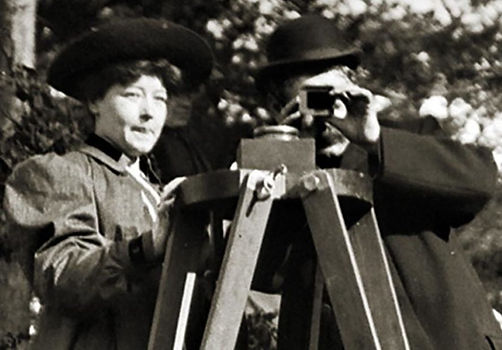
Alice Guy on the set of La vie du Christ (1906). Photo courtesy of Collection Société Française de Photographie
Solax
On September 7, 1910, she formed the Solax Company. Its offices were at 147 Fourth Avenue in Manhattan, but Guy-Blaché shot her films at Gaumont’s building in Flushing, using the surrounding countryside for location work. The company’s trademark of a blazing sun soon became familiar to moviegoers, and the company’s success allowed Guy-Blaché to build a modern studio on Palisades Avenue in Fort Lee, New Jersey. The new studio had two-storey-high glass, south-facing windows and a laboratory that could print 16,000 feet of positive film a day. Its first film, released on October 21, 1912, was A Child’s Sacrifice (1912). From then until June 1914, Guy-Blaché directed an average of one film a month. She also continued filming for the Chronophone, recording Mignon and Fra Diavolo, two three-reel ‘artistic operas’ with orchestral accompaniment, in 1912. While still running Gaumont’s New York office, Herbert founded the Film Supply Company to distribute the pictures of independent companies including those made by his wife.
Guy-Blaché’s films possessed a realism that was uncommon in American films of the period. The Sewer (1912) featured a scene in which the hero was attacked by real sewer rats trained by an expert; for the crime drama Mickey’s Pal (1912) she set fire to an automobile. Such realism alarmed her husband, who insisted that Edward Warren directed the scene and stepped in himself to direct scenes for The Yellow Traffic (1914), which required the use of dynamite.
Guy-Blaché established a stock company at the studio that included Darwin Karr, Blanche Cornwall, Vinnie Burns, Claire Whitney, Gladden James, Marian Swayne, Lee Beggs, Mace Greenleaf, Frannie Fraunholz, and Billy Quirk.

In March 1913, Guy-Blaché made her most ambitious film up to that date: Dick Whittington and His Cat (1913) was a three-reel, 45-minute feature which cost £35,000 to make and featured the burning of a boat.
In June 1913, Gaumont released Herbert Blaché from his contract. He worked for a while as president of Solax, but in October he founded Blaché Features Inc., which used the Solax studio and actors. Although Solax continued to produce movies in parallel with the new company, the two companies became virtually interchangeable, with both directing features under the Blaché banner. Eventually, Solax became defunct.
With feature production replacing shorts, the Blachés joined Popular Plays and Players, a coalition of production companies which made films for distributors such as Metro, Pathé, and World Film Corporation. However, by 1916 they had grown dissatisfied with this arrangement and left to produce films under the U.S. Amusement Corporation banner.
Later life
In 1917, Guy-Blaché’s children, nine-year-old Simone and Reginald, five, fell ill with measles, and Herbert sent his wife and children to Weaverville, North Carolina, to recover and wait out the war. There, while her husband managed their business in Fort Lee, like her mother before her, Guy-Blaché immersed herself in charitable endeavours. She returned to New York when Herbert found her work directing The Great Adventure (1918) for Pathé. It was not a happy experience for Guy; her health was poor—she had lost mobility in one arm which repeated surgery failed to repair and seemed to suffer a crisis of confidence. By then her marriage to Herbert Blaché was over. Emotionally distraught and almost penniless, she moved into a small apartment in the Breton Hall Hotel in New York.
Her last film was Tarnished Reputations (1920), for which Léonce Perret paid her $2,000 a week. At the end of filming, Guy fell ill with Spanish influenza. When Blaché saw her condition while visiting New York, he invited her and the children to California. Guy moved into a small bungalow and worked as assistant director to her husband on The Brat (1919) and Stronger than Death (1920). Upon completion of those films, she returned to New York to oversee the auction of the Solax properties. When a polio epidemic swept the area, she uprooted her children once again, fleeing to Canada.
Guy returned to France in 1922 following her divorce from Herbert. Her attempts to find work in the French film industry met with failure, and she left the industry after an abortive attempt to find copies of her films in the United States. She became financially dependent on her children but attempted to supplement her income by writing children’s stories and film novelisations for women’s magazines.
The film industry in which she had played such a major role appeared to have forgotten her until Louis Gaumont, the son of Léon, gave a speech in Paris on 8th September 1954 on ‘Madame Guy-Blaché, the First Woman Filmmaker,’ which brought her to the attention of such historians as Georges Sadoul, Jean Mitry, and Charles Ford. The following year, she was awarded the Légion d’Honneur, France’s highest non-military honour.
Guy-Blaché returned to the United States with her daughter, where they settled in New Jersey. She died in a nursing home in New Jersey on 24th March 1968, at the age of 105.
Sources: Alice Guy-Blaché: Lost Visionary of the Cinema, Alison McMahan; Out of Oblivion: Alice Guy-Blaché, Sight & Sound, summer 1971; Alice Guy-Blaché, Women Film Pioneers Project (https://wfpp.columbia.edu/pioneer/ccp-alice-guy-blache/); The Memoirs of Alice Guy-Blaché, Alice Guy-Blaché.
Alice Guy-Blaché Filmography
(Selected titles)
La Fée aux Choux (1896); Les Fredaines de Pierrette (1900); Charmant Froufrou (1901);Faust et Méphisto (1903); Les Apaches pas Veinards (1903); Le Cake-walk de la Pendule (1903); a Fève Enchantée (1904); Lui (1904); La Première Cigarette (1904); L’Assassinat du Courrier de Lyon (1904); Rapt d’Enfants par les Romanichels (1904); Rélubilitation (1904);Le Fiancé Ensorcelé (1904); Le Baptême de la Poupée (1904); Les Petits Peintres (1904); Les Petits Coupeurs de Bois Vert (1904); Une Noce au Lac Saint-Fargeau (1905); La Voiture Cellulaire (1906); La Crinoline (1906); La Fée Printemps (1906); La vie du Christ (1906); J’ai un Hanneton dans mon Pantalon! (1906); La Messe de Minuit (1906); Mireille (1906); Déménagement a la Cloche de Bois (1907); La Légende de Saint-Nicolas (1907); A Child’s Sacrifice (1910); Mixed Pets (1911); Across the Mexican Line (1911); Cupid and the Comet (1911); A Man’s a Man (1912); The Detective and His Dog (1912); Mignon (1912); Fra Diavolo (1912); Two Little Rangers (1912); Canned Harmony (1912); His Double (1912); A Comedy of Errors (1912); Burstop Holmes’ Murder Case (1913); Dick Whittington and His Cat (1913); A House Divided (1913); Matrimony’s Speed Limit (1913); The Pit and the Pendulum (1913); Shadows of the Moulin Rouge (1913); Beneath the Czar (1914); The Dream Woman (1914); The Monster and the Girl (1914); The Woman of Mystery (1914); The Lure (1914); The Beasts of the Jungle (1914); Heart of a Painted Woman (1915); The Vampire (1915); My Madonna (1915); What Will People Say? (1915); The Ocean Waif (1916); The Empress (1917); The Great Adventure (1918); Tarnished Reputations (1920).