John Bunny
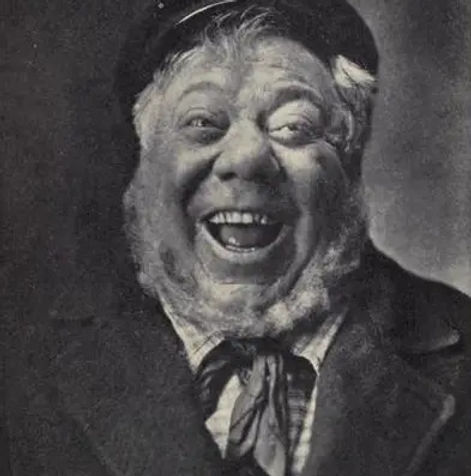
John Bunny
"I have chosen a better thing. I shall live longer than Irving or Booth. Not because I deserve to, but because there is a record of me that they did not leave; the public can have me always the same, so long as the pictures are preserved."
John Bunny, on leaving the stage for films
Birth name:
John Bunny
Born:
21st September 1863, New York City, New York, USA
Died:
26th April 1915, Brooklyn, New York, USA
Years active:
1910 - 1914
Before Chaplin’s Little Tramp, Max Linder’s dapper gentleman, and the manic exploits of the Keystone Kops, John Bunny reigned supreme as cinema’s foremost comedian. Virtually forgotten today, Bunny was an international star of whom, upon his death in 1915, the London Evening Standard asked, “Did ever a man so subjugate the wide world? Was ever a name so famous?”
Early life and stage career
John Bunny was born in New York City on 21st September 1863 to an English father and an Irish mother. He received his education in Brooklyn public schools before attending St. James High School. After working as a clerk in a general store, he joined a travelling minstrel show. Eventually, he found his way onto the stage—where he remained for 22 years. One of his earliest appearances was in The Stranglers of Paris; he also appeared in Way Down East for Sol Smith Russell’s company, alongside Hattie Williams in a musical called Fluffy Ruffles, and with Raymond Hitchcock in Easy Dawson. His generous girth won him notice as a comic actor, and he played the part of Bottom in A Midsummer Night’s Dream. Although he worked under such legendary theatrical figures as William Brady and Charles and Daniel Frohman, Bunny never achieved real stardom on the stage.
Signing for Vitagraph
When asked why he joined Vitagraph in 1910, when most stage actors looked down on movie acting as something almost shameful, he told the interviewer for Motion Picture Acting, “About three or four years ago, I was one of the foremost comedians on the stage. I have played good parts with the Shuberts, Chas. Frohman’s productions and all the biggest managers. However, I woke to the fact that the stage game was not what it had been and that the ‘movies’ were the coming thing. So I decided I would rather be behind the guns than in front of them. I wanted to be with the ‘shooters’ rather than with the ‘shot/ so I canceled my thirty weeks’ contract with the Shuberts, threw aside all the years of experience and success I had had, and decided to begin all over again. I went down to the Vitagraph studio, which was then in its infancy, and frankly told them I wanted to work in the pictures. They knew of me and my work and were naturally surprised, in view of the general attitude toward moving picture players at that time, that I should be seeking an entrance into the field. However, I ignored this and offered to work in my first picture for nothing, so they could judge of my appearance on the screen. I was game and they accepted.
“Before I had finished my first picture they asked me to play in the next and I agreed, saying nothing till I had finished the first. Then I asked them what they could do for me in stock. I must admit that I did not receive a very enthusiastic reception. They said: ‘Mr. Bunny, you are a high-salaried comedian. We have looked up your past engagements, and while we realize you would be a very valuable addition to the Vitagraph, yet since we have just started we could not afford to pay you anything approaching $150.00.’ So I knew by this that they had looked into my past and learned that my salary was $150.00. This was all true, but I felt that the big future would be with the ‘movies,’ so I asked them what they would offer, and they said: ‘There’s no use for us to make you an offer, Mr. Bunny, you would only laugh at the ridiculously low sum.’ I promised to be a real good boy and not even smile, so they continued: ‘The best we could offer you now, Mr. Bunny, would be $40.00 a week.’ No, I didn’t laugh. I could see the big difference between what I had been getting and the $40.00, but I could see a greater future on the side of the $40.00 with the shooters. So I said, ‘You’re on, I’m game.’”

Joint-owner of Vitagraph J. Stuart Blackton’s recollection of his first encounter with Bunny conflicted somewhat with the actor’s. He recalled, “A very fat man was leaning against the wall of the studio, like a buttress supporting the wall of Notre Dame. ‘We need a new comedy man,’ said Albert, ‘maybe this one will be funny.’ He saw us coming. ‘Look,’ he said, ‘can either of you gentlemen do this?’ Springing into the air he clicked his heels together three times before he hit the ground again. ‘I want a chance at the pictures,’ he pleaded, ‘just a chance.’”
Bunny was hired at $40 per week—considerably less than the $150 weekly wage he earned on the stage. His debut film was Jack Fat and Jim Slim at Coney Island (1910), released on 2nd December 1910, and described by Vitagraph as ‘A Side-shaking Comedy That is Taken Where They Manufacture Fun and Millions Go to Have a Good Time.’ The studio paired him with another heavyweight debutante, the actress Kate Price, who would appear with Bunny many times over the next four years. Later, reminiscing about her first movie in an interview for the trade paper Motography, she recalled, “We put one chute out of working order, and I did everything I was told to do. I weighed two hundred and twenty then…and I had to do all the things first, and the others flying after me would all land on me.”
Bunny’s films eschewed the wild chases and destructive slapstick made popular by continental comedians and focused instead on domestic misadventures—the husband tangling with his wife, neighbours, servants, or in-laws, or succumbing to a small temptation that escalates into humiliation; plots that relied on reaction, timing, facial expression, and the gradual collapse of Bunny’s confidence for laughs.
Stardom
Price was not to be Bunny’s most regular comic foil. That honour was reserved for Flora Finch, an actress whose tiny, stick-thin figure provided an amusing visual counterpoint to Bunny’s rotund figure. Together, they made around one hundred comedy shorts for Vitagraph, which came to be known as ‘Bunnyfinches’. Their comedies together were hugely popular, and many believed them to be married in real life. Not only were they not married, but “they cordially hated each other,” according to Albert E. Smith, Vitagraph’s other joint-owner.
Bunny spent his entire short film career at Vitagraph. The number of films he made for the studio is uncertain, but is probably somewhere between 150 and 200. He became one of cinema’s earliest international stars. In Germany audiences knew him as Herr Kintop, and in Russia he was Pockson (or Poxon).
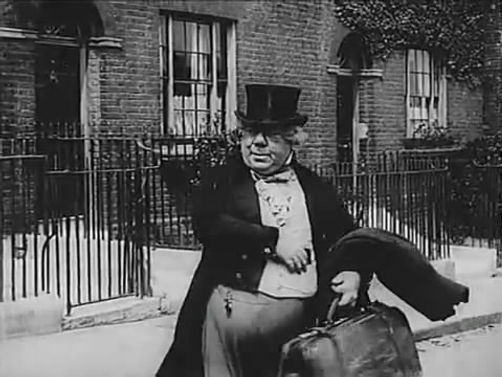
John Bunny in The Pickwick Papers (1913)
His off-screen persona was the opposite of the jovial fat man his legions of fans adored. Those who worked with Bunny remembered him as a pompous man with a short temper and an arrogant nature. “He looked down on anyone who wasn’t as great as he was,” said actor James Morrison, who appeared with Bunny in a dozen films. Director William P.S. Earle remembered, “knowing he was a motion picture star, he was something of an S.O.B.” Jan Zilliacus, the daughter of Vitagraph director Larry Trimble, told film historian Anthony Slide, “He was very bad-tempered, very difficult. He upstaged everyone. He was an old egocentric. He always wanted the camera on him.”
On May 25, 1912, Trimble accompanied Bunny and cameraman Arthur Ross on a voyage to the British Isles. En-route, they shot Bunny All at Sea (1912), an improvised comedy in which Bunny and Trimble battled sea sickness. On terra firma they shot six shorts and an adaptation of Charles Dickens’ Pickwick Papers (1913). Fans mobbed Bunny in London, and while filming Bunny at the Derby (1912); the adulation served to stoke his already over-inflated ego. “The trip spoiled him,” said Blackton. “He returned with delusions of grandeur and was never the same again.”
Later life and death
After his trip to London and a brief return to the stage, Bunny returned to Vitagraph in the spring of 1913 at a salary of $1,000 a week for fifty weeks of the year. He alternated between shooting films from them, appearing on stage, and in his own road show, Bunny in Funnyland. Vitagraph groomed Actor Jay Dwiggins as a replacement for Bunny, with the two appearing together in Bunny’s Little Brother (1914).
Touring with Bunny in Funnyland took a toll on Bunny’s health, and an illness in early April 1915 confined him to bed for three weeks. His condition appeared to be improving, but he suffered a relapse and died of ‘a complication of diseases, in which Bright’s disease predominated,’ at his Brooklyn home on 26th April 1915.
Bunny’s death made headlines around the world, but emerging new stars like Charlie Chaplin and Roscoe ‘Fatty’ Arbuckle quickly made Bunny’s gentler brand of comedy seem antiquated and his fame rapidly faded. Today, none but the most ardent cinephiles know his name.
Sources: Motion Picture Acting, Frances Agnew; The Big V, Anthony Slide; The A-Z of Silent Film Comedy, Glenn Mitchell; Motography, August 15, 1914; London Evening Standard, April 28, 1915.
John Bunny Filmography
(Selected titles)
Jack Fat and Jim Slim at Coney Island (1910); He Who Laughs Last (1910); In Neighboring Kingdoms (1910); Cupid and the Motor Boat (1910); Doctor Cupid (1911); Davy Jones and Captain Bragg (1910); Davy Jones’ Domestic Troubles (1910); The New Stenographer (1911); A Tale of Two Cities (1911); Winsor McCay, the Famous Cartoonist of the N.Y. Herald and His Moving Comics (1911); Troublesome Secretaries (1911); Teaching McFadden to Waltz (1911); The Subduing of Mrs. Nag (1911); Her Crowning Glory (1911); Kitty and the Cowboys (1911); In the Clutches of a Vapor Bath (1911); Chumps (1912); Captain Barnacle's Messmate (1912); The First Violin (1912); Bunny and the Twins (1912); A Cure for Pokeritis (1912); Stenographers Wanted (1912); Mr. Bolter's Infatuation (1912); Burnt Cork (1912); At Scrogginses' Corner (1912); Captain Jenks' Diplomacy (1912); Working for Hubby (1912); Vanity Fair (1912); Diamond Cut Diamond (1912); The Troublesome Step-Daughters (1912); Suing Susan (1912); Bunny and the Dogs (1912); The Lovesick Maidens of Cuddleton (1912); Bunny's Suicide (1912); Bunny All at Sea (1912); Bunny at the Derby (1912); Doctor Bridget (1912); Who Stole Bunny's Umbrella? (1912); Ida's Christmas (1912); Freckles (1912); Three Black Bags (1913); Bunny Blarneyed; or, The Blarney Stone (1913); Stenographer Troubles (1913); The Locket; or, When She Was Twenty (1913); The Pickwick Papers (1913); Bunny's Honeymoon (1913); Seeing Double (1913); Bunny Versus Cutey (1913); Cupid's Hired Man (1913); Bunny and the Bunny Hug (1913); Bunny's Birthday Surprise (1913); Bunny as a Reporter (1913); Bunny's Dilemma (1913); The Pickpocket (1913); When the Press Speaks (1913); Those Troublesome Tresses (1913); The Feudists (1913); (1913); Bunny for the Cause (1913); The Autocrat of Flapjack Junction (1913); The Golf Game and the Bonnet (1913); Bunny's Mistake (1914); Bunny's Birthday (1914); A Change in Baggage Checks (1914); Bunny's Scheme (1914); Tangled Tangoists (1914); Mr. Bunny in Disguise (1914); Bunny Buys a Harem (1914); Bunny's Swell Affair (1914); Mr. Bunny Buys a Hat for His Bride (1914); Father's Flirtation (1914); The Old Maid's Baby (1914); A Train of Incidents (1914); The Vases of Hymen (1914); Private Bunny (1914); The Locked House (1914); Polishing Up (1914); The Honeymooners (1914); Hearts and Diamonds (1914); Bunny Backslides (1914); Bunny's Little Brother (1914); A Strand of Blonde Hair (1914).