Wallace McCutcheon Sr.
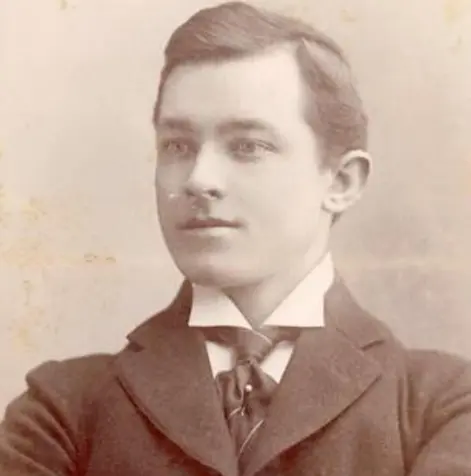
Wallace McCutcheon
"Old exhibitors will well remember he is the father of the story film, both comic and pathetic, which in the later '90s held audiences spellbound..."
Moving Picture World, 12th October 1907
Birth name:
Wallace McCutcheon
Born:
1861, New York, USA
Died:
4th October 1918, Sea Gate, Brooklyn, New York, USA
Years active:
1896 - 1910
Early Life
An often overlooked figure of early American cinema, Wallace McCutcheon was born in 1861, although so little is known about this pioneering filmmaker the exact date of his birth is uncertain. By 1894 he was the youngest theatre manager in Brooklyn, where he managed the Grand Opera House after working as treasurer for J. H. “Jack” Haverly, manager of a large travelling minstrel troupe. Despite its name, the Grand Opera House presented mostly light entertainment and plays. Business was so bad in 1895, however, that his show business friends had to arrange a benefit show for him at the end of the season.
That summer, McCutcheon fared no better when he became manager of Raulah House, a summer resort hotel in Patchogue, Long Island. Within months of taking up his new position, he disappeared when a warrant for his arrest was issued for assaulting a boy. Faced with angry creditors a few weeks later, his wife escaped through the hotel’s rear entrance and fled to New York after promising to pay them 65c in the dollar for overdue debts.
Entry into Movies
After that unfortunate incident, the trail goes cold until the spring of 1897, when McCutcheon was placed in charge of production at Biograph following the departure of W. K. L. Dickson and Elias Koopman. McCutcheon acted both as director and cinematographer on his earliest films, often working closely with his friend and former housemate Frank Marion, and probably filmed the studio’s most historically significant pictures up to 1906. A report in 10th August 1897 issue of the New York Herald revealed that McCutcheon and Billy Bitzer were thrown to the ground and badly bruised while filming a drill for the Atlantic City fire dept. As Biograph grew, McCutcheon also supervised the work of other directors. Notable releases during this period include Kit Carson (1903), The Escaped Lunatic (1904), one of the earliest chase movies, Photographing a Female Crook (1904), and The Story the Biograph Told (1904).
In May 1905, Edison enticed McCutcheon and cinematographer A. E. Weed away from Biograph. There he collaborated with Edwin S. Porter on many films, including The Night Before Christmas (1905), Dream of a Rarebit Fiend (1906), and The ‘Teddy’ Bears (1907).
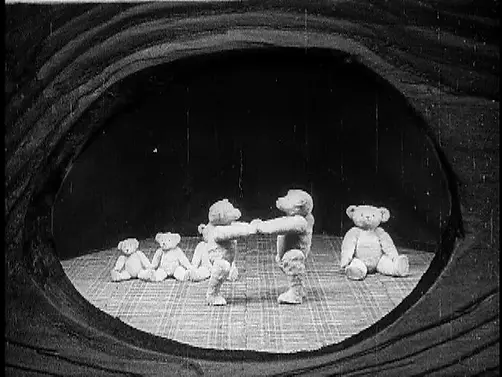
Edwin S. Porter's and Wallace McCutcheon's The 'Teddy' Bears (1907)
Return to Biograph
Biograph had struggled following McCutcheon’s departure, but his return in May 1907 did little to reverse its failing fortunes. He found it difficult to adapt to the new production techniques developed to cope with the need for greater output, and his health was failing. By now, his son, Wallace McCutcheon Jr., was undertaking many of his father’s production duties, although it was McCutcheon Sr. who employed D. W. Griffith as an actor in 1908. Griffith’s wife, Linda Arvidson, who also worked as an actress at the studio, recalled that everyone knew McCutcheon as “Old Man McCutcheon.” Whether this was because he was a genial, slightly portly gentleman or because he was the father of eight children whom he frequently cast in his films, she couldn’t say.
His son’s deputising for him in his final months at Biograph has resulted in confusion over directing credits on Biograph films released in 1908 as McCutcheon Jr. briefly took over the rains. He would rather have been acting or dancing on stage than barking instructions from behind a camera, and his films were so inadequate that studio executive Harry Marvin asked Griffith to stand in until McCutcheon Sr.’s health improved.
McCutcheon never returned to Biograph. In autumn 1909, Gaston Méliès hired him to head the Star Film Company. In January 1910, the company established a studio in San Antonio, Texas, to make westerns, but McCutcheon left within a month, possibly because of renewed problems with his health. His departure from Star marked the end of his career in the motion picture business. He moved into real estate until his death of heart failure at the age of 56 on 4th October 1918.
Brooklyn Daily Eagle, p11, 23rd September 1894; “J. H. Haverly's “Our Strategists,” Smithsonian website; When the Movies Were Young, Linda Arvidson; The First Movie Studio in Texas, Kathryn Fuller-Seeley & Frank Thompson; Who’s Who of Victorian Cinema, Stephen Herbert & Luke McKernan; The Emergence of Cinema, Charles Musser; D. W. Griffith: The Years at Biograph.
Wallace McCutcehon Filmography (incomplete)
Biograph (1897 – 1905)
The Fastest Wrecking Crew in the World (1897); The X-Ray Mirror (1899); The Pioneers (1903); Kit Carson (1903); Boat Race (1904; with Billy Bitzer); The Story the Biograph Told (1904); The Escaped Lunatic (1904); Personal (1904); The Moonshiner (1904); The Widow and the Only Man (1904); The Lost Child (1904); The Chicken Thief (1904); Panorama from Times Building (1905); The Nihilist (1905); Tom Tom the Piper's Son (1905).
Edison (1905 – 1907)
The Whole Dam Family and the Dam Dog (1905; with Edwin S. Porter); The White Caps (1905; with Edwin S. Porter); The Watermelon Patch (1905; with Edwin S. Porter); The Miller's Daughter (1905; with Edwin S. Porter); The Train Wreckers (1905; with Edwin S. Porter); The Life of an American Policeman (1905; with Edwin S. Porter); Police Chasing Scorching Auto (1905; with Edwin S. Porter); The Night Before Christmas (1905; with Edwin S. Porter); Dream of a Rarebit Fiend (1906; with Edwin S. Porter); Three American Beauties (1906; with Edwin S. Porter); The Black Hand (1906); A Winter Straw Ride (1906; with Edwin S. Porter); The Terrible Kids (1906; with Edwin S. Porter); Kathleen Mavourneen (1906; with Edwin S. Porter); Getting Evidence (1906; with Edwin S. Porter); Daniel Boone, or Pioneer Days in America (1907; with Edwin S. Porter); Dr. Skinum (1907); Love Microbe (1907); The ‘Teddy’ Bears (1907; with Edwin S. Porter).