Frankenstein (1910)
released 18th March 1910
Cast:

Charles Ogle

Augustus Phillips

Mary Fuller

Unknown
Unknown
Unknown
Frankenstein (1910)
Horror, Short
16m
Edison Studio
Director:
Writer:
J. Searle Dawley

"The most absorbing "silent drama" ever produced."
For many years, historians considered J. Searle Dawley’s Frankenstein to be one of many-thousand lost silent movies. Most people had forgotten the 1910 version of Mary Shelley’s novel even existed. Then, in 1963, a historian found an edition of The Edison Kinetogram among the millions of documents in the Edison archives. The magazine’s cover, dated 15th March 1910, featured the actor Charles Ogle in full monster make-up. Only then did the search for the lost film begin.
In 1980, the American Film Institute included it on its top ten list of most ‘culturally and historically significant lost films’. That was when an eccentric movie collector from Wisconsin announced he had owned a 35mm nitrate copy since the 1950s. How Al Detlaff came to own the film is a story almost as unlikely as the one told by Shelley. Detlaff’s wife’s grandmother, Marie Franklin, originally owned the film, which she used to incorporate into a stage show. When she died, ownership of the film passed to her son, who, in time, left it to Detlaff’s brother-in-law. He sold it to a collector, who sold it on to another collector, who then sold it to Detlaff in the 1950s.
Detlaff, an avid private collector, valued his collection of silent films at $45 million. He was extremely protective of what had suddenly become his most prized possession. In the early 1980s, he allowed the BBC to include a few minutes of the film in a documentary (for a price, presumably), which was later released on video. Detlaff was annoyed to find these excerpts turning up in other video compilations without his permission or recompense and grew extremely possessive of the film. He did release a copy to the Academy of Motion Picture Arts and Sciences in 1986. However, he first inserted a scrolling copyright notice across the middle of the film, making it difficult to view.
Forrest J. Ackerman, the founder of Famous Monsters of Filmland, recalled a private screening Detlaff once gave at Ackerman’s home. The friend who drove Detlaff back to his hotel later told Ackerman that the collector had left a gun on top of the film can. Ackerman also claimed that Detlaff tried to persuade the Academy to include the film in one of its awards performances – and demanded a five-figure sum. Don Crafton, Chair of the Department of Film, Television, Theater at Notre Dame, revealed in a speech at the first ‘Orphans of the Storm’ symposium that Detlaff kept his print of the film in a safe deposit box in a bank ‘not in Wisconsin.’ It was only in 2010, five years after Detlaff’s death, that the film was finally released without the scrolling copyright notice.
As of October 2025, the 1910 version is the first of 423 movies to feature a version of the monster. It is unusually elaborate for a picture made by Edison, a studio not known for its artistic integrity, although at fourteen minutes, it offers a severely truncated version of Shelley’s saga. As the opening titles confess, it provides a liberal adaptation of her novel.

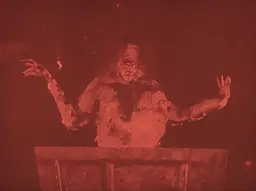
The creation of the monster in J. Searle Dawley's Frankenstein (1910)
Frankenstein is bidding farewell to his father and fiancée when we meet him. With one swift cut, two years pass, and he is preparing to create the perfect specimen of human life. Director Dawley departs from Shelley’s book here by showing Frankenstein mixing various chemicals in an enormous cauldron to create his monster. He watches his ghastly creation take shape through a window in a reinforced metal door. Dawley created this impressive sequence by manipulating a burning dummy and then reversing the shot.
Dawley appears to have taken a lot of care with the look of the monster, which differs considerably from conventional iterations. Back then, the actors created their own makeup, so Charles Ogle is probably responsible for its distinctive appearance. Ogle’s monster shares the same distinctive square forehead as Boris Karloff’s more famous incarnation, but sports a wild mane of shoulder-length hair. His eyes peer out from deep sockets beneath thick eyebrows. His fingers are long and skeletal, and he wears ragged furs.
Edison made a point of avoiding anything more horrific than the creature’s creation. In fact, the film focuses more on its subtext – the duality of man - which mirrors that of Robert Louis Stevenson’s Dr Jekyll and Mr Hyde. Frankenstein’s evil side creates the monster, and it is his essential goodness that vanquishes it. Instead of being hounded to death by torch-bearing villagers, Edison’s monster fades out of existence. It leaves only its image in a mirror, which remains for a few moments when Frankenstein stands before it.
Frankenstein is one of the Edison studios’ better films, but it is hardly a classic and is really only memorable for Ogle’s make-up and the creation scene. The film enjoyed only limited distribution, with many exhibitors declining to show the film because they considered it too frightening for their audiences.
The film’s continued existence is a minor miracle, but live on it does, in lovingly restored condition, twenty years after Alois Detlaff’s death. The collector never made the fortune from Frankenstein that he had hoped for and died alone at 84. His body lay undiscovered for a month, even though his daughter lived just down the street.
Sources: It's Alive! The Classic Cinema Saga of Frankenstein, Gregory W. Mank; A Pictorial History of the Silent Screen, Daniel C. Blum; Movie Monsters, Denis Gifford; Monsters from the Movies, Thomas G. Aylesworth; Forrest J. Ackerman's World of Science Fiction, Forrest J. Ackerman.