Hollywood in the 1910s

The Selig Polyscope Company studio in the Edendale neighborhood of Los Angeles, California, ca. 1910
1910 saw the Motion Picture Patents Company seek to tighten its stranglehold on the American film industry. By forming the General Film Company, it sought to manage the distribution of films made by its members. Independent producers responded by establishing the Motion Picture Distributing and Sales Company. But internecine battles resulted in its closure in 1912. New distributors, such as Mutual and Universal, emerged from its collapse.
The MPPC sought to limit the length of movies to two reels. It believed audiences would not welcome longer-form pictures. However, the success of such lengthy Italian epics as The Last Days of Pompeii (1913) and Cabiria (1914) proved they had an appetite for feature-length films.
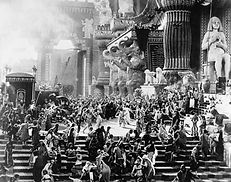
Frustrated by Biograph’s refusal to permit him to make features, D. W. Griffith allowed the studio bosses to believe he was making a short while shooting the hour-long Judith of Bethulia (1914). Upon discovering the film’s budget had escalated to $35,500, they prohibited Griffith from making features. As a result, the director departed for the Aitken brothers’ Mutual. There he made The Birth of a Nation (1915), a monumental 195-minute Civil War epic that transformed the film industry. It also sparked huge controversy over its offensive portrayal of blacks as lazy drunks and the Ku Klux Klan as heroes. Stung by the criticism he received, Griffith’s next picture, Intolerance (1916), was in part intended to be a rebuttal of the accusations of racism levelled against him. Intolerance was another ambitious spectacle, featuring stupendous sets and intertwining storylines,
A second major development of the first part of the decade was the emergence of the star system. In 1909, IMP signed former Biograph Girl, Florence Lawrence. IMP’s boss, Carl Laemmle, capitalised on his coup in early 1910 by naming her as part of a fake death publicity stunt. Fans had only known Lawrence as “The Biograph Girl,” a mantle that would fall to Mary Pickford before she and all other players’ names appeared in the films they made.
Lawrence’s career soon faded, but the 1910s saw Pickford – dubbed “America’s Sweetheart” by an adoring public – become one of the world’s most popular movie stars. The Canadian actress faced fierce competition from her future husband, action hero Douglas Fairbanks, and the British comic Charlie Chaplin.
These new stars negotiated lucrative contracts. With industry expansion and the fall of foreign competition from war-ravaged Europe, the studios they signed with pursued a strategy of vertical integration. A legal ruling in 1915 had found the MPPC to be an illegal monopoly. That left the way clear for the independents to control the production, distribution, and exhibition of their films. Soon, they supplanted the Trust as the industry’s power centres. Most now operated in or around Hollywood, which, by the middle of the decade, had replaced New York as the country’s movie capital.
The increasing popularity of feature films prompted a change in cinema venues. Large, purpose-built movie theatres with comfortable seating replaced the ramshackle nickelodeons that had proliferated since 1905.
The era also saw the rise of local and statewide censorship. The U.S. Supreme Court’s 1915 decision in Mutual Film Corp. v. Industrial Commission of Ohio found that motion pictures were commerce rather than protected speech. Its ruling allowed local and state censorship boards to regulate content.
As the decade drew to a close, the country’s three biggest movie stars joined forces with D. W. Griffith to form United Artists. It was an attempt to provide themselves with the means of controlling the production and distribution of their own films. Progress was slow, however, with the owners soon having to abandon their original target of each releasing five films a year.
By 1919, Hollywood’s infrastructure – feature-length films, vertically integrated studios and distributors, and a thriving network of first-run theatres – was firmly in place, putting the movie industry in a strong position to exploit the economic boom of the 1920s.