Cleopatra (1912)
released 13th November 1912
Cast:

Helen Gardner

Pearl Sindelar

Miss Fielding
Miss Robson
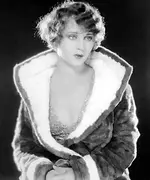
Helene Costello
Charles Sindelar
Cleopatra (1912)
Drama, History
100m
Helen Gardner Picture Players
Director:
Writer:
Charles L. Gaskill

"Reigns supreme over all...The brightest luminary in the motion picture firmament... Helen Gardner in Cleopatra... Sensational box office success"
“Six thousand feet of sumptuous beauty and exquisite art—absolutely a motion picture in a class to itself—a perfect story. One hour and forty minutes of thrilling, dramatic interest—a story of the most remarkable woman in all human history.”
Full-page ad in Moving Picture World
Helen Gardner made a name for herself in several Vitagraph shorts directed by her husband, the writer and director Charles L. Gaskill. In 1912, she and Gaskill left the studio, and together they formed the Helen Gardner Picture Players, with money borrowed from Gardner’s mother. Gardner built an open-air studio at Tappan-on-the-Hudson—although, curiously, she chose not to film any of Cleopatra’s scenes on the river.
Cleopatra was the first film released by the new company. Gaskill directed and wrote the screenplay, adapting an 1890 play by Victorien Sardou, which borrowed from Shakespeare’s Antony and Cleopatra. Although the film's credits don't acknowledge Shakespeare’s contribution, they confirm that “perfect freedom has been exercised in the adaptation.”
The film's very first scene provides evidence of Mr Gaskill's tinkering by introducing a new, curiously annoying character. Pharon is a fisherman so enamoured with Cleopatra that, even though he is romantically involved with one of the queen’s handmaidens, he agrees to forfeit his life in return for ten days of love with her.
Gardner exudes little of the allure one would expect from Shakespeare’s woman of ‘infinite variety’. The only variety in her performance comes when she switches from wildly flailing her arms around to moving slowly, like a cat trying to be invisible. One film historian noted—rather unkindly but not without an element of truth—that she was rather well-upholstered, which means her periodic attempts to project a seductive air of irresistibility sometimes border on the comical. But love is blind, and Pharon is besotted—as is Marc Antony, literally seconds after meeting her.

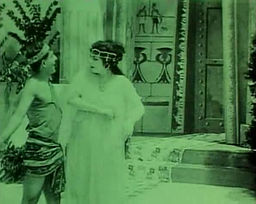
Mr Howard and Helen Gardner in Charles L. Gaskill's Cleopatra (1912)
Somehow, Pharon survives the entire movie, despite accepting Cleopatra's offer, receiving a death sentence, and taking an arrow in the chest. As anyone familiar with the tale will know, few of the other characters are so fortunate. However, Gaskill’s theatrical presentation means it takes forever for them to meet their fates. At least the film as it exists today, in a version restored by TCM and the George Eastman House, runs a merciful 14 minutes shorter than the original. Every second of film lost is a tragedy, but still….
Gaskill shoots almost every scene with a static camera from a distance, as if filming a stage play from a seat in the audience. There are no close-ups, and the characters barely stray from their marks. Cleopatra and Antony's first meeting lasts almost ten minutes; Gaskill appears to have shot it in a single take, although the insertion of intertitles—all non-Shakespearean—makes it impossible to be sure. The sets and costumes are at least decent; the mysterious Madame Stippange, whose only screen credit this is, became the first costume designer to receive a screen credit.
Although Cleopatra looks very dated today, it was an enormous success upon its release, attracting fulsome praise from critics. Lewis Reeves Harrison considered Gardner’s performance to “rank as one of the greatest ever shown on the screen up to the present time.” The New York Dramatic Mirror hailed the production “Probably the most stupendous and beautiful picture ever produced.” In Britain, the film ran for three weeks at the Theatre de Luxe on The Strand. Gardner's production company sold territorial rights in Russia, Germany, Austria, Switzerland, Romania, Italy, Belgium, and Australia. Sadly, Quebec’s censors banned it for being “too voluptuous for the general public.”
The film even earned Gardner a reputation as the screen’s first vamp. While this epithet might be a trifle generous, Gardner was without doubt a trailblazer. She became the first star to form their own production company, beating Florence Lawrence by weeks, and among the first American filmmakers to produce a feature-length film. However, despite releasing several films under the Helen Gardner Picture Players banner, the company folded, and she briefly returned to Vitagraph. Despite re-releasing Cleopatra with additional scenes to coincide with the release of Theda Bara’s version in 1917, she failed to repeat her earlier success, and both her and Gaskill’s film careers were over by the mid-1920s.
Source: The Movies in the Age of Innocence, Edward Wagenknecht; Guide to the Silent Years of American Cinema, Donald W. McCaffrey and Christopher P. Jacobs; Motion Picture Story Magazine, Jul-Sep 1912.