From the Manger to the Cross (1912)
premiered 3rd October 1912
Cast:

Robert Henderson-Bland

Percy Dyer

Gene Gauntier

Alice Hollister
Samuel Morgan
James D. Ainsley
From the Manger to the Cross (1912)
Biography, Drama
71m
Kalem Company
Director:
Writer:
Gene Gauntier

"This remarkable production in Five Parts was made by the Kalem Company in the Holy Land and presents in a reverent manner the principal events in the Life of Christ." Kalem Kalendar, 1st April 1913
In November 1911, Kalem’s director Sidney Olcott and screenwriter Gene Gauntier were in Florida to film the studio’s winter schedule. Three weeks after their arrival, Olcott received a telegram from the studio co-owner, Francis J. Marion. He wanted the Florida company to travel to Egypt to film four scenarios provided by E. Alexander Powell. They had expected to pay a visit to Ireland, where the ‘O’Kalems’ had twice previously made several successful movies. However, the previous year, British authorities, angered by Rory O’More, a film celebrating the eighteenth-century Irish revolutionary written by Gauntier, had threatened expulsion. So, Marion cancelled the studio’s annual pilgrimage to the Emerald Isle and set his sights farther afield. On 2nd December 1911, the company, now re-dubbed the ‘El-Kalems’, set sail on the SS Adriatic for the Middle East. To cover the cost of such an ambitious voyage, Marion instructed Gauntier to write further scenarios en route, to be filmed wherever they stopped.
The company stayed at the Luxor Hotel, and each morning they rode camels to that day’s shoot. They filmed at speed, shooting several pictures with titles designed to evoke images of their exotic locale: Captured by Bedouins, An Arabian Tragedy, A Prisoner of the Harem. The desert also featured in many titles: The Fighting Dervishes of the Desert, Dust of the Desert, Tragedy of the Desert, and so on.
While confined to her hotel room with sunstroke misdiagnosed as malaria, Gauntier hit on the idea of filming the life of Christ, despite Marion’s instruction not to portray Him under any circumstances. The crew departed for Cairo almost immediately. Rain delayed the shoot, but filming began on Palm Sunday with a recreation of the flight from Egypt. The breathtaking landscape so inspired Olcott and Gauntier they decided the film would be six reels long instead of the customary three. While Gauntier oversaw the constructing of the film’s sets, Olcott returned to London to hire more actors to play apostles and other principal parts.
At home, news of the proposed movie provoked a storm of protest from religious organisations. If anything, the uproar cemented Olcott’s decision to make the movie. “I knew then I had to make the film,” a 1913 New York Times article quoted him. “With all that free publicity, the film would obviously be a big profit maker.”
However, adverse publicity in London made finding an actor to play Christ more difficult than expected. Olcott finally found his man in Robert Henderson Bland, a gifted—if eccentric—theatrical stage actor who had worked under the celebrated Herbert Beerbohm Tree. According to Olcott, Bland walked into his hotel room wearing a long blonde wig and flowing white robe, declaring, “I am Jesus Christ. I will portray myself in your film.” The actor claimed God had told him he was His chosen son in a vision during the night. “Frankly, we thought he was mad,” Olcott recalled. “But we didn’t argue. He was obviously what we wanted.”
The director flew a theatrical costumer from Cairo with fabrics and a small sewing machine who fashioned authentic costumes using the Tissot Bible of detailed illustrations as a guide (the tailor was also drummed into service to play the bridegroom in the film’s marriage feast scene). Assistants purchased Oriental prints and velvets, tinsel and bangles from the bazaars of Jerusalem. Members of the cast toiled under the relentless sun, helping ready the sets for Olcott’s return. While all this went on, Gauntier refined the script, confining it to Jesus’s life and resisting pressure to depict his resurrection. Upon discovering that her preferred title of Jesus of Nazareth was under copyright, she settled on From the Manger to the Cross; or Jesus of Nazareth as an appropriately imposing title.

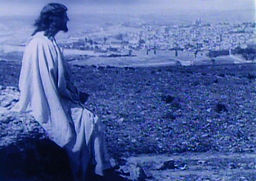
Robert Henderson-Bland in Sidney Olcott's From the Manger to the Cross (1912)
Olcott returned to Egypt in the late spring of 1912, bringing with him Bland, the actress Helen Lindroth, who would play various roles in the film, and Sidney Baber, a child actor who would depict the twelve-year-old Christ. During filming, Bland told Olcott he was completely unaware of the camera, and that “some strange and compelling force” guided him. The shoot went smoothly, despite the primitive conditions and searing heat, although fierce—and potentially violent—objections from locals forced the filming of the entry of Christ into Jerusalem on Palm Sunday to be abandoned.
While Gauntier, who played the Virgin Mary, returned to New York, Olcott took the company to Ireland, braving any residual wrath of the British authorities to shoot four films. However, upon their return to New York, the debate over the film rumbled on. Twenty years later, Olcott admitted that every member of Kalem’s staff contributed at least two letters to the press—some writing to support the film, others in protest. “Of the hundreds of letters the papers printed, we sent perhaps forty,” he recalled. “But I must admit we set the ball rolling.”
The film received its first public screening on 3rd October 1912, for an audience of clergy at Queen’s Hall in London, England. Clergy in the States enjoyed a specially composed score for their screening at Wanamaker’s Auditorium in New York on 14th October. The public didn’t see the finished picture until early the following year when it premiered in Jacksonville, Florida. Gauntier estimated the film recouped at least thirty times the approximately $25,000 cost of production (studio publicity inflated the cost to $100,000) and claimed that Kalem received letters and telegrams of congratulations from prominent ministers. Cities that banned cinemas from opening on a Sunday, granted permission for them to open their doors to screen From the Manger to the Cross.
Kalem distributed the film without cast or technical credits. Infuriated, Olcott, who had only just negotiated an improved contract with Kalem, handed in his resignation. When the studio accepted it, Gauntier, her husband Jack Clark and art director Allen Farnham, followed suit. With Olcott, they formed the Gene Gauntier Featured Players Company. “Our notices were accepted with unflattering alacrity,” Gauntier reported, “and we were thanked, but behind the expressed good wishes we had the feeling that the Kalem Company was relieved at our desertion.”
The stunning locations in From the Manger to the Cross support its ambitious vision, but the film feels far from epic in scale. Its sets are small and unimposing; they lack the grandeur one expects from a biblical spectacle. Within months, the Italian epic Cabiria boasted elaborate sets and casts of thousands that dwarfed those used by Olcott. Gauntier’s decision to use only passages from the Bible as intertitles is also misguided. Their use too often harks back to the earliest days of intertitles, when they described the action about to take place on screen rather than provide context to enhance the associated images.
Olcott was a journeyman director. Although highly regarded during the silent era, he was virtually forgotten by the time of his death in 1949. No one would describe any of his films as classics. Even this, his most ambitious, pales alongside the epics that followed, although he coaxes effective performances from his cast—particularly Bland, who inhabits the role of Jesus as only a man who truly believes he is the chosen one can.
Sources: Blazing the Trail, Gene Gauntier, Woman's Home Companion October 1928-March 1929; The Bible on Film: A Checklist, 1897-1980, Richard H. Campbell