Bangville Police (1913)
released 24th April 1913
Cast:

Mabel Normand

Fred Mace

Nick Cogley

Charles Avery

Dot Farley

Rube Miller
Bangville Police (1913)
Comedy, Short
8m
Keystone Film Company
Director:
Writer:
No writer credited
Canadian-born Mack Sennett moved to the United States with his Irish Catholic family when he was seventeen. He worked as a labourer for the American Iron Works, and in the evenings, received singing lessons from one of the ten boarders lodging at his parent’s house. His dream – never realised – was to sing with the Metropolitan Opera. Legend has it that future President Calvin Coolidge, then a lawyer practicing in the Sinnott’s hometown of Northampton, provided Sennett’s mother with a letter of introduction to Marie Dressler. The redoubtable Dressler furnished him with an introduction to theatrical impresario David Belasco. Records of Sennett’s activities for the next half-dozen years are sketchy, suggesting an offer of employment from Belasco was not forthcoming.
He resurfaced in 1908, knocking on the door of the Biograph studio at 11 East 14th Street. His arrival coincided with that of another struggling actor, a gentleman of the South named David Wark Griffith. Sennett became a member of Griffith’s stock company, making his first screen appearance in Old Isaac’s, the Pawnbroker, released on 28th March 1908. Sennett closely studied actor-turned-director Griffith’s evolving skill at his new profession, and in the spring of 1911 became the director of Biograph’s comedies.
A year later, Keystone was born. Time, faltering memories, and the tendency for men like Sennett to embroider the truth, have muddied the details of its birth. What we know is that Sennett left Biograph for a third-share in Keystone with independent film entrepreneurs Adam Kessel and Charles Baumann, owners of the New York Motion Picture Company. He took with him Mabel Normand and Ford Sterling, arriving in California in August 1912.
Normand, just 20-years-old and with her life already more than half over, had been an artists’ model. She began in movies as an extra with Biograph before moving to Vitagraph at Griffith’s suggestion. A year after joining Vitagraph, Sennett talked Griffith into inviting Normand back to Biograph, this time as a featured actor. While working together there, Normand and Sennett became romantically involved.
Ford Sterling hailed from a privileged background that was poles apart from Normand’s modest roots. Raised in Chicago, he attended Notre Dame College in South Bend, Indiana, where his interest in acting emerged. At eighteen, illness and financial problems arising from the untimely death of his father cut short Sterling’s education. He embarked on a stage career, starting with a Shakespearean repertory company. He then found work with John Robinson’s Circus as Keno, the Boy Clown. Further stage work followed. Sterling boosted his earnings during lean periods by working as a cartoonist and illustrator.
In the spring of 1912, when he was appearing in the Broadway musical comedy Sidewalk Chatter, Sennett (or Henry “Pathe” Lehrman – accounts differ) persuaded Sterling to join Biograph. His first verifiable screen appearances were in Tragedy of a Dress Suit and The Interrupted Elopement, both of which were released on the 15th August 1912.


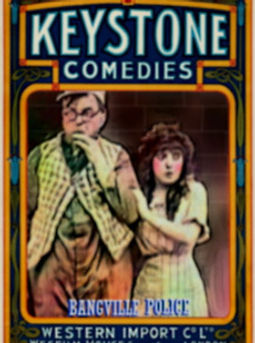
Fred Mace in Henry Lehrman's Bangville Police (1913)
It’s perhaps appropriate that confusion reigns over the debut appearance of Mack Sennett’s madcap enforcers of the law. Some claim they first appeared in Hoffmeyer’s Legacy, a Ford Sterling comedy short released on 23rd December 1912. In that film, the actor who is most closely associated with the chief of the Kops played the title character, and Sennett himself played a police chief. However, the film is lost, making it impossible to confirm. Another short, The Man Next Door, released in March 1913, may have featured an early version of the Kops. Rob King, in his book The Fun Factory, cites Pat’s Day Off, released on 2nd December 1912, as another contender. We’ll probably never know for sure, but most historians consider Bangville Police to be the first movie in which the Kops appear as an ensemble.
Normand plays Della, a farmer’s daughter, who mistakes two men delivering a calf for vagrants intent on mischief. In a panic, she phones the police, awakening police chief Fred Mace. He rallies his men, signalling the start of a cavalcade of slapstick pratfalls that unfold at a frantic pace. Della barricades herself in her house, and the police climb aboard a dilapidated jalopy. Inevitably, they encounter every imaginable mishap on their madcap dash to the farm.
Bangville Police was a success for Keystone, and so audiences of the time clearly found it funny. But the frantic pace of the crude physical humour means only the youngest of viewers would find much to laugh at today. Instead, we can admire the dextrous antics of physical comics such as the unheralded Fred Mace and Charles Avery. Much of Bangville Police feels improvised (and probably was), and it serves more today as a record of evolving screen humour than entertainment.
Sennett must have sensed he had stumbled upon something with this film and featured the Kops in further movies. Many of Keystone’s early comic actors claimed they were an original Kop, but Sennett recalled only seven: Hank Mann, George Jesky, Mack Riley, Charlie Avery, Edgar Kennedy, Slim Summerville and Bobby Dunn.
Over time, the Kops acquired uniforms. The stunts they performed were arduous and often dangerous enough to discourage insurance companies from covering the performers, although most of them were trained acrobats and tumblers capable of taking physical punishment that would cause serious injury to an average person. Each new Keystone comic served on the force to test both their stamina and their ability to raise a laugh. Charlie Chaplin was a rare exception, despite rumours to the contrary.
Sennett’s Keystone Kops cast a long shadow over silent comedy, yet appeared in only a dozen movies. They helped take slapstick comedy, hair-raising stunts and breakneck chases in silent comedy to new heights. Included in their ranks at various times were future stars such as Roscoe ‘Fatty’ Arbuckle, Al St. John, Chester Conklin, Mack Swain and Charlie Chase.
Sources: Keystone, the Life and Clowns of Mack Sennett, Simon Louvish; Mack Sennett's Keystone: The Man, the Myth and the Comedies, Kalton C. Lahue; Mack Sennett's Fun Factory, Brent E. Walker; Mabel, Betty Harper Fussell.