Kid Auto Races at Venice (1914)
released 7th February 1914
Cast:

Charlie Chaplin
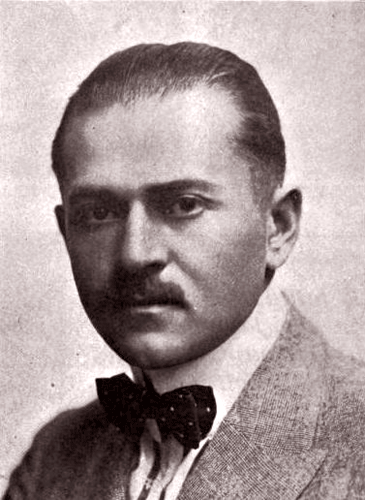
Henry Lehrman

Kid Auto Races at Venice (1914)
Comedy, Short
11m
Keystone Film Company
Director:
Writer:
Henry Lehrman, Charlie Chaplin

Charlie Chaplin’s ‘discovery’ while appearing as a drunk in Fred Karno’s sketch Night in an English Music Hall on the Karno troupe’s US tour has passed into movie folklore. The facts, however, are shrouded in a fog of uncertainty. One account claims that Mack Sennett and Mabel Normand caught his act at the American Theater in New York in the autumn of 1912. Another states that the little Englishman’s act wowed Adam Kessel and Charlie Baumann, partners in the New York Motion Picture Company, Keystone Pictures’ parent company. Yet another claims NYMPC’s third partner, Harry Aitken, made the momentous discovery. Either way, in the spring of 1913, Alf Reeve, the Karno manager, received a telegram while at the Nixon Theater in Philadelphia:
IS THERE A MAN NAMED CHAFFIN IN YOUR COMPANY OR SOMETHING LIKE THAT IF SO CAN HE COMMUNICATE WITH KESSEL AND BAUMANN 24 LONGACRE BUILDING BROADWAY NEW YORK.
Chaplin travelled to New York the very next day to meet Kessel and Baumann. The two executives, explaining they needed someone to replace Keystone’s top star, Fred Mace, offered him a contract worth $150.00 a week. Two weeks later, Chaplin signed, with his employment to begin on 16th December 1913.
Sennett, the manager of Keystone Studios, often filmed his comic shorts at real-life events. He believed that doing so added colour and interest to a film at little cost to the studio. In January 1914, he sent Henry ‘Pathe’ Lehrmann, Chaplin and two camera crews to the Junior Vanderbilt Soapbox Derby at Venice to make a comic short. Lehrmann, who also directed, would play a director filming the derby, and Chaplin would be a spectator who repeatedly wandered into shot.
Although he had only been at Keystone for a few weeks, things were not going well for Chaplin. Kessel and Baumann had disliked his performance as the seedy, monocle-wearing city slicker Edgar English in Roscoe ‘Fatty’ Arbuckle’s Making a Living. Sennett feared he had, in the words of Mabel Normand, “hooked himself up with a dead one.” Chaplin also had a fractious relationship with Lehrmann because the director had cut much of his performance from the finished film. Most people in the business disliked Lehrmann, the fiancé of the actress Virginia Rappe, who died in 1921 at a party held by Arbuckle, because of his disregard for actors’ safety.
Kid Auto Races at Venice marked the first screen appearance of Chaplin’s iconic ‘little tramp’ character, although some claim he first donned it for Mabel’s Strange Predicament, which began shooting before Kid Auto, but was released two days after. It is possible Chaplin filmed Kid Auto during a break in shooting of the Normand film.


Henry Lehrman and Charlie Chaplin in Lehrman's Kid Auto Races at Venice Beach (1914)
Mystery also surrounds Chaplin’s creation of the tramp’s famous outfit. Lehrmann recalled, “[He] borrowed Fatty’s trousers, Chester Conklin’s old shoes, and got the rest of the clothes from the dressing room he shared [with Arbuckle and Mack Swain] and from the studio wardrobe. A few days later, we were getting ready to go out to Venice… and I saw Chaplin arrive wearing the costume that would make him famous. His mustache consisted of a rectangle of black crepe glued under his nose. He seemed delighted with his appearance and twirled his walking-stick with his fingers.”
However, in his autobiography, Chaplin suggested more thought went into his selection: “On the way to the wardrobe, I thought I would dress in baggy pants, big shoes, a cane and a derby hat. I wanted everything a contradiction: the pants baggy, the coat tight, the hat small and the shoes large. I was undecided whether to look old or young, but remembering Sennett had expected me to be a much older man, I added a small mustache, which, I reasoned, would add age without hiding my expression.”
In a 1916 interview for McClure’s magazine, Chaplin revealed he based the tramp’s distinctive shuffling walk on an old man who used to hold horses for horsemen outside a London pub run by his uncle.
“There was a cab stand nearby, and an old character they called ‘Rummy’ Binks was one of the landmarks. He had a bulbous nose, a crippled, rheumatic body, a swollen, distorted pair of feet, and the most extraordinary trousers I ever saw. He must have got them from a giant, and he was a little man.
When I saw Rummy shuffle his way across the pavement to hold a cabman’s horse for a penny tip, I was fascinated. The walk was so funny to me that I imitated it... Day after day, I cultivated that walk. It became an obsession. Whenever I pulled it, I was sure of a laugh. Now, no matter what else I may do that is amusing, I can never get away from the walk.”
Filming took just forty-five minutes on 10th January 1914. Films come no simpler – even Keystone’s low-reaching, production-line efforts – with the tramp repeatedly and deliberately entering camera shot for the entire six-minute running time as a camera crew tries to film the racers. It is no masterpiece and quickly becomes repetitive, but is still an auspicious debut for the iconic character. Chaplin at least finds new ways of having the tramp insinuate into Lehrmann’s film. The film is completely at odds with the frantic mugging and slapdash chaos found in most other Keystone films from the period. And anyone who has watched contemporary live news reports filmed on the street will know that it is a problem producers still contend with today. Following his stratospheric rise to fame, it is also a movie the British comic could not make just a few weeks later without being mobbed by the assembled crowd.
Keystone released Kid Auto at Venice to wide acclaim as a split reel with the educational short, Olives and Their Oil. The Cinema magazine reported: “Kid Auto struck us as about the funniest film we have ever seen. When we subsequently saw Chaplin in more ambitious efforts our opinion that the Keystone Company had made the capture of their career was strengthened. Chaplin is a born screen comedian: he does things we have never seen on the screen before.”
Sources: Keystone, the Life and Clowns of Mack Sennett, Simon Louvish; Mabel, Betty Harper Fussell; The Films of Charlie Chaplin, Gerald D. MacDonald; Charlie Chaplin and His Times, Kenneth S. Lynn; My Autobiography, Charles Chaplin.