The Perils of Pauline (1914)
released 24th March 1914
Cast:

Pearl White

Crane Wilbur

Paul Panzer

Edward José

Francis Carlyle

Clifford Bruce
The Perils of Pauline (1914)
Action, Adventure, Drama, Serial
199m
Pathé Fréres
Director:
Writer:
Charles W. Godard, Basil Dickey
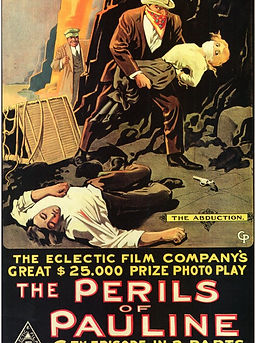
"The Public Have Gone Crazy Over the Mysteries in The Perils of Pauline" Trade ad, Motion Picture News, 1914
The birth of the film serial dates back to 1913. A year earlier, Edison had released one-reel films to coincide with the publication of their story in McClure’s Ladies World. Each film told a self-contained story starring Mary Fuller and so was in effect a series rather than a serial. William Selig, the owner of the Selig Polyscope Company, noticed that sales of newspapers and magazines increased when they ran serial stories. He took Edison’s idea one step further by broadening the story’s horizons and turning it into an adventure. He took his idea to the Chicago Tribune, a newspaper embroiled in a fierce circulation battle. With six rivals, the Tribune would consider any idea that might give it an edge over its competitors.
The result was The Adventures of Kathlyn, a 13-episode serial starring Kathlyn Williams as an American girl who inherits a throne in India. Gilson Willetts adapted Harold McGrath’s story, which was later published as a book. Each of its loosely connected episodes told a complete story. The series wasn’t a huge box-office success for Selig, but the Tribune recorded a 10 per cent increase in circulation.
Newspaper magnate William Randolph Hearst, one of the Tribune’s chief rivals, noted the upturn. He summoned the successful playwright Charles Goddard to his apartment building on Riverside Drive in New York. Goddard’s brother, the editor of Hearst’s Sunday supplement, had told him the magnate wanted to produce a movie with “a background of wealth and power, melodrama with a suspense hangover carrying into the next instalment.” Hearst had already agreed to promote Pathé releases such as the studio’s adaptation of Zola’s Germinal. His newspapers carried instalments of the story and encouraged their readers to see the movie.
Goddard came up with a five-hundred-word outline, which met with Hearst’s approval after he first made some suggestions to improve its pace. It was Hearst who came up with the alliterative title that would become part of America’s cultural vocabulary.
Pathé chose Pearl White to play Pauline. White was born into a farming family on 4th March 1889, in Green Ridge, Missouri. White told colourful tales of debuting on stage as a 6-year-old in the part of Little Eva in Uncle Tom’s Cabin and travelling with a circus as a trapeze artist at 13. Today, these stories are considered the imaginings of a woman for whom the truth was always an elastic commodity. In 1907, on her eighteenth birthday, she found work with a travelling stock company. She would spend the next three years on the road. During this time she acquired a husband and a throat condition that affected her voice and threatened her stage career. Mabel Miller, a New York actress with movie industry experience, encouraged White to try film work as, of course, she wouldn’t need to use her voice. In 1910, she signed with the Powers Film Company in New York and starred in one-reel comedies and dramas. Between 1912 and 1914, she was the Crystal Film Company’s star performer, appearing in several slapstick comedy shorts. Then, realising she had accumulated $6,000 (worth £200,000 at the time of writing), she took a seven-week holiday in Europe that lasted seven months.
A few months after returning, White met with the French director Louis Gasnier. He was casting for a new project for Pathé and required an actress with physical dexterity. A clause in the contract read, “the party of the second part, being of age, takes her part in this motion picture play at her own risk, and in case of accident or loss of life she or relations have no claim for damages against the party of the first part…”. Despite reservations, White signed and became the lead in the forthcoming serial The Perils of Pauline. She earned a wage of $250 per week, and shooting began in early February 1914 at Pathé’s Jersey City studio. Production transferred to Florida in late February when a ferocious blizzard wrecked the studio’s glass roof.
Pauline Marvin, the heroine whom White would play in this new serial, was an example of a new type of heroine gaining favour with readers and audiences, an independent woman that, in the words of a contemporary article, “has stepped down off the pedestal upon which she was once placed and shows that after all she is only flesh and blood and not an impossible ideal that can never be attained.” Pauline was the embodiment of the increasingly influential women’s suffrage movement. Orphaned by the death of her Uncle, she is left in the care of her rich uncle’s secretary, Koerner (Paul Panzer), who spends the entire serial dreaming up elaborate methods of murdering his young ward in order to obtain her wealth for himself. Pauline aids his endeavours by pursuing a life of adventure and thrills before settling down to marry her protective fiancé, Harry (Crane Wilbur).
How The Perils of Pauline became such a popular cultural phenomenon might mystify modern viewers. The full serial no longer exists. Of the original 20-episode series, only an abridged 9-episode version, re-issued by Pathé in 1916, survives, meaning we can’t assess the serial as it was supposed to be seen. However, it is unlikely that a further eleven examples of the same unvarying formula would improve what has survived. The scratched and blurred existing print cries out for a restoration, which does nothing to improve one’s viewing experience.
Each episode’s plot varied only in terms of the setting and the identity of those hired to murder the heroine. In one episode it might be a modern-day pirate, in the next a band of gypsies. Her treacherous guardian Koerner hired them all. In 1916, Pathé changed his German name from Owen to reflect Germany’s status as Europe’s enemy. In each instalment, Pauline would be trapped in a cave or a burning building or a yacht about to explode or a cellar in which floodwater is rising. She faced certain death until her plucky fiancé Harry rescued her. Yes, as ‘modern’ as Pauline might be, she lacked ingenuity or foresight and so still needed rescuing by a man. Such was the early twentieth-century’s interpretation of a modern woman. Men even control Pauline’s money: her uncle places it in the care of her male guardian until she marries Harry. Presumably, he will then assume control of their finances.


Pearl White and Crane Wilbur in The Perils of Pauline (1914)
It is not only Pauline’s portrayal that is a problem. The Perils of Pauline in its current butchered state isn’t an enjoyable watch. Its stories are repetitive, and excluding White, the acting is poor. The titles, translated back into English by the French, are misspelled – a test of Pauline’s ‘immortal’ strength assumes a completely different meaning when the titles misspell the word as ‘immoral’. Of course, this wasn’t a fault of the original release, but is a jarring distraction.
But in 1914, The Perils of Pauline captivated the nation, as did the actress who played its heroine. White’s bubbly, vivacious character shines through even the scratchiest print. The actress became famous for performing all of her own stunts – although the studio used stunt doubles when her fame (and her value to Pathé) grew. One scene called for White to escape her captors by transferring from the running board of one vehicle to another. However, she lost her footing and fell between the two vehicles. “Only the quick thinking of the two drivers who turned their cars out and apart prevented a serious accident,” cameraman Arthur Miller later recalled.
The most hair-raising incident happened on 9th May 1914 while filming a scene in which Pauline was supposed to be cast adrift in a hot-air balloon. Somehow, the rope tethering the balloon to the ground worked loose while White was in the basket. Before she knew it, the balloon was floating over the Hudson River towards New York with its anchor still attached. Fortunately, its owner had been hiding in the basket out of camera sight, waiting for the prompt to move. When he realised the balloon was in flight, he made his presence known to the startled actress. Unable to land in the city, he prepared to land in the ocean. A fortunate wind blew them towards Battery Place and then open country, where he could set down. The Brooklyn Daily Eagle reported that a seven thousand-strong crowd then swarmed towards them. White and her pilot narrowly avoided being trampled to death. Ironically, White was to suffer her severest injury during a relatively safe scene. Actor Francis Carlyle lost his balance while climbing stairs with White over his shoulder, and they both toppled to the floor. Bound hand and foot, White couldn’t protect herself. Although she carried on filming, she would suffer back problems for the rest of her life. One horrific scene, in which a biplane crashes to earth, is not a stunt but footage of a genuine crash in which the pilot lost his life.
The first episode of the series had a gala premiere at Loew’s Broadway Theatre in New York on 23rd March 1914, with Hearst in attendance. The day before – a Sunday – the first episode had run in the tycoon’s newspapers. Pathé spent a then-unprecedented $300,000 on publicity. The serial’s success exceeded everyone’s expectations. Its popularity increased with the release each fortnight of a new episode. The audience reached a peak of fifteen million in the United States. White’s popularity soared and crossed over into other media. Ragtime and jazz musician Clarence M. Jones composed Pauline Waltz, the sheet music for which featured a portrait of the actress on its cover. Another song, Poor Pauline, written by Raymond Walker and Charles McCarron, became a popular hit. Goddard wrote a novelisation of the serial featuring stills from the films. Perhaps more significantly, rival studios noted Pauline’s success and released serials of their own. From Universal came the fifteen-chapter Lucille Love, the Girl of Mystery; Thanhouser released the twenty-three episode thriller The Million Dollar Mystery. In November 1914, Kalem released The Hazards of Helen, whose popularity eclipsed even that of Pauline, running for an incredible 119 chapters. Sadly, the 20-episode version of The Perils of Pauline was seen only on its initial run. Fire destroyed the American nitrate prints a few years after its release. The surviving 9 chapters also disappeared after its 1916 release, but resurfaced in Europe in the 1950s.
For a while, White competed with Mary Pickford for a place in the nation’s hearts. Movie magazines wrote articles praising her talent and beauty and swamped the actress with requests for interviews. Pickford herself was a fan. In her 1955 autobiography, Sunshine and Shadow, she recalled how their paths crossed when she was on a train with Adolph Zukor in early December 1914. “I...watched her sweep down the red-carpeted platform at Grand Central Station to the special train for the motion-picture people going to Boston for an exhibitors’ convention. Sweep down like an empress in her Russian black velvet coat, wide band of red fox about the skirt, enormous red fox muff, matching the tint of her hair, and a huge black velvet picture hat. In awe I had watched her enter the club car, light a cigarette, and, in the presence of all those men, raise a highball to her lips. This apparition was Pearl White, and I was her devoted fan.”
White consolidated her fame, earning herself the sobriquet the “peerless, fearless girl” in further serials such as The Iron Claw (1916), The Fatal Ring (1917), The House of Hate (1918) and the popular Elaine serials: The Exploits of Elaine (1915), The New Exploits of Elaine (1915) and The Romance of Elaine (1915). However, she tired of making serials and left Pathé to star in features for Fox. These films, mostly society dramas, yielded disappointing results, and by 1922 she was back at Pathé where she made Plunder (1923), her final serial. A tragic accident during the filming of Plunder prompted White’s retirement from American screens. John Stevenson, a 38-year-old extra, doubled for White on a stunt because no trained stuntmen were available. He died attempting to grasp an overhanging steel girder after leaping from a moving bus. White was famous for performing her own stunts, and the revelation that she had been duping the public created massive negative publicity. As one report tartly commented, “John Stevenson is one of those movie actors who take all the bumps and bruised elbows so the stars may be regarded as reckless daredevils.”
Later that year, White moved to France where she made her last film, Terreur (1924) before appearing on stage in London with comedian Max Wall in 1925. She retired the same year and settled in France, having amassed a $2 million fortune, some of which she invested in a Paris nightclub, a hotel in Biarritz and a stable of ten racehorses.
White’s attempt to manage her back pain with alcohol and drugs took an inevitable toll on her health. In 1937, she purchased a plot in Passy Cemetery and planned her own funeral. In July 1938, she was admitted to the American Hospital of Paris near Neuilly in need of emergency care for a liver ailment, and died there of cirrhosis of the liver on 4th August after slipping into a coma the day before. She was 49-years-old.
The Perils of Pauline spawned a host of imitations and created a form of movie that survived into the 1950s, expiring only with the growing popularity of television.
Sources: Bound and Gagged: The Story of the Silent Serials, Kalton C. Lahue; The Motion Picture Serial: An Annotated Bibliography, Wayne Schutz; Cliffhanger: A Pictorial History of the Motion Picture Serial, Alan G. Barbour; Pearl White, the Peerless, Fearless Girl, Manuel Weltmann.