Intolerance (1916) - Part 2
released 5th September 1916
Cast:

Lillian Gish

Robert Harron

Mae Marsh

Howard Gaye

Constance Talmadge

Tully Marshall
Intolerance (1916) - Part 2
Drama
163m
Wark Producing Corporation
Director:
D. W. Griffith
Writer:
D. W. Griffith, Anita Loos
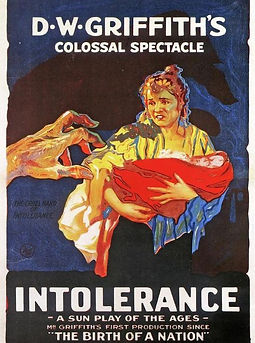
"D. W. Griffith's Colossal Spectacle...A Sun Play of the Ages"
Building the Sets for Intolerance
Karl Brown recalled that the set designers on Intolerance used Tissot’s Illustrated Bible as their reference for recreating the Judean period, much as Sidney Olcott had for his 1912 religious epic From the Manger to the Cross. Soon after production was under way, Griffith selected key members of the crew for a Sunday screening of the original version of The Mother and the Law. Assistant director Joseph Henabery was the only member to offer criticism. Waiting until everyone else had left the screening room, he pointed out that the prison priest was wearing the outfit of a French cleric, something that would be immediately apparent to Catholic members of the audience. Under Griffith’s instruction, Henabery found a priest who had worked at San Quentin and who not only offered to loan his outfit but to stay on as technical advisor for the gallows scene. A delighted Griffith consequently placed Henabery in charge of all research for the picture.
Henabery was so conscientious he would frequently sleep on piles of extras’ costumes to ensure he was ready for work early the following morning. He ransacked second-hand bookstores, buying so many books he needed a car to transport them to the studio, much to studio comptroller J. C. Epping’s distress. Henabery purchased two copies of every reference book so that he could cut the illustrations from one and paste them, categorised by subject matter, into a scrapbook for quick reference. Eventually, a thirteen-feet long bookshelf strained under the weight of books on “Babylon and Assyria, Jerusalem and France.” After initial doubts, Griffith found the scrapbook indispensable and carried it around with him. It now resides at the Museum of Modern Art in New York.
Remembering the pause to admire the Tower of Jewels during the journey home after visiting San Quentin, Griffith despatched the ever-eager Henabery to San Francisco to find the men who had helped build the monumental construction—particularly those who worked in plaster of paris—and the painters who had created the impressive aged effect. Henabery tracked one of the men down after learning of his whereabouts from the staff of a small shop that made plaster of paris models. Not only was this man willing to go to Hollywood for $35 a week, but he also knew two other men skilled in working with the material, and one of the painters who had worked on the tower. The next day, Henabery brought them all to Griffith’s set.
The man responsible for providing the drawings from which carpenter Frank ‘Huck’ Wortman would construct the staggering Babylonian sets was the enigmatic Walter L. Hall, an English theatrical designer whose sole film credit this was. Remarkably, Karl Brown’s recollections of Hall appear to be the only information available on the man responsible for designing arguably cinema’s most famous, instantly recognisable set.

D. W. Griffith

Intolerance (1916)
Brown describes him as something of a tortured soul. Resembling a young Winston Churchill, Hall had two obsessions: the science of perspective (which earned him the nickname “Spec”) and protecting the virtue of his teenage daughter from the rogues that wandered around film sets. He worked in an office with windows at one end of the stage, from where he could see his designs come to life—and keep an ever-watchful eye on his daughter. He possessed, according to Brown, “the great gift of an imaginative creative artist with the needlepoint accuracy of a fine architect,” and the ability to draw to scale freehand and at speed. “He could look at a pictured fragment of a recently unearthed archaeological find,” Brown reminisced, “and from it reconstruct the entire subject…A partial remnant of a stairway at Persepolis became the entire great stairway to the great palace of Belshazzar.”
Brown’s remark to Hall that he must receive great satisfaction from so easily doing something so wonderful met with an unexpected response. “Satisfaction? Humpf!” Hall responded. “Chained to a drawing board hand and foot, day in and day out, when I ought to be out looking after my daughter? It’s a dog’s life, Brown—a dog’s life.”
“Then why do you do it?”
“Because I must, can’t you see that? Because I must!”
“Don’t you like drawing?”
“I hate it,” Hall said vehemently. “It’s the most demanding, the most merciless work a man can do.”
Working from the drawings and designs provided by the tormented Englishman, Huck Wortman and his men slowly constructed Intolerance’s magnificent sets on an empty lot across from the studio. The Walls of Babylon thrust skyward, transforming the skyline on the corner of Sunset and Hollywood Boulevard and mystifying locals until hoardings revealed the film’s title—still The Mother and the Law at this stage—and the name of its director.
As a practical joke, Bitzer asked Wortman if it would be possible to construct runways and platforms on the walls and to reinforce the structure to allow galloping horses to tow chariots on it. When Griffith heard about the suggestion, he thought it an excellent idea, and much to Bitzer’s later regret, instructed Wortman to make it happen. To protect these towering sets from the harsh Santa Ana winds, workmen had to lash thick, sturdy rope to the top of each set and anchor it to the ground with railroad ties buried in the earth.
Eventually, the winds passed, and the skies calmed. The time had at last arrived for filming to begin…
Please click the 'Next Film' button to read Intolerance - Part 3.
Sources: Sight and Sound, 12th February 1947; D. W. Griffith and the Banks: A Case Study in Film Financing, Janet Wasko; A Silent Siren Song: The Aitken Brothers' Hollywood Odyssey, 1905-1926, Al P. Nelson; D. W. Griffith: An American Life, Richard Schickel; D.W. Griffith Interviews, Anthony Slide; Adventures with D. W. Griffith, Karl Brown; D. W. Griffith: His Life and Work, Robert M. Henderson; Before, In, and After Hollywood, Joseph Henabery; Anita Loos: a Biography, Gary Carey; A Girl Like I, Anita Loos; D. W. Griffith: American Film Master, Iris Barry; The Films of D. W. Griffith, Edward Wagenknecht; The Man Who Invented Hollywood: the Autobiography of D. W. Griffith; The Movies, Mr. Griffith, and Me, Lillian Gish; Billy Bitzer: His Story, G. W. Bitzer.