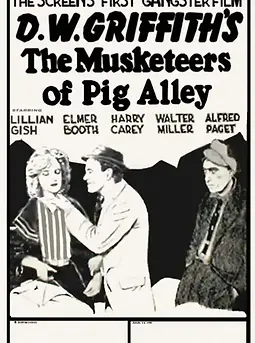
The Musketeers of Pig Alley (1912)
released 31st October 1912
Cast:

Elmer Booth

Lillian Gish

Walter Miller

Alfred Paget

Harry Carey

John Francis Dillon
The Musketeers of Pig Alley (1912)
Crime, Drama, Short
17m
Biograph
Director:
Writer:
Willard Bradley
“In 1912 there was a series of gangster killings and vice scandals that implicated the police. The newspapers headlined these events… The social realism of stories and situations based on newspaper reports that we have come to associate with the gangster genre began when the Biograph Company capitalized on these headlines and the subsequent cries for reform.”
Lillian Gish, interviewed in the Biograph Bulletin.
The Biograph studio was on New York’s 14th Street, a stone’s throw from Tammany Hall, a hub of political corruption once described as the ‘nerve center of gangsterism.’ In 1911, Al Rooney, the founder of the 14th Street gang, received a sentence of between twenty years and life for shooting a man to death in a casino hallway; Police arrested underworld figure ‘Boston Red’ Phil Davidson on 14th Street after the contract murder of Big Jack Zelig; Charles ‘Lucky’ Luciano, father of the Italian-American Mafia, grew up on the street. It was inevitable, then, that working from a studio surrounded by crime, D.W. Griffith would one day draw on such local colour to make a gangster movie.
His inspiration for The Musketeers of Pig Alley was the murder of Herman ‘Rosy’ Rosenthal, a small-time bookmaker who complained about the protection money police lieutenant Charles Becker demanded from his casino operations. Two days after his allegations appeared in the New York World, Lenox Avenue gang members gunned Rosenthal down as he left the Hotel Metropole just off Times Square. The killing made headlines when Becker was accused (and later found guilty) of orchestrating the murder. In its publicity for the movie, Biograph claimed it featured real gangsters Kid Broad, an East Side prizefighter, and a shadowy figure named “Harlem Tom” Evans, both of whom played heavies.
According to Griffith’s cameraman Billy Bitzer, the director shot the film in September 1912, following ten days of rehearsals. Fort Lee substituted for New York’s tough Lower East Side; for many years, Griffith’s recreation of cluttered streets, garbage-strewn alleyways and seedy bars convinced film historians that he actually shot the film on the mean streets it depicted. Griffith’s images recalled those of slum conditions on the Lower East Side captured by photographer Jacob Riis in the late nineteenth century. His primary intention was “to show the doings of the gangster type of people,” and Biograph itself noted that “this picture production… does not run very strong as to plot.”


Lillian Gish and unknown actress in D. W. Griffith's The Musketeers of Pig Alley (1912)
Lillian Gish stars as a poverty-stricken wife living on New York’s ‘other side’, who catches the eye of local gangster The Snapper Kid, played by Elmer Booth, whose cocky persona foreshadows the pugnacious energy of a young Jimmy Cagney. Booth’s promising career – and life – was cut short in the early hours of 16th June 1915 when he was a passenger in a car driven by the director Tod Browning which collided in heavy fog with a freight train in downtown Los Angeles. Booth robs Gish’s musician husband (Walter Miller) but then rescues Gish from being drugged in a bar by a rival gang leader. His intervention sparks a feud between the two gangsters. Gish and her husband become involved when Booth seeks an alibi after killing his rival.
“Pig Alley” was an area in and around the Lower East Side’s Essex and Hester Streets where immigrants gathered to seek work as day contractors. Contemporary sources speculate locals coined the term Pig Alley because visitors could buy everything but pork in that neighbourhood of New York. Another theory is that it was an Americanisation of the French Pigalle, an area in Paris famous for sex shops and adult entertainment venues. Whatever its origin, “Pig Alley” was familiar enough to general audiences for Griffith to feel no need to explain its meaning.
In his memoirs, Billy Bitzer recalled an early preview of the film: “Another way we learned was through tryouts. Tryouts were usually in remote theaters, and it was to our advantage to be there. One memorable tryout was held in a converted store in the lower East Side Jewish section of Manhattan. It was in 1912 for The Musketeers of Pig Alley, an early gangster film with Elmer Booth, much of which was filmed in that locale. We got very strong and favorable reactions – it was one of the first “realistic” films, one of our best.”
Although not cinema’s first gangster film – some of Griffith’s earlier films had touched on genre elements – The Musketeers of Pig Alley depicted a criminal milieu rife with staples of the gangster movie: a seedy urban world populated with often desperate underworld characters; a ruthless gang leader, prepared to go to any length to achieve his aims, but with some redeeming feature which earns him a measure of audience sympathy; a loyal henchman – in this case, Harry Carey - and a gang rivalry that usually ends in a shootout or some other form of violent confrontation. Martin Scorsese admits that The Musketeers of Pig Alley has influenced his crime movies more than any other, and filmed scenes for his 1990 gangster opus Goodfellas just blocks from where Griffith shot The Musketeers of Pig Alley seventy-eight years earlier.
Sources: Crime Movies: From Griffith to The Godfather and Beyond, Carlos Clarens; The Encyclopedia of Crime, Oliver Cyriax, Colin Wilson and Damon Wilson; Griffith, First Artist of the Movies, Martin T. Williams; D. W. Griffith and the Origins of Narrative Film, Tom Gunning; Billy Bitzer, His Story, G. W. Bitzer.