The Bargain (1914)
released 3rd December 1914
Cast:

William S. Hart
J. Frank Burke

J. Barney Sherry

James Dawley

Clara Williams
The Bargain (1914)
Drama, Western
80m
New York Motion Picture Company
Director:
Writer:
Thomas H. Ince, William H. Clifford, Richard V. Spencer

"Featuring William S. Hart in feats of incomparable daring."
“I saw a Western picture. It was awful! I talked with the manager of the theater and he told me it was one of the best Westerns he had ever had. None of the impossibilities or libels on the West meant anything to him – it was drawing the crowds... I was so sure that I had made a big discovery that I was frightened that someone would read my mind and find it out.
Here were reproductions of the Old West being seriously presented to the public – in almost a burlesque manner – and they were successful. It made me tremble to think of it....
“I had to bend every endeavour to get a chance to make Western motion pictures. Usually when stirred by ambition I would become afraid. But surely this could not be the valor of ignorance. I had been waiting for years for the right thing, and now the right thing had come!”
William Hart: My Life East and West
More than any other early screen cowboy, William Surrey Hart could claim to have lived something of the life he portrayed on the screen. Spending part of his childhood in the American Midwest, he played with the children of Sioux Indians, from whom he learned how to hunt and track and who taught him the fundamentals of their language. He handled livestock as a boy and worked as a ploughboy and thresher while his English immigrant father worked in grist mills and sought the ideal site for a mill of his own. When still a child, he helped drive cattle to Fort Robinson to feed the Indians there. He and his father passed through the Black Hills of Dakota, teeming at the time with gold prospectors and restless Indians unsettled by their intrusion. In Sioux City, they were caught in the crossfire of a gunfight between a sheriff and two gamblers.
Eventually, the family returned east, their patriarch’s dream unrealised. Hart worked for three years as a postal clerk until, released of family obligations by his understanding father, he pursued the acting career he had coveted since his teens. He became a travelling player, acting for some of the hundreds of stock companies criss-crossing the country in the late 19th Century before appearing as Messala in the original stage production of Ben-Hur (a role that resulted in some erroneously crediting him as playing the part in Kalem’s 1907 screen production). A two-year stint as Cash Hawkins, the villainous cowboy in The Squaw Man followed. His performance in that won him further cowboy roles: he replaced Dustin Farnum in The Virginian and played Dan Stark in Rex Beach’s The Barrier. Whenever parts grew scarce, Hart’s brother-in-law found him work as a yard detective for the railroads.
That fateful visit to the nickelodeon prompted Hart to seek Thomas H. Ince when The Trail of the Lonesome Pine, the play he was appearing in, stopped at Los Angeles. Ince, a former roommate, now worked as a supervisor for the New York Motion Picture Company. His old friend showed him around Inceville, the 18,000-acre site where the studio filmed their Westerns. Ince offered Hart little encouragement, explaining that audiences were tired of Westerns, but was impressed by his friend’s undaunted enthusiasm and offered him a salary of $75.00 per week. Hart joined a labour force of over 300, many of them cowboys who trained new arrivals and patrolled the area bearing arms if rumours of Patents agents sniffing around reached their ears.
Hart roamed the site, observing the technicians at work, and received encouragement from Gilbert M. ‘Broncho Billy’ Anderson, who believed Hart possessed the right personality to become a Western hero.
Ince, still unconvinced about the future of Westerns, introduced Hart’s lugubrious features to moviegoers in a couple of two-reelers – His Hour of Manhood and Jim Cameron’s Wife – both directed by their star Tom Chatterton, who had little directing experience. Critics disliked both, and Hart’s debut as an actor barely caused a ripple. Disheartened, he once again approached Ince, writing a letter this time in which he complained his old friend wasn’t keeping to his side of the bargain.

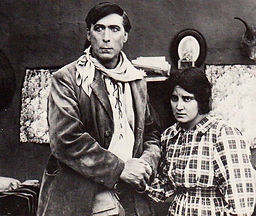
William S. Hart and Clara Williams in Reginald Barker's The Bargain (1914)
Ince recalled a short he had made a few years before called Getting His Man which he thought could be expanded to feature length, and told it to Hart. The actor asked him for three days to build it up and returned after five with a story twice the original’s length. Ince forwarded the treatment to screenwriter C. Gardner Sullivan, who came up with a scenario.
Ince assigned the young Scottish director Reginald Barker, and shooting began under the working title of The Two-Gun Man on 11th June 1914. He also authorised scenes to be shot in the Grand Canyon, where they filmed for several days, camping beside the Colorado River. The intense heat at the foot of the canyon melted the actors’ makeup in its containers. They shot more scenes at Topanga Canyon, near Inceville, and finished shooting on 5th August.
Hart played ‘two-gun man’ Jim Stokes, one of the first of his ‘good bad men,’ a resourceful bandit who operates alone. He cons a stagecoach crew and its passengers into believing he is part of a gang by arranging hats and rifles behind boulders to give the appearance of armed accomplices but is wounded making his getaway. Phil Brent (Barney Sherry), a kindly miner who lives with his daughter, Nell (Clara Williams, who would marry director Barker in 1920) gives him shelter. After falling in love with Nell, who nurses him back to health, Stokes goes straight, and when he asks Brent for his daughter’s hand in marriage, her father agrees. However, Stokes is recognised the day after the wedding and makes for the Mexican border alone. Things look hopeless for him when Sheriff Walsh (J. Frank Burke) cptures him in a border town. But when the sheriff loses the recovered loot at the gaming tables, Stokes makes the sheriff a proposal that just might get them both out of trouble.
The Bargain is a strange hybrid of gritty realism, questionable acting (particularly from the novice leading man), and sometimes florid prose. Its first title reads, “The West! The Land of Vast Golden Silences Where God Sits Enthroned on the Purple Peaks and Man Stands Face to Face With His Soul.” Fortunately, such flamboyant philosophising only occasionally rears its head. After a slow panning shot of the Grand Canyon, we see Stokes, surveying his surroundings as he rolls a cigarette with one hand before lighting it. It’s an introduction that puts one in mind of Clint Eastwood as the Man With No Name, a man as much a part of the landscape as the brush and rocky mountains. At 49-years-old, Hart possessed the weathered features of someone used to hardship and, acting aside, came to the screen as a ready-made cowboy, a desperado whose past was etched into every line on his face.
According to the AFI, some doubt exists about who photographed The Bargain. Some modern sources credit Joseph H. August, while others claim it was Robert Newhard. Whoever was responsible captured some stunning backdrops that provide a striking contrast to the film’s dingy interiors. The saloon in the town where Stokes is captured and the sheriff duped of his money is particularly impressive, not only for its seediness but because its size allows August/Newhard to capture some great shots along its rowdy length. The shabbily dressed characters also look as if they have stepped out of the real Old West, although Sheriff Walsh has a severe case of the Buffalo Bills.
The Bargain is crisply edited by persons unknown as cutters (as they were known back then) didn’t receive screen credits in cinema’s early years. Its pace is much slower than that of movies from rivals such as Tom Mix, but none the worse for that. Ince was so impressed with the film that he sold its distribution rights for three years to Famous Players-Lasky, feeling its potential was too great to be released through Mutual. Through Adolph Zukor’s organisation, The Bargain could play premium theatres.
The film was a major hit. The New York Dramatic Mirror described it as “a model of what can be accomplished in a popular field of photoplay work,” while Variety’s reviewer, revealing that 2400 feet had been cut from the first positive, considered it “among the best of the western dramas shown since film features were. It has all the attributes of the best things in pictures: exceptional scenic beauty, compellingly interesting story, and capital pantomimic actors.” The review described Hart as “fine and polished a bit of artistic creation as a Frederick Remington sketch,” and drew attention to a stunt in which Hart and his horse tumble down a steep bank “that looked like an invitation to suicide.”
The film’s success persuaded Ince to place Hart under a short-term contract at $125.00 per week – which was still $50 per week less than the actor had been earning on the stage.
Sources: My Life East to West, William S. Hart; Thomas Ince: Hollywood's Independent Pioneer, Brian Taves; William S. Hart, Ronald L. Davis.