Double Trouble (1915)
released 5th December 1915
Cast:

Douglas Fairbanks

Richard Cummings

Olga Grey

Margery Wilson
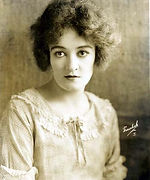
Gladys Brockwell

Monroe Salisbury
Double Trouble (1915)
Comedy, Romance
50m
Fine Arts Film Company
Director:
Writer:
Christy Cabanne

"A Story of Love, Business and Politics"
Douglas Fairbanks couldn’t attend the premiere of his first film, The Lamb. By the time of its unveiling at the Knickerbocker Theater in New York on 23rd September, he was out west shooting Double Trouble.
Christy Cabanne, director of The Lamb, was reunited with Fine Arts’ new star for Double Trouble, and also adapted Herbert Quick’s 1906 novel for the screen. D. W. Griffith was the production supervisor, but the extent of his involvement is debatable. There is no record of the reserved director and flamboyant leading man ever clashing, but it’s possible they were of such diverse personalities that Griffith felt he couldn’t work with Fairbanks.
Margery Wilson, Fairbanks co-star in Double Trouble, said Griffith’s production company was having money problems before they started filming. Efficiency experts sent out west by his New York backers to examine all aspects of the business recommended sweeping cuts. The studio summarily dismissed lesser names, including Wilson. The unemployed actress took to sitting in the studio’s outer casting office each morning, hoping to be selected for a part. After over two weeks, Griffith expressed surprise at seeing Wilson sitting there, and the next day summoned her to a rehearsal that night. Waiting to meet her was Fairbanks, who had requested an actress with stage experience for his next leading lady. “We ran through a couple of scenes, and Mr. Fairbanks, with his customary enthusiasm for anything that met his approval, said he was delighted to have me,” Wilson recalled in her autobiography. “His breeziness and good humor, rising up like the vapor from a pot of boiling energy, gave his personality great impact.”
Performers further down the cast list included comic actor Billy Quirk as a camp bellboy who propositions Fairbanks’ character. Quirk had enjoyed a brief period of success with Biograph (often appearing opposite Pickford) and Solax. When a move to Universal proved unsuccessful, Quirk signed with Vitagraph. It was there that his career faltered, eclipsed by bigger comedians with stronger material, such as John Bunny and Sidney Drew. By 1919, he was working for the Eastern Film Company, a tiny independent outfit operating out of Providence, Rhode Island. In February 1920, despondent over the failure of his career, he threw himself from a third-floor window of Harlem Hospital, where he was staying following a nervous breakdown. A snowbank broke his fall, and he recovered. He died in 1926 at the age of fifty-three.
Another member of the cast to meet an unfortunate end was Monroe Salisbury, who played a hotel clerk in the movie. Salisbury enjoyed a brief spell of stardom after playing the romantic lead in Ramona (1916). He retired from acting in 1922, and an attempted comeback in 1929 met with little success. He was working as a hotel clerk in 1935 when he was admitted to Patton State Hospital for the Insane in San Bernardino, California. Shortly after arriving, he died after hitting his head. He lay in the morgue for two days before his sister identified him, and only four mourners attended his funeral.
Double Trouble followed a trend for ‘dual role’ pictures which possibly started with the 1913 drama, German of Prague. Many silent stars would explore the concept of dual personality – although Fairbanks was one of the first. According to John C. Tibbetts and James M. Welsh in Douglas Fairbanks and the American Century, Double Trouble bears more than a passing resemblance to the plot of Max Mack’s 1913 thriller, Der Andere (The Other).
Location shooting took place in Santa Ana in California. To shoot a parade scene for Double Trouble, Cabanne got permission from its mayor to use the town’s polling booth, its fire and police departments, the municipal band, and 4,000 extras. For scenes in which Fairbanks’ character underwent two personality changes, the director had a complete, authentic reproduction of a Pullman car constructed in the Fine Arts Studio on Sunset Boulevard under the supervision of the Los Angeles district manager of the Pullman Company. The production cost $40,488.33, and Fairbanks spent just twenty-two days filming it.
The film premiered at the Knickerbocker Theatre on 5th December 1915, alongside Thomas H. Ince’s The Golden Claw and Mack Sennett’s Saved by Wireless. Although generally favourable, praise for Double Trouble was not as generous as it had been for The Lamb. Moving Picture World wrote, “There is a depth of meaning to the screen version, and it affords Douglas Fairbanks abundant opportunity to display his versatile talents, but there is a tendency to drag at times and more than one incongruity that could have been completely eliminated where the main purpose is so obviously that of light and amusing entertainment.” Motion Picture News noted: “Here again as in The Lamb, these titles are mindful of George Ade and consequently very humorous. No strong dramatic situations arise, partly because of the character of the titles, but the picture is quite novel in development and interesting.” It was not so generous about Fairbanks’ performance, stating, “…with the Knickerbocker audience as a criterion, responsible for no small amount of laughter, the exaggerated zeal displayed by Fairbanks in order to create an effective contrast, may be passed over with no more than slight regret.”
Double Trouble has not aged well, although the criticism of Fairbanks’ performance feels unfair compared to other performers from the period. He does exaggerate, but Double Trouble is a comedy, and his flamboyant gestures don’t feel out of place. The film’s biggest problem is that it simply isn’t funny, despite some amusing intertitles.

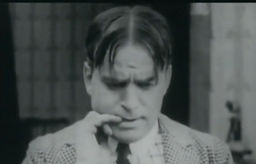
Douglas Fairbanks in Christy Cabanne's Double Trouble (1915)
While Fairbanks’ film career was taking off, his domestic life was not so positive. In her autobiography, I Found My Way, Margery Wilson wrote about her friendship with Fairbanks’ wife, Beth, and of the state of the couple’s relationship while they were shooting Double Trouble. She first met Beth Fairbanks in Santa Ana, where Fairbanks had taken to teasing the actress about her weight, nicknaming her Miss Shylock because of the malted milk drink she consumed every hour and joking that she was always “hunting a pound of flesh.”
During filming, Beth Fairbanks would wait in her limousine, which was parked at the kerb. One day, she invited Wilson to lunch, and they became friends. “I learned there was little harmony between her and her husband,” Wilson remembered. “When he felt it was necessary to come to the car, one could feel the strain and the discord, like tangible things. Their teeth-gritting politeness was worse than quarreling, and there was even some of that.”
It was while he was in this strained relationship that Fairbanks first met Mary Pickford. Both attended a party given by the actress Elsie Janis in November 1915. Fairbanks, driving a sporty yellow Leon Bollée he had borrowed from Roy Aitken, spotted Owen Moore, Pickford’s husband and fellow Fine Arts actor, waving him down at a crossroads. Pickford recalled passing the sports car earlier and said in her memoir, “I noticed that the couple sitting in the back had a leopard rug over their laps. I wasn’t quite sure that I approved of this showy car or that flamboyant lap robe.”
Fairbanks jumped out of his car and removed his hat as he strode across to Moore. He then flashed his dazzling smile at Pickford when Moore introduced them. Although they had never met before, Pickford had seen Fairbanks perform in A Gentleman of Leisure on Broadway and on the screen in The Lamb. Fairbanks gave her chauffeur directions to Janis’s home, a colonial manor in Tarrytown in which George Washington once slept, and sped off in the Bollée.
Fairbanks was already entertaining a huddle of enthralled listeners when Pickford and Moore arrived at the party. Unimpressed, Pickford retired to a corner with a fashion magazine. An aloof Moore drank alone. “Poor Owen is worried about his new contract,” Pickford excused him when asked. Eventually, Janis organised a walk with Fairbanks and Moore. Pickford and Beth Fairbanks tagged along, but Beth soon turned back, protesting it was too cold.
Although the others were some distance ahead, Pickford soldiered on until she came to a cold stream, across which lay a log. She made it halfway across but was too frightened to go on. Thankfully, Fairbanks had turned back. In typical fashion – and after first receiving the stricken Miss Pickford’s permission – “he swept me up into his arms and leaped back to the other side, where we were joined by Elsie and Owen.”
Pickford didn’t consider it a romantic incident at the time and gave little thought to Fairbanks once they had parted company. He might not have been so unmoved. Frances Marion, Pickford’s friend and writer, was also at the party and recalled, “I saw Doug gazing at Mary; it was a long, inquisitorial look and for a moment there seemed to be a strange stillness within him.”
Fate would throw Fairbanks and Pickford together soon after, at a party held at the Algonquin Hotel by its owner, Frank Case. Although the invitation made no mention of it, the party was to celebrate the opening of Double Trouble. Case and Fairbanks therefore stood at the door to welcome guests. Case introduced Pickford to Fairbanks, not realising they had already met. For years after, he believed he was the one who brought them together.
Between dances, Pickford and Fairbanks talked movies. He told the disbelieving actress he believed she and Charlie Chaplin were “the two outstanding artists in pantomime… you do less apparent acting than anyone else I know, and because of that you express more.” Pickford was unused to such vivid enthusiasm over her work – her husband was more likely to belittle than enthuse – and remembered: “I hugged the echo of his words for days, repeating them over and over to myself… I had been living in half shadows, and now a brilliant light was suddenly cast upon me…”
When the night was over, the couple parted, he with his wife Beth and Pickford alone to her room in the Algonquin. Both were still married, and both had successful careers to attend to: Pickford was in the middle of filming The Foundling, and Fairbanks was about to start work on His Picture in the Papers.
Sources: I Found My Own Way, Margery Wilson; His Majesty, the American: The Cinema of Douglas Fairbanks Sr, John C. Tibbetts; Kindergarten of the Movies, Anthony Slide; The First King of Hollywood: The Life of Douglas Fairbanks, Tracey Goessel; Mary Pickford and Douglas Fairbanks: The Most Popular Couple the World Has Ever Known, Booton Herndon; Sunshine and Shadow, M Pickford; Doug & Mary: a Biography of Douglas Fairbanks and Mary Pickford, Gary Carey; Mary Pickford, Scott Eyman; Mary Pickford: Sweetheart of the World, Robert Windeler; Pickford: The Woman Who Made Hollywood, Eileen Whitfield; Clown Princes and Court Jesters, Kalton C Lahue; Off With Their Heads: A Serio-comic Tale of Hollywood, Frances Marion; AFI Catalog.