Intolerance (1916) - Part 4
released 5th September 1916
Cast:

Lillian Gish

Robert Harron

Mae Marsh

Howard Gaye

Constance Talmadge

Tully Marshall
Intolerance (1916) - Part 4
Drama
163m
Wark Producing Corporation
Director:
D. W. Griffith
Writer:
D. W. Griffith, Anita Loos
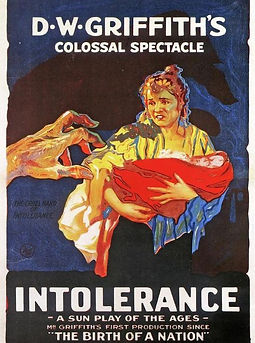
"D. W. Griffith's Colossal Spectacle...A Sun Play of the Ages"
After more than a year’s filming, Griffith was at last ready to start the monumental task of editing Intolerance and adding intertitles. To help him with the titles he chose Anita Loos, a precocious talent who, at the age of twenty-six, already had more than fifty screen credits to her name. Loos had sought Griffith out on the Babylonian set of Intolerance, where he had offered her a job writing titles for $75 per week plus a bonus each time one of her scripts went into production. After some minor rewriting duties, she was given the job of writing an adaptation of Macbeth, which Fine Arts-Triangle were planning to film with Sir Herbert Beerbohm Tree in the lead role. For this task she received a credit of “Macbeth by William Shakespeare and Anita Loos.”
Soon after that, Griffith invited her to work with him on the titles for Intolerance. One evening, he showed her a first cut of the picture. She later described believing the director had ‘lost his mind’ after watching it. “I sat a moment in stony silence, which I could only explain to the Great Man by telling him that I had been moved beyond words. Actually, he was so absorbed in his film I doubt he realized my bewilderment.”
Editing some 200,000 feet* would prove to be a far more arduous task. Griffith closeted himself in a cutting room with his regular editors, Jimmy and Rose Smith. Lillian Gish, who had earned herself a reputation as a ‘Goody Two-Shoes’ around Griffith among some of the other female cast members, also provided assistance. In the midst of editing, the couple requested time off to be married, fully expecting the director to refuse, but Griffith agreed on the proviso their honeymoon lasted only one weekend.
The first rough cut ran for eight hours, and while Griffith accepted the film would have to be half that long, he toyed with the idea of running it over two nights. However, trials with a few carefully selected exhibitors showed there was no interest even in a four-hour film. Somehow, he managed to cut it to approximately 13,000 feet. Rather than tell each story in sequence, Griffith adopted the then-revolutionary technique of interweaving the four plots—a device familiar to modern audiences, but which many in 1916 found confusing.
Each strand explored an example of intolerance from four different historical periods. In modern America poverty, labour conflict and crime result in the wrongful conviction of a young family man who is sentenced to hang; in Judea, Jesus is crucified after people reject or wilfully misinterpret his message of love; in 16th Century Renaissance France, a young Huguenot couple is caught up in the St. Bartholomew Day massacre; and in Ancient Babylon, the mighty city falls as a consequence of religious and political conflict. Joseph Carl Breil, working under Griffith’s close supervision, assembled a score to accompany this mammoth cinematic tapestry.
On 6th August 1916, Griffith’s chauffeur-driven Fiat carried the director, Lillian Gish, Bobby Harron, Joseph Henabery and Mae Marsh to see the preview at an out-of-the-way theatre. Most historians state this sneak preview took place at Riverside, California, although in his autobiography, Henabery insisted the preview was held at the town of Pomona, thirty-five miles west of Riverside. While filming was going on, Henabery had harboured doubts that even a director as accomplished as Griffith could weave together all its strands in a way a 1916 audience could understand, and the version shown that night simply confirmed his doubts had been correct. “In his efforts to carry four parallel lines of action…Griffith, in many cases, used extremely short cuts, mere flashes of what had been fine, understandable scenes,” Henabery wrote. “…I know this proved confusing to the audience. I fear many were disappointed; they expected something surpassing The Birth of a Nation.”
Henabery went on to say that when Griffith asked him what he thought of the film the following day, he criticised only the titles, complaining that they assumed a level of knowledge about the historical incidents depicted that the average audience wouldn’t possess. Griffith initially rejected his criticism but changed his mind later the same day and had Henabery collaborate with Frank Wood and screenwriters Mary O’Connor and Hettie Grey Baker to improve the titles.
Less than a month later, on 5th September 1916, Intolerance premiered at the Liberty Theatre in New York, the same theatre at which The Birth of a Nation received its East Coast premiere. Those in attendance found in the programme notes a message from the director which read, “The purpose of the production is to trace a universal theme through various periods of the race’s history. Ancient, sacred, medieval and modern times are considered. Events are not set forth in their historical sequence, or according to the accepted forms of dramatic construction, but as they might flash across a mind seeking to parallel the life of the different ages.”
This excerpt was sandwiched between The New York Times’ review of Griffith’s latest film. “Ever since the remarkable film “The Birth of a Nation,” was unreeled before an amazed public more than a year ago, the question of whether it was an accident or whether D. W. Griffith, the man who directed the film, was really a new master of the cinema, has interested those who follow the personalities that manipulate the puppets of stage and studio. The answer came last night when D. W. Griffith’s second big picture, “Intolerance,” was exhibited in the Liberty Theatre before an audience that might have gathered to witness the premiere of some favorite dramatist’s latest work, so dotted was it with prominent folk of the theatre…The verdict “Intolerance” renders in the controversy concerning its maker is that he is a real wizard of lens and screen.”
However, the unnamed reviewer tempered their favourable verdict in the very next sentence: “For in spite of its utter incoherence, the questionable taste of some of its scenes and the cheap banalities into which it sometimes lapses, “Intolerance” is an interesting and unusual picture.”
Alexander Woolcott’s review in the Times struck a similar note: “Unprecedented and indescribable splendor of pageantry is combined with grotesque incoherence of design and utter fatuity of thought to make the long-awaited new Griffith picture at the Liberty an extraordinary mixture of good and bad…”
Vachel Lindsay provided an alternative perspective, arguing that the structure some critics found so terrible in fact enhanced the significance of each story. “Babylon is shown signalling across the ages to Judea,” he wrote, “And in like manner the days of St Bartholomew and of the crucifixion signal back to Babylon sharp or vague or subtle messages…The ages make a resonance behind their simple plans and terrible perplexities. The usual shallowness of appeal of private griefs and loves as shown in the most painstaking intimate films, their inability to arouse complete responding passion in the audience, is thus remedied.”

D. W. Griffith

Billy Bitzer, Josephine Crowell, D. W. Griffith and Erich von Stroheim on the set of Intolerance (1916)
The Film Daily review, however, showed no reticence about throwing superlatives Griffith’s way: “Stupendous, revolutionary, intense, thrilling…Mr. Griffith has put on the screen what is, without question, the most stirring human experience that has ever been presented in the world.”
Most reviews fell within one of two camps: either a curious brand of reserved praise from those who compared it to contemporary and preceding works, or fulsome praise from more progressive critics who considered Griffith’s film a step forward in the development of narrative cinema.
Estimates of just how much Intolerance cost vary wildly. Articles dating back to the time of its release have quoted figures around $2,000,000. The Birth of a Nation came in at just over $100,000, and while the spectacular Babylon sets must have cost a fortune, it seems unlikely that Intolerance would have cost twenty times more. Richard Schickel, in his biography D. W. Griffith: An American Life, suggests a far more realistic—and precise—figure of $385,906.77 culled from an accountant’s statement found among Griffith’s papers.
Whatever the cost, the steeply declining customer footfall that followed a short period of strong box-office returns must have been a worrying development for all involved in the production. While no-one has provided conclusive evidence for its ultimate failure at the box-office, perhaps Julian Johnson, in his review for Photoplay magazine, called it correctly when he wrote, “Still, we wish to follow, undisturbed the adventures of a single set of characters, or to thrill with a single pair of lovers. Verily, when the game is hearts, two’s company, and the lovers of four ages an awful crowd.” However, the fact that Intolerance out-performed The Birth of a Nation for months before dropping off calamitously suggests otherwise.
Some have blamed America’s entry into the Great War for its sudden downturn. They argue that the film’s pacifist message no longer chimed with a nation preparing itself for conflict. And yet, Intolerance’s returns began to dip months before the United States broke off diplomatic relations with Germany in late-February 1917 and finally declared war in April. Only in Russia did the film enjoy enduring success, running continuously for ten years. Iris Barry points to the ‘sociological implications’ of the modern story for its success there, where it profoundly influenced a future generation of celebrated filmmakers, including Sergei Eisenstein, Vsevolod Pudovkin, Leonid Trauberg, and Grigori Kozintsev.
Historians in the past have erroneously emphasised the huge financial blow Griffith suffered because of the film’s ultimate box-office failure. In fact, the director suffered no debilitating loss to either his wallet or his reputation. Nevertheless, in a letter to Lillian Gish, Griffith dolefully described barking his shins on empty seats as he wandered through darkened theatres. “I don’t know where to go or where to turn since my great failure,” he wrote.
However, the Great War, which may have played a part in Intolerance’s commercial failure, also provided Griffith with his next adventure. Sometime in the winter of 1916-17, the British War Office Cinematograph Committee had invited him to produce a feature about the war. Griffith accepted, and on 17th March 1917 set sail for England to start work on Hearts of the World (1918).
With the passing of the years and the increasing sophistication of narrative cinema, Intolerance has come to be recognised for the groundbreaking masterpiece it always was, surpassing even The Birth of a Nation.
To Griffith biographer Iris Barry, Intolerance represented the “end and justification of that whole school of American cinematography based on the terse cutting and disjunctive assembly of lengths of film, which began with The Great Train Robbery and culminated in The Birth of a Nation and this… All the old and many new technical devices are employed in it—brief, enormous close-ups not only of faces but of hands and of objects; the “eye-opener” focus to introduce vast panoramas; the use of only part of the screen’s area for certain shots; camera angles and tracking shots such as are commonly supposed to have been introduced by German producers years later; and rapid cross-cutting the like of which was not seen again until POTEMKIN.”
Film historian Theodore Huff proclaimed it “the greatest motion picture ever produced. In its original form and properly presented, it is a masterpiece of creative conception and execution which ranks with such works of art as Beethoven’s Ninth Symphony, Rembrandt’s ‘Descent from the Cross,’ Da Vinci’s ‘Mona Lisa,’ the sculptures of the Parthenon, or with works of literature such as Tolstoy’s War and Peace, the poetry of Walt Whitman or Shakespeare’s Hamlet.”
Intolerance was among the first batch of films to be added to the United States’ National Film Preservation Board’s National Film Registry in 1989. In 1995, it was included in the Vatican’s list of 45 Alcuni film Importanti (some Important Films), under the category ‘Values’.
*At least one contemporary source claims Griffith shot 300,000 feet.
Sources: Sight and Sound, 12th February 1947; D. W. Griffith and the Banks: A Case Study in Film Financing, Janet Wasko; A Silent Siren Song: The Aitken Brothers' Hollywood Odyssey, 1905-1926, Al P. Nelson; D. W. Griffith: An American Life, Richard Schickel; D.W. Griffith Interviews, Anthony Slide; Adventures with D. W. Griffith, Karl Brown; D. W. Griffith: His Life and Work, Robert M. Henderson; Before, In, and After Hollywood, Joseph Henabery; Anita Loos: a Biography, Gary Carey; A Girl Like I, Anita Loos; D. W. Griffith: American Film Master, Iris Barry; The Films of D. W. Griffith, Edward Wagenknecht; The Man Who Invented Hollywood: the Autobiography of D. W. Griffith; The Movies, Mr. Griffith, and Me, Lillian Gish; Billy Bitzer: His Story, G. W. Bitzer.