Intolerance (1916) - Part 3
released 5th September 1916
Cast:

Lillian Gish

Robert Harron

Mae Marsh

Howard Gaye

Constance Talmadge

Tully Marshall
Intolerance (1916) - Part 3
Drama
163m
Wark Producing Corporation
Director:
D. W. Griffith
Writer:
D. W. Griffith, Anita Loos
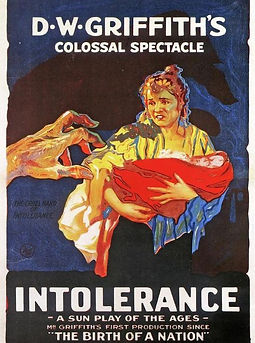
"D. W. Griffith's Colossal Spectacle...A Sun Play of the Ages"
Filming Intolerance
Griffith began shooting The Mother and the Law while production of The Birth of a Nation (or The Clansman, as it was then known) was still ongoing. To avoid confusion, he gave each story a code: The Clansman was F (for feature) 1, The Mother and the Law was F2, the French story F3, and so on. This led many studio workers to believe that he was working on separate projects simultaneously.
For the prison scenes in The Mother and the Law, Griffith built a replica of the grimy cells he encountered while visiting the squalid San Francisco city jail rather than the lighter, cleaner ones found in San Quentin. While visiting the set, Lillian Gish turned away from the foul cell without speaking when Griffith asked her what she thought of it. “Well, that’s life,” Griffith solemnly intoned.
He shot the rest of The Mother and the Law in the same downbeat manner. Brown recalled encountering a raid on a brothel, a U-shaped building designed for a special purpose with cells not unlike those in the San Francisco prisons. Here, though, the doors were made of wood and emblazoned with the name of their occupant: Frisco Kate, Minnesota Minnie, etc. The crew also witnessed uniformed troops mowing down charging strikers in a hail of gunfire.
Filming on the city streets attracted the curiosity of onlookers who followed the crew as they filmed. Brown recalled one of them, a Mexican woman who wheeled her small, paralysed daughter around in a home-made cot. Griffith paid her no heed but instructed his assistant, George Siegmann, to fetch a small bag. When the director thought he was unobserved, he approached the cot and placed silver dollars from the bag around the girl’s body. Then, without words, he handed the bag with the rest of the dollars to the tearful mother and turned away.
He shot the film out of sequence, organising the schedule by the availability of sets and crowds, or simply by which scene he felt like shooting next. First was the marriage scene at Cana. Although Griffith wasn’t slavishly devoted to historical authenticity, insisting that “people believe only what they already know,” he consulted once again with the Catholic priest who had helped him out on The Mother and the Law’s jail scenes. He also called upon the services of Rabbi Isidore Myers, the father of Carmel Myers, who would become a successful silent screen actress. However, to capture the look of those attending the wedding at which Jesus turned water into wine, he drew on well-known academic paintings of the scene. For extras in these scenes, he engaged Orthodox Jews from Boyle Heights who wore the same style of hair and beards as their ancestors. Other extras he furnished with fake beards made from crepe paper attached to wires that hooked over their ears. Between shots, the extras would push the simple device onto their foreheads to serve as makeshift visors.
Because of the immense, time-consuming effort needed to construct its set, Griffith filmed the Babylonian sequences last. To film a sequence as complex as the battle scene, he employed several assistants, including future director W. S. Van Dyke and actor Monte Blue. On each hip, Blue wore a revolver loaded with blanks for signalling; he also carried coloured flags for the same purpose. Lead actors such as Elmer Clifton, George Siegmann and Joe Henabery would each lead a small group of extras.
Huck Wortman had constructed mobile attack towers that were to be pushed by elephants towards the walls of Babylon during the battle scenes. The shot proceeded smoothly at first, but then the towers stopped amid growing agitation amongst the massive creatures. Griffith despatched George Siegmann to find out why and discovered that the elephants were a mix of male and female. The male elephants, it seemed, were more interested in acquainting themselves with their female counterparts than pushing towers. They were therefore summarily dismissed, leaving the females to do all the pushing.
Griffith ordered the battle scene to be shot repeatedly from various angles as different ideas came to him. He decided one tower should crash to the ground, so had Wortman rig it so that the wooden construction would look like crumbling stone and mortar as it collapsed. When Brown asked Wortman why he was paying such meticulous attention to measuring and remeasuring everything, the carpenter informed him it was so the cameraman wouldn’t be killed while capturing the shot. Griffith also demanded a night shot of the battle. ‘Fireworks’ Wilson, who had worked with him on The Birth of a Nation, had to place three-minute magnesium flares in strategic locations so that the set concealed them from Bitzer’s cameras.

D. W. Griffith

Intolerance (1916)
To film Belshazzar marshalling his troops by golden chariot on the ninety-foot-high battlements, horses needed to be coaxed up a zigzag ramp one at a time. A team of men lifted the chariot by hand and hitched it with some difficulty to the skittish horses on a platform the animals sensed was not stable. Here was where Bitzer came to regret his practical joke on Wortman. To capture the shot that Griffith desired, he and Brown had to lean far out from an unstable tower and shoot down on the wall while the battle raged on the ground below.
At Griffith’s signal, the charioteer urged the horses to gallop straight towards the tower. The structure, already weakened by the Santa Ana winds, swayed perilously beneath their weight and movement. Griffith, ignoring Wortman’s breathless warning that the structure wouldn’t withstand such use, ordered the shot to be retaken. While the wranglers returned the chariot and terrified horses to their starting positions, Brown noticed Griffith observing them. “He was leaning casually against a parapet, his cheap straw hat shoved back on his head, his mouth slightly open in a grin of purest delight.” Thankfully, the director demanded only two takes of the sequence, and Bitzer and Brown descended gratefully to terra firma.
However, it wasn’t just epic battle scenes and elaborate sets Griffith had to manage. He also had a large cast to oversee. For the role of Princess Beloved in the Babylon story, he cast Seena Owen over Alma Rubens. Owen was an incredibly beautiful woman, but a mediocre actress prone to putting on weight, which could be a serious problem on a film with a long shoot. Griffith brought her to the attention of an actor called George Walsh. He was Raoul Walsh’s older brother, whom Griffith signed when he travelled west to visit his sibling, and who was a hit with the ladies. In casual conversation with Walsh, Griffith mentioned Owen’s stunning looks and kind nature. He then did the same with Owen, and soon the couple were in a loving relationship which Griffith hoped would help the actress bring more emotion to her role. When, in the throes of contentment, Owen began piling on the pounds, Griffith told Walsh she was too fat for her part. To Owen, he mentioned she was wasting his time with Walsh, who was merely toying with her affections. The couple split, and the inconsolable actress’s excess weight melted away.
Griffith also had to coax an acceptable performance from actress Marguerite Marsh. One scene called for her to smile in recognition when she saw her lover across a crowded ballroom. Griffith noticed the actress, who was Mae Marsh’s older sister, wilting after a punishing morning before the camera. To perk her up, he joked, “Just think, you’re going to have a nice lunch presently paid for by the firm.” Marsh smiled at his encouragement, and he urged her, “Save that for the picture. That is exactly the expression I want when you see your lover coming to ask you for a dance.” As the camera rolled, Griffith shouted “Steak!” at the vital moment to induce the smile he was after.
One young actress named Juanita Horton talked herself into a role when Griffith overheard her being interviewed by Frank Wood. “Mama said I wasn’t trained to do anything,” the naïve eighteen-year-old confessed, “so there was nothing left for me but acting.” Amused by her candour, Griffith gave her a screen test which she passed with flying colours. Although Intolerance provided her with her first acting role, eight other films she subsequently made were released before it reached the screen. By then, audiences already knew her as Bessie Love, the screen name given to her by the studio. Love would become a major star of the silent screen and was still appearing in movies in the 1980s.
Once Griffith completed filming the battle scene, he ordered the Walls of Babylon to be torn down to make way for the monumental Belshazzar set. While that was being constructed, filming moved to the Dominguez Slough, a body of freshwater that wound its way to the San Pedro mudflats, and which was to double for the Euphrates River. Each day, George Siegmann oversaw the making up and costuming of an army of extras at the studio before transporting them several miles by electric train to the Slough. Once there, they often had to wait for the fog to lift before any shooting could take place. Some days, the fog didn’t lift at all, and an entire day’s work would be lost.
The shoot dragged on: week after week; month after month; until more than a year had passed. Each day cost thousands of dollars—more than most big studios spent in a week. On several occasions, despite the generous initial financial backing, Griffith would have to delay the shooting of elaborate scenes and film smaller ones instead. When he overheard someone wonder out loud whether the shoot would ever end, he simply said, “I don’t see why everybody is in such a hurry to get through. We’d only start another one.”
Rather than level the ground before building the set for Belshazzar’s court, Wortman simply built it on timber stilts. First to go up was the stairway, then the flooring, followed by the columns. Bordered by the unforgettable elephant-surmounted columns, the platform at the top of the steps stretched back around 300 feet. To one side sat an enormous effigy of the goddess Ishtar, a full-grown man clutched to her naked breast. The entire set could comfortably accommodate five thousand people. “The set glittered with gold and glowed with colour,” Brown recalled. “Everything everywhere was richly carved, richly decorated, richly draped.” Using an extra shutter wheel, he captured alternate shots using red and green filters and showed Griffith how colour could transform the already wondrous set. The director turned down his suggestion: either every scene of the picture was in colour, or none at all, and he had come too far to reshoot the entire picture.
The set was so large that shooting it presented another problem to be solved. Initially, Bitzer and Brown tried filming it from a balloon as it was slowly winched down, but were unhappy with the result. For once, the solution proved to be relatively simple. The crew built a two-floor lift into a tower constructed in such a way that half-a-dozen men could easily roll it smoothly forwards and backwards along rail tracks. The lift allowed Bitzer and Brown to film from any level up to fifty feet. Thus was one of the most iconic establishing shots in cinema history captured.
Please click the 'Next Film' button to read Intolerance - Part 4.
Sources: Sight and Sound, 12th February 1947; D. W. Griffith and the Banks: A Case Study in Film Financing, Janet Wasko; A Silent Siren Song: The Aitken Brothers' Hollywood Odyssey, 1905-1926, Al P. Nelson; D. W. Griffith: An American Life, Richard Schickel; D.W. Griffith Interviews, Anthony Slide; Adventures with D. W. Griffith, Karl Brown; D. W. Griffith: His Life and Work, Robert M. Henderson; Before, In, and After Hollywood, Joseph Henabery; Anita Loos: a Biography, Gary Carey; A Girl Like I, Anita Loos; D. W. Griffith: American Film Master, Iris Barry; The Films of D. W. Griffith, Edward Wagenknecht; The Man Who Invented Hollywood: the Autobiography of D. W. Griffith; The Movies, Mr. Griffith, and Me, Lillian Gish; Billy Bitzer: His Story, G. W. Bitzer.