William Fox

William Fox
"I always bragged of the fact that no second of those contained in the twenty-four hours ever passed but that the name of William Fox was on the screen, being exhibited in some theatre in some part of the world."
William Fox
Birth name:
Wilhelm Fried Fuchs
Born:
1st January 1879, Tolcsva, Hungary
Died:
8th May 1952, New York, USA
Years active:
1904 - 1930
William Fox was one of the key figures in the early American movie industry. He built a vertically integrated theatre, distribution, and production empire, founded the Fox Film Corporation, and helped establish sound newsreels. His extraordinary rise was followed by a rapid loss of control after his failed acquisition of Loew’s/MGM and the Wall Street crash of 1929.
Early life
William Fox was born Wilhelm Fried Fuchs on January 1st, 1879, to Michael Fuchs and Anna Fried, the owners of a general merchandise store in the rural town of Tolcsva, Hungary. A few months after the birth of his son, 22-year-old Michael emigrated to America in search of a brother who had moved there ten years before. After selling the store, his wife and young son followed six months later.
The move turned out to be a bad one for Michael and his family. They had exchanged a comparatively comfortable life in their homeland for the squalid tenements of New York’s Lower East Side, which were rife with typhus and smallpox. The couple lost seven of their thirteen children, and Michael never found his brother. He spent much of his time out of work and lost the respect of his oldest son, who claimed his father never earned more than $1,000 a year. Fox later recalled, “All I remember of those early years is my father slurping up Mama’s chicken soup at the dinner table.”
A fall from the back of an ice truck resulted in a local dentist removing the elbow joint of his left arm because his father couldn’t afford a doctor. From the age of nine, perhaps realising as a result of that accident and his subsequent disability, that his father was incapable of providing for his family, William worked to support them. He sold sweets for a penny apiece and recruited helpers when he realised he could sell more than he could carry. The following year he dropped out of school and lied about his age to get a job with a clothing company, D. Cohen & Sons; three years later he was promoted to foreman in charge of cutting linings and overseeing a dozen employees. In the evenings, at the insistence of his mother, he attended night school until he was fourteen.
Then, with his evenings free, Fox began visiting vaudeville shows, buying the tickets at a favourable price from shopkeepers who received them for free for carrying ads for the shows in their windows. He and a friend developed a vaudeville routine of their own which they performed for $5 or $10 a night, but he soon realised they weren’t talented enough to make a fortune as performers. Financial stability by any legal means had by now become Fox’s main goal in life, and he became frugal in his habits. When he was fifteen, he started working for G. Lipmann & Sons, another clothing company, but an improved wage only strengthened his resolve to covet every dollar: ”I can recall going out with boys when I was sixteen, seventeen, or eighteen,” he later recalled, “and though I wanted to do the things they did, on checking up the cost I usually did without. I knew the soles of my shoes had holes in them and that was the time to have them repaired, but I delayed it by putting pasteboard in them to save the half-soling.... Every penny was something that I denied myself, with the thought in mind that if I was going forward, I had to have money.”
Although he earned at most a weekly salary of only $17, he managed to save $580 by the age of 20, and on 31st December 1899, the eve of his 21st birthday, he married Eva Leo, whom he’d met at a party when she was 10 and he was 14.
Realising he would never attain the wealth he desired working for someone else, Fox went into business for himself. Staying in the clothing industry, he started the Knickerbocker Cloth Examining and Shrinking Company, a venture that required little start-up money and factory space. While Fox continued to limit his salary to $17 a week, he allowed his partner a weekly wage of $25. When the business realised a profit of $10,000 after its second year, Fox bought out his partner. Shortly after, he sold the business for a profit of $50,000.
Entering the film business
Searching around for his next business venture, Fox noted the growth of nickelodeons and the constant stream of patrons entering these makeshift premises. In 1904, he and two business partners bought a nickelodeon at 700 Broadway for $5,000. It turned out that this new business wasn’t as successful as he had been led to believe: the seller had hired people to make the place look popular. So, to drum up trade, he engaged a magician to perform coin tricks outside who promised his audiences he would finish his act upstairs for free. Within a week, police had to control the crowds willing to pay to see the ‘flickers,’ and soon, Fox and his two partners had fifteen highly profitable establishments. Once again, when he could afford to, Fox bought out his partners.
Business was booming, but Fox realised there was an even greater profit to be made by distributing films to other exhibitors and established the Greater New York Film Rental Company. Dissatisfied with the ceiling on profits he could make from his chain of small nickelodeons, Fox began buying theatres. The first was a dilapidated place known locally as the ‘Bum’ theatre at 194 Grand Street in Brooklyn, which he purchased for $20,000. While renovation was underway, Fox mailed 10,000 neighbourhood residents regular updates on its progress. Fox’s programme of vaudeville acts combined with movies proved popular, and he quickly repaid the theatre’s mortgage.
The next few years saw Fox aggressively expand his empire. In February 1909, he took over William Gane’s newly signed lease on the Family Theatre on 125th Street, offering to cover Gane’s expenses and pay a $10,000 bonus. In May 1909, he formed the City Theatre Company with “Big Tim” Sullivan, a shady New York politician with underworld connections, his cousin, “Little Tim” Sullivan, and George Kraus to build a 2,500-seat theatre on 14th Street. It opened in April 1910 with Anna Held starring in Miss Innocence, but its programme of live theatre made a loss from the outset. After seven months, having taken out a 21-year lease for sole control of the theatre, Fox reversed its fortunes by switching it to vaudeville and motion pictures.
Around the same time that the City Theatre opened, Fox helped form the Phoenix Amusement Company to build the 1,800-seat Washington Theatre at Amsterdam Avenue and 149th Street, employing emerging architect Thomas Lamb. He also leased the Academy of Music on 14th Street, but its mix of plays, opera, and boxing produced heavy losses. A renovation and the incorporation of shop-fronts finally saw it make a profit. Fox’s troubles with that venture didn’t deter him from starting construction of the 1,800-seat Riverside Theatre at Broadway and 96th, which opened in December 1911 and became an instant attraction. He later gained control of an entire Broadway block by adding the Riviera and Japanese Gardens theatres to the Riverside complex.
In February 1912, he began building the massive Audubon Theater complex between 165th and 166th streets on Broadway, which comprised a 3,000-seat theatre, a roof-garden theatre, a ballroom, and retail shops. The building opened on 27th November 1912. By early 1913, after investing more than $4 million in land and construction in four years, he had fourteen theatres in the New York area. He had also looked beyond New York, establishing theatre operations in Newark, Connecticut, and Massachusetts.
The MPPC and film production
In December 1908, the leading studios, who between them owned the key patents that applied to production and exhibition within the film industry, combined to form the Motion Picture Patents Company (MPPC, also known as the Trust) with the aim of controlling all phases of the industry. In early 1909, they decreed that all distributors must become Trust licensees and each pay a weekly $2 licence fee. Then, in April 1910, the Trust established the General Film Company (GFC) to control motion picture distribution. The GFC quickly bought out the majority of the country’s exchanges; those it couldn’t buy had their licences cancelled. Only Fox held out, refusing to sell and offering to buy feature films from any producer. When the Trust cancelled his licence, Fox sued it for $600,000, arguing it was in violation of the Sherman Antitrust Law, which outlawed unfair monopolies. The case dragged on for two years, but in 1913 the Trust settled out of court, paying Fox $350,000.
In 1914, Fox moved into production to ensure a constant supply of good quality feature films to his exchanges and theatres. By doing so, he created an early example of the practice of vertical integration, where an organisation controls the production, distribution and exhibition of its pictures, a practice widely adopted throughout the industry until it was ruled in breach of anti-trust law in 1948. Fox Film Corporation’s first film, a $6,000 romantic drama called Life’s Shop Window, was released on Octobber 20th 1914. It was based on a popular novel, the screen rights to which Fox purchased for $100, and filmed at the former Eclair studio in Fort Lee, New Jersey. It was in many ways typical of the type of product offered in his production company’s earliest days: social melodramas that revolved around proven plot devices such as infidelity, addiction, crime and suicide, but which also possessed a strong moral viewpoint designed to appeal to the working-class and immigrant populations. Fox said of this policy: “The motion picture did not appeal to the native born. He had other forms of recreation and entertainment. The motion picture appealed mainly to the foreign born, who could not speak or understand our tongue, who had no theatre where he could hear his own tongue. He was a Pole, a Russian, a Slav or of some other foreign nationality. He wanted a diversion and found it in the motion picture. It was the money contributed by the foreign born towards the purchase of tickets that enabled the people in the motion picture business at that time to enlarge their scope until the industry grew to such a size that it had a right to expect the respect of the populace of the world.”
A Fool There Was (1915) was a sensational hit for the early Fox production company and made a star of its leading lady, Theda Bara, who played a manipulative ‘vamp’ who revels in her power to destroy any man who falls under her spell. Bara, whose real name was Theodosia Goodman, was born in Cincinnati, but Fox’s extensive publicity claimed she was the daughter of an Arab and a Parisian actress. This mysterious and exotic invented persona contributed as much to Bara’s stratospheric rise to fame as her performance in the film, and she remained Fox’s biggest star until her popularity started to wane in 1919.
Fox was heavily involved in selecting or approving the plot of each film his studio produced. He said, “No picture ever produced by the Fox Film Corporation was permitted to be viewed by the general public, until every title it contained had been approved and passed by me, and I don’t remember a single picture ever made by the company that the titles contained therein were not corrected, edited and rewritten by me.” He relied heavily on his wife, Eva, an avid reader, for advice on which properties to purchase. Eva would also visit the studio each evening to view the day’s rushes with her husband. Fox also found jobs for his brothers-in-law in the company and put another in charge of the film lab.
In 1916, Fox opened the William Fox Studio in Los Angeles at a site purchased for $180,000 from W. C. Frye and Thomas Dixon, author of The Clansman, the book which D. W. Griffith had adapted into The Birth of a Nation (1915). There, Fox filmed Westerns such as The Mediator (1916), starring George Walsh, the brother of director Raoul Walsh, who had joined the studio the previous year, and the two-reel Sunshine Comedies, a series of popular slapstick comedies overseen by Henry Lehrmann. In 1917, Fox expanded the West Coast facilities to accommodate twelve productions simultaneously, meaning that, with Fox producing on both coasts, the studio could release around 70 films per year. Stars that rose to prominence at Fox alongside Theda Bara and George Walsh during this period included Gladys Brockwell, June Caprice, William Farnum, Tom Mix, Virginia Pearson, and Valeska Suratt.
In 1916, Fox produced A Daughter of the Gods, an epic fantasy intended to rival The Birth of a Nation (1915). Fox authorised writer and director Herbert Brenon to film on location in Jamaica, with world-famous swimming champion Annette Kellerman. Dismayed by the escalating budget, Fox was so disappointed with the final result that he ordered it to be re-cut and removed Brenon’s name from the credits. Even the prospect of the shapely Kellerman appearing in the nude (she was actually clad in a body stocking) failed to draw audiences, and in 1920 the film was still $178,000 in the red after a couple of re-releases.
The success of a film became increasingly dependent on its stars; realising this, Fox devised a three-tier level of release. An Excel picture was the most modest picture the company produced. Fox would use these cheaper films to test new talent on audiences. Those the audience warmed to might then be promoted to a Victory picture, the mid-level tier of production. Proven stars with strong audience recognition would appear under the top-level Standard banner.
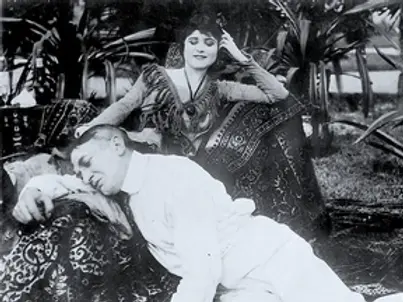
Theda Bara and Edward José in Frank Powell's A Fool There Was (1915)
A major player in the 1920s
The end of the Great War in 1918 saw an expansion as the European market opened up once more. While in Europe on business, Fox general manager Winfield Sheehan set up Fox Newsreels to send news from around the world to America, and they quickly became an integral part of a theatre’s program.
In 1919, Fox announced it was to construct a $2,500,000 studio in New York that would occupy an entire city block. As competition intensified in the 1920s, Fox cut costs to such a degree that critics and reviewers noticed and complained. The reviewer of an Excel brand film called Molly and I remarked: “When the director serving the Fox picture interests will desist in working on an economic schedule that robs them of achieving results they might otherwise secure by the expenditure of a little more money, only then can these features hope to line up alongside other concerns in competitive bidding.” Fox executives also became so committed to maintaining the rigorous release schedule that quality inevitably suffered. Soon, only the films of Tom Mix, the studio’s major attraction, had sustained box-office appeal.
However, Fox had a keen enough sense of market influence and shifting customer tastes to keep the studio at the forefront of the industry throughout the first half of the 1920s. It was during this period of sustained growth and fierce competition that the companies that would become the titans of the business—Warner Brothers, Metro Pictures/MGM, Universal, Paramount—consolidated their positions and secured their futures.
One thing these successful companies had in common was that they owned theatre chains, which naturally showed their parent companies’ products. Realising this put him at a competitive disadvantage, Fox began acquiring a chain using capital from the sale of stock in the company to the public in 1925. After a year of acquisitions, he had built a chain of 800 theatres, the flagship of which was the world’s largest: the massive 6,000-seat Roxy in New York. Despite the exorbitant cost of running such a movie palace, Motion Picture News reported that the Roxy quickly became ‘without doubt the world’s most successful theatre enterprise.’
Forever seeking an advantage over his rivals, Fox next became enamoured of the prospect of talking pictures. In July 1926, he formed the Fox-Case Corporation with the inventor Theodore Case, to whom he gave $1 million for filming with sound outdoors. They called the system Movietone. On 21st January 1927, Fox debuted Movietone Newsreels, which added synchronised sound to news footage, at the Sam H. Harris Theatre on Broadway. It aroused only mild interest among the public, but placed Fox in a strong position to cope with the coming transition to talking pictures.
1927 also saw Fox release F. W. Murnau’s Sunrise (1927), an artistic landmark in the history of the silent cinema, and a determined effort by the mogul to elevate the motion picture to high art. Fox allowed for a budget of $750,000—a not insubstantial amount for 1927—but the final cost was closer to $1.2 million. Today, Sunrise is considered one of the finest pictures ever made, but while 1927’s critics universally praised Murnau’s tragic tale of doomed love, they questioned its commercial potential. They were right to do so: financially, the film was a disaster.
Despite this setback, Fox prospered throughout 1928, and his thoughts turned to expanding his empire following the death of Marcus Loew on September 5th 1927. Neither Loew’s widow nor his sons wished to run Loew’s theatre chain, or MGM, which was a wholly owned subsidiary of Loew’s, leaving the way clear for a takeover. Negotiations continued throughout 1928, and in early 1929 a deal was struck under which Fox would purchase the Loew family’s entire holdings for $50 million. To finance the deal, he had to borrow $15 million, repayment of which would be due in twelve months. A further loan of $12 million also had to be repaid just two months after the first. Fox wasn’t worried by the narrow window for repayment—although the numbers had never been so large, he had frequently financed his ventures that way. He planned to finance the repayment by selling new stock in his company. So, on 2nd March 1929, Fox became the majority shareholder of Loew’s Inc., and arguably the most powerful man in Hollywood.
Downfall
A change of key government personnel in 1929 signalled the beginning of Fox’s downfall. Before acquiring his interest in Loew’s, Fox had ensured he was not violating any antitrust laws with government officials. Without such assurances, he would be unable to secure the long-term loans he required to pay back the money he had borrowed to finance the deal. However, once the deal was complete, William D. Mitchell, the new Attorney General, insisted that Fox had received no assurance that he wasn’t in violation of antitrust laws. John Lord O’Brian, the assistant D.A. in charge of antitrust, then told Fox that records showed the government had warned him against going ahead with the deal.
Fate then conspired to worsen his situation considerably. On 17th July 1929, the car in which he was travelling to meet with Adolph Zukor at the Lake View Country Club in Long Island collided with another vehicle. Fox’s chauffeur died, and Fox was seriously injured. He remained in hospital for ten days, and it was three months before he was well enough to return to his New York office.
On October 24th, 1929, he attended a banquet at which Secretary of Commerce Robert P. Lamont gave a speech offering a grim warning about the nation’s economy that so alarmed Fox he ordered his brokers to sell all of his shares in businesses other than his own. Five days later, on October 29th, the market crashed, and the value of the stocks Fox had sold for $20 million the previous week plummeted to $6 million. However, even this fortuitous move would not be enough to save him: the value of his shares in Loew’s plummeted to less than half the price he paid for them, and Fox Corporation shares fell from a high of $119 to just $1. Then the killer blow: the government moved to dissolve Fox’s ownership of Loew’s Inc. due to violation of antitrust laws.
When Fox was unable to repay the loans he had taken out to finance the acquisition of Loew’s, creditors began receivership actions against his companies, and in March 1930, he sold his interests to a group of bankers for $18 million. Although the corporation retained his name, Fox no longer played any part in its management.
Fox lost most of the $18 million on the failing stock market. In 1932, a Senate committee investigation accused him of deliberately trying to destroy his own companies and of tax evasion, and The Fox Film Corporation began legal proceedings against its former owner. The cost of defending these charges stripped Fox of what remained of his fortune, and in October 1936 he filed for bankruptcy.
Five years later, with his fortune gone and his health failing, Fox was charged with conspiracy to obstruct the course of justice by attempting to bribe a judge during his bankruptcy hearing. He was sentenced to one year’s imprisonment and a fine of $3,000. He was released on parole in May 1943 after serving six months in the Northeastern Penitentiary in Lewisburg, Pennsylvania.
Eventually, Fox paid off his debts and emerged from bankruptcy. Revenue from various patents and projects from his time in the film business enabled him and his wife to live comfortably, although the comeback of which he often spoke never materialised.
He considered his misfortune to be the consequence of betrayal by others: Winfield Sheehan, who he believed sided with men he considered his enemies; financiers like Harold Stuart, John Otterson and Harley Clarke, whom he suspected refused him help when he needed it because he was a Jew. Perhaps he was right, but Fox was a remote, somewhat flinty individual, considered by many to be the most amoral of that peculiar breed of ambitious men who rose to the top of the early film industry.
Fox received a full and unconditional pardon from President Truman in 1947. Four years later, he suffered a serious stroke. He died at Doctor’s Hospital in Manhattan on 8th May 1952 at the age of seventy-three.
Importance and legacy
The company Fox founded remains a major force in the film industry today, more than a century after its inception. By defying the Motion Picture Patents Company, he helped lay the foundations for the Hollywood studio system and played a key part in the transition from silent movies to talking pictures.
Sources: The Man Who Made the Movies, Vanda Krefft; The Fox Film Corporation 1915-1935, Aubrey Solomon; The Moguls: Hollywood’s Merchants of Myth, Norman J. Zierold.
William Fox Filmography
(selected titles)
Life’s Shop Window (1914); The End of the Bridge (1914); The Idler (1914).
A Fool There Was (1915); Kreuzer Sonata (1915); The Nigger (1915); From the Valley of the Missing (1915); The Plunder (1915); The Devil’s Daughter (1915); The Regeneration (1915); The Galley Slave (1915); Destruction (1915).
The Serpent (1916); East Lynne (1916); The Beast (1916); A Daughter of the Gods (1916).
A Modern Cinderella (1917); The Scarlet Letter (1917); The Silent Lie (1917); Jack and the Beanstalk (1917); The Scarlet Pimpernel (1917); The Babes in the Woods (1917); Madame Du Barry (1917).
Six Shooter Andy (1918); The Woman and the Law (1918); The Kid is Clever (1918); Salome (1918); The Prussian Cur (1918); Queen of the Sea (1918); Fame and Fortune (1918); Ali Baba and the Forty Thieves (1918).