Hollywood Timeline: 1878 - 1909
Hollywood was not established as a filmmaking community until the 1910s. This section of the Story of the Movies Hollywood Timeline charts the key incidents, developments and milestones in the American film industry from 1878 to 1909 that laid its foundations.
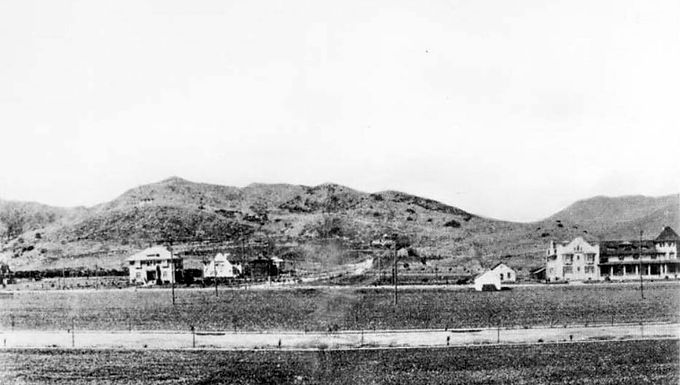
Hollywood at the turn of the 20th century
Date | Event |
June 1878 |  English photographer Eadweard Muybridge captures a series of images for American railroad tycoon Leland Stanford to settle a wager over whether all four of a galloping horse’s hooves leave the ground at the same time. |
1880 | George Eastman starts manufacturing photographic dry plates. |
1884 | George Eastman secures a patent for a transparent paper-backed photographic film. |
| |
1887 | |
1st February | Harvey Wilcox submits a detailed subdivision map to the County Recorder for 170 acres of land purchased in 1883, which he and his wife have christened ‘Hollywood.’ |
|
|
2nd May | Episcopalian minister Hannibal Goodwin develops the use of celluloid as a base for photographic emulsion. |
|
|
1888 |
|
November | John Carbutt presents his invention – celluloid – to the Photographic Society of Philadelphia and the Franklin Institute. |
|  Thomas Edison commissions his employee William Kennedy Laurie Dickson to invent a motion picture camera to serve as a visual accompaniment to the Phonograph |
1889 | |
George Eastman manufactures rolls of celluloid film. | |
1891 | |
20th May | Edison demonstrates a prototype Kinetoscope, a peephole viewing device created by W. K. L. Dickson, to members of the National Federation of Women’s Clubs. |
24th August | Edison applies for patents for his Kinetoscope and Kinetograph, but neglects to apply for patents outside of the US. |
1893 |
|
February | Construction of Edison’s ‘Black Maria’ studio is completed at West Orange, New Jersey. |
April | Blacksmith Scene is filmed at Edison’s ‘Black Maria’ studio. |
9th May | Blacksmith Scene receives its first public screening at the Brooklyn Institute of Arts & Sciences. |
6th October | W. K. L. Dickson deposits the first films made at the ‘Black Maria’ with the Library of Congress. |
|
|
1894 |
|
7th January | Edison Kinetoscopic Record of a Sneeze (aka Fred Ott’s Sneeze) is filmed. |
9th January | Each frame of Edison Kinetoscope Record of a Sneeze is copyrighted as a photograph at the US Library of Congress |
5th February | Jean Aimé Leroy claims to have projected two Kinetoscope films to a paying audience in New York |
6th April | The first Kinetoscopes are shipped from Edison’s laboratory to the Holland Brothers Kinetoscope Parlor at 1155 Broadway in New York |
14th April | The Holland Brothers’ Kinetoscope Parlor opens for business. |
17th May | The Holland Brothers open a second Kinetoscope Parlor in Chicago. |
14th June | W. K. L. Dickson films a boxing match between Michael Leonard and Jack Cushing for Gray and Otway Latham. |
17th July | Edison’s Kinetoscope film of Carmencita performing the Serpentine dance is banned in Newark, New Jersey. |
August | The Latham’s Kinetoscope Exhibition Co. opens its first Kinetoscope Parlour in New York. Six expanded Kinetoscopes each show one round of the six-round fight filmed by W. K. L. Dickson in June. |
7th September | A staged fight between Jim Corbett and Pete Courtney is filmed. |
21st November | Herman Casler patents the Mutoscope. |
|
|
1895 |
|
26th March | Charles Francis Jenkins files a patent for the Phantoscope projector. |
2nd April | W. K. L. Dickson resigns from his position with Thomas Edison. |
18th December | Charles Francis Jenkins demonstrates his Phantoscope projector to the Franklin Institute. |
30th December | The American Mutoscope Company, which will eventually become one of early American cinema’s most successful studios, is formed. |
1896 |
|
|  Following the Lumière brothers’ successful projection of motion pictures in Paris on 28th December 1895, Edison buys the patent to Thomas Armat’s modified version of the Phantoscope projector and markets it as the Vitascope. |
15th January | Businessmen Norman C. Raff and Frank R. Gammon negotiate with Edison to construct Thomas Armat’s Phantoscope projector. |
9th April 1896 | Colonel William N. Selig founds the Multoscope and Film Co. (later to become Selig Polyscope) in Chicago. |
April 23rd 1896 | The first public demonstration of projected movies using Edison’s Vitascope is staged at Koster & Bial’s Music Hall in New York City. |
11th May | The Lathams unveil their new, improved Eidoloscope. |
15th June | Edison’s The Kiss, a re-enactment of a scene from John McNally’s hit stage play starring May Irwin and John C. Rice is released. |
26th July | William T ‘Pop’ Rock and Walter J. Wainwright open the 400-seat Vitascope Hall, the USA’s first business exclusively devoted to projecting films, at 623 Canal Street in New Orleans. |
14th September | American Mutoscope demonstrate their Biograph to an audience for the first time at the Alvin Theater in Pittsburgh. |
19th October | Edisonia Hall, the first building constructed specifically for projecting motion pictures, opens in Buffalo, New York. |
|
|
1897 |
|
March | J. Stuart Blackton and Albert E. Smith found the American Vitagraph Company. |
May | Enoch J. Rector’s The Corbett-Fitzsimmons Fight is released. Filmed in an early widescreen format called Veriscope, it runs for over 100 minutes, making it the world’s first feature-length film. |
15th May | Siegmund Lubin’s first film, Unveiling of the Washington Monument is released for peep-show exhibition. |
May | The Burglar on the Roof, Vitagraph’s first fiction film, is filmed. There is some doubt over co-founder Albert E. Smith’s claim it was the first film shot by Vitagraph as it was not released until 1898. |
24th July | The Dingley Bill, which will result in a US embargo on the Lumieres’ Cinematograph, is passed. |
5th August | Admiral Cigarettes, the first filmed advertisement, is lodged for copyright at the Library of Congress. |
31st August | The patent is finally issued for Edison’s Kinetoscope. |
22nd November | The Horitz Passion Play premieres at the Philadelphia Academy of Music. |
| American Mutoscope’s The Haverstraw Tunnel, the first ‘Phantom Ride’ film, is released. |
|
|
1898 | |
15th February | The sinking of the USS Maine and the ensuing Spanish-American War revive flagging interest in cinema as filmmakers film re-enactments of key incidents in response to anti-Spanish sentiment aroused by the yellow press. |
April | American Mutoscope cameraman W. K. L. Dickson films Pope Leo XIII in the Vatican. |
| Edison brings legal proceedings against Vitagraph and American Mutoscope in an attempt to secure a monopoly over the film industry. |
|
|
1899 |
|
3rd November | The World Heavyweight Championship bout between James J. Jeffries and Tom Sharkey marks the first fight to be filmed under artificial light. Although American Mutoscope have the contract, Vitagraph also covertly film the match. |
| Siegmund Lubin opens his first theatre, the Cineograph, in Philadelphia |
|
|
|
|
1900 |
|
May | American Mutoscope release Sherlock Holmes Baffled, the earliest known screen appearance of Arthur Conan Doyle’s famous detective. |
November | Edwin S. Porter joins the Edison Manufacturing Company and is soon put in charge of motion picture production |
| William Selig makes Chicago Stockyards for meat packing magnate Philip Danforth Armour using stage lights borrowed from a local theatrical company. |
|
|
|
|
1901 |
|
10th January | |
January | Production of films at Edison’s ‘Black Maria’ stops after the company acquires a glass-roofed studio in New York. |
February - March | Vaudeville managers turn to filmmakers to provide entertainment when the White Rats, the theatrical performers union, organise a strike of their members. |
15th July | Thomas Edison wins his legal battle with American Mutoscope over patent infringements. Henry Marvin of American Mutoscope immediately appeals Judge Hoyt Henry Wheeler’s ruling and later wins an injunction. |
| Siegmund Lubin moves his motion picture manufacturing operation to Germany following Edison’s legal victory over American Mutoscope, fearing he is next in the firing line. |
|
|
|
|
1902 |
|
10th March | In the case of Edison v American Mutoscope Company, the US Court of Appeal rules that Edison’s Kinetograph patent does not give him control of all motion picture technology. |
16th April | Thomas Lincoln Tally opens the Electric Theater, the first permanent movie theatre, in Los Angeles (some sources cite 2nd April). |
| Henry Miles opens the first film exchange, renting prints to exhibitors instead of selling them outright. |
|  Edwin S. Porter films Life of an American Fireman. He is inspired to experiment with creating a continuous narrative after seeing Georges Méliès Le voyage dans la Lune, which Edison duped in October 1902. |
|
|
1903 |
|
January | Edwin S. Porter’s Life of an American Fireman is released. |
January | Edison release Electrocuting an Elephant, footage of the electrocution of Topsy, a circus elephant in her twenties. |
January | Gaston Melies opens a US distribution office and printing laboratory for brother Georges’ Star Films at 204 East 38th Street in New York with the aid of his son Paul. |
February | Hungarian immigrant furrier Adolph Zukor opens a penny arcade called 'The Bazaar' in New York. |
April | The US Court of Appeal for the Third Circuit rules that filmmakers can copyright complete films instead of separately registering each frame. |
May | The American Mutoscope & Biograph studios, the first in the country to use artificial light, go into full operation at 11 East 14th Street in New York. |
May | Siegmund Lubin appears in his version of Uncle Tom’s Cabin and opens his first film exchange. |
22nd August | Gaston Melies releases his first production, Reliance: Shamrock III |
21st September | The first two known Westerns – Kit Carson and The Pioneers – are copyrighted. |
September | Edwin S. Porter’s Uncle Tom’s Cabin is released. |
September | American Mutoscope & Biograph switches to the industry standard 35mm film gauge and introduces a three-blade shutter that greatly enhances projection quality. |
November | Marcus Loew opens a number of penny arcades in New York and Cincinatti. |
November | American Mutoscope & Biograph’s The Escaped Lunatic is the first US film to be structured around a chase. |
December | Edwin S. Porter’s The Great Train Robbery is released. |
| The four Warner brothers open an arcade called the Cascade in Pittsburgh. |
| Harry Chandler and Moses Sherman buy Harvey Wilcox’s Hollywood real estate development for $3 million. |
| The film rental business expands, with the pioneering Miles Brothers facing competition from the likes of Percival Waters’ Kinetograph Co. in New York, Eugene Cline & Co. and George Kleine in Chicago. |
| Adolph Zukor and Marcus Loew enter into a partnership with Mitchell Mark, owner of a chain of movie theatres, to form the Automatic Vaudeville Company. |
| Edison’s Black Maria studio is demolished.Edison’s Black Maria studio is demolished. |
|
|
|
|
1904 |
|
13th January | Photographing a Female Crook, Wallace McCutcheon Sr.’s 40-second film for American Mutoscope & Biograph, features a shot that tracks into a close-up. |
May |  George Hale of the Kansas City Fire Brigade introduces ‘Hale’s Touring Car,’ a new novelty, at the St. Louis Fair. Sitting in a mock-up of a train carriage, the audience watches the passing scenery of locations from around the world. |
10th July | Oskar Messter shoots films with a synchronised soundtrack at the St. Louis Olympics. |
August | American Mutoscope & Biograph’s The Moonshiner is one of the first films to make consistent use of intertitles. |
14th November | Marcus Loew founds the People’s Vaudeville Company. |
| Eugene Lauste builds a sound-on-film system using separate films for picture and sound. |
| Filmmakers start moving away from shooting entirely from eye-level and start filming from an angle. |
| Siegmund Lubin unsuccessfully attempts to market sound movies |
| William Fox purchases a Brooklyn penny arcade called The Automat from J. Stuart Blackton,. |
|
|
1905 |
|
1st June | Adolph Zukor opens a ‘Hale’s Tour’ show in Union Square, New York. |
19th June |  Harry Davis and John P. Harris open the first nickelodeon on Smithfield Street in Pittsburgh. The first film shown at the 96-seat storefront theatre is The Great Train Robbery. By May 1907 there are an estimated 2,500-3,500 nickelodeons in the United States. |
16th December | Sime Silverman publishes the first 16-page issue of the trade entertainment paper Variety. |
| Adolph Zukor and Marcus Loew form Loew's consolidated theatre chain. |
| Edison cause disruption at American Mutoscope & Biograph by luring away some of their most creative talent. American Mutoscope & Biograph also lose their contract for the Keith Vaudeville Circuit to the Kinetograph Film Exchange, a company with links to Edison. |
| Vitagraph begin renting films to exchanges instead of selling them and commits to making story films. |
| Massachusetts introduces a law setting safety standards in motion picture theatres. |
| American Mutoscope & Biograph become the first studio to use Peter Cooper-Hewitt's mercury lamps to enable filming indoors. The 4ft tubular lamps emit a distinctive blue-green colour. |
|
|
|
|
1906 |
|
24th February | Carl Laemmle opens the White Front Theater, “the coolest 5c theatre in Chicago,” at 909 Milwaukee Avenue. |
6th April | J. Stuart Blackton’s stop-motion animation Humorous Phases of Funny Faces is released. |
26th April | Views and Film Index, the first trade paper devoted solely to the film business, is published for the first time. |
May (approx) | William Fox dispenses with the arcade attractions at 700 Broadway, Brooklyn and focuses exclusively on projecting moving pictures. |
June | American Mutoscope & Biograph construct a new film stage at their East 14th Street studio. |
23rd July | Harry E. Aitken and John R. Freuler found the Western Film Exchange in Milwaukee for the purpose of renting movies to theatres. It becomes the centre of the exchange industry with fifteen exchanges controlling 80% of the US film rental business. |
October | Carl Laemmle opens the Laemmle Film Exchange. |
November | Vitagraph opens its new film studio in Greenfield (now Midwood), Brooklyn. |
| Nickelodeons spread rapidly across the country. |
| The Keith Organization vaudeville circuit begins converting some of its vaudeville theatres into nickelodeons. |
| Edison’s projectors enjoy a 131% increase in sales over the previous year. At $135 each, they generate sales of over $182,000. |
| A shortage of American-made films due to the boom in nickelodeons allows foreign producers like Pathé to increase their sales to the US market. |
| Florence Turner starts work as a wardrobe mistress and occasional extra. She will become famous as The Vitagraph Girl. |
|
|
|
|
1907 |
|
19th January | Variety publishes it’s first film review. |
February |  George K. Spoor and Gilbert M. “Broncho Billy” Anderson form the Essanay Co. Its named is derived from the men’s initials – S & A. The new studio is based at 501 Wells St., Chicago, and its first picture is entitled An Awful Skate or The Hobo on Rollers. |
March | Daniel H. Bell and Albert S Howell form The Bell & Howell Co., America’s first manufacturer of cameras and lenses, in Chicago. Their first product is the Kinedrome projector. |
12th April | George Kleine, Samuel Long and Frank Marion form the Kalem Company. Their first film is The Runaway Sleighbelle. |
July | Edison’s film production moves from New York to a purpose-built studio in the Bronx. |
October | Jeremiah Kennedy, a consultant engineer, assumes the position of director of American Mutoscope & Biograph. He lays off many of the studio’s staff in an attempt to ease its financial difficulties. |
November | Chicago passes America’s first local censorship ordinance “prohibiting the exhibition of obscene and immoral pictures commonly shown in Mutoscopes, Kinetoscopes, Cinematographs and penny arcades.” |
7th December | Kalem’s Ben Hur, directed by Sidney Olcott, is released |
| E. E. Norton develops a sound film system. |
| After they are refused membership to the Variety Artists Federation, film projectionists form their own trade union, The Bioscope Operator’s Association. |
| The Selig Polyscope Co. makes the first westerns actually filmed in the real west. |
| The Saturday Evening Post reports that nickelodeon attendance has reached 2 million people a day. |
| Louis B. Mayer buys his first nickelodeon. |
| William Fox founds the Greater New York Film Exchange. |
| Siegmund Lubin moves his studio to ‘Lubin Building’ in the centre of Philadelphia’s business district. |
| Edison projector sales reach $481,000, a 130% increase over the previous year. |
| D. W. Griffith enters the film industry as an actor for the Edison Co at a wage of $5 per day. |
| Vitagraph become the major American movie producer and organises film production by assigning responsibility for all aspects of the making of the film to a director. |
| The Warner Brothers open the Duquesne Amusement Supply Company, a film exchange, in Pittsburgh. |
|
|
|
|
1908 |
|
5th February | Henry Marvin, Vice President of American Mutoscope & Biograph, buys the patent to the Latham Loop. |
20th February | Five days after replacing William E. Gilmore as Edison’s Vice President, Frank L Dyer, the inventor’s lawyer and biographer, imposes a $5,000 annual license fee on film distributors. |
1st March | Edison forms the Association of Edison Licensees to regulate film distribution. Biograph refuse to join. |
5th May | |
6th May | Mack Sennett makes his first screen appearance (alongside D. W. Griffith) in Wallace McCutcheon’s The Sculptor’s Nightmare for American Mutoscope & Biograph. |
May | The National Cameraphone company opens a factory and studio in New York for synchronised sound apparatus. |
14th July | D. W. Griffith directs his wife Linda Arvidsen in Adventures of Dollie, his directorial debut. The film opens on this day at the Union Square Theatre in New York. |
July | Gilbert M. "Broncho Billy" Anderson takes an Essanay unit to Colorado to film westerns. |
17th August | D. W. Griffith becomes American Mutoscope & Biograph’s chief director at a salary of $50 per week following the departure of Wallace McCutcheon Sr.. |
9th September | The Motion Picture Patents Company, a Cartel formed to end the legal battles that have plagued the industry since its birth, is incorporated under the laws of the State of Maine. Membership comprises of American Mutoscope & Biograph, Vitagraph, Selig, Kalem, Essanay, Lubin, George Kleine, Pathé and Méliès. Its intention is to prevent any organisations outside the MPPC from producing or selling films in the US without making a payment to the Trust. |
19th September | David Horsley’s Centaur Film Company of Bayonne releases A Cowboy Escapade, it’s first film. |
Winter | A unit from the Kalem Company temporarily relocates to Florida to escape the poor light of the New York winter. Its first film, A Florida Feud or Love in the Everglades is released in December. |
18th December | The MPPC begins issuing licenses under the pooled patents arrangement. |
24th December | New York Mayor George McClellan authorises the inspection and subsequent closure of all the approximately 500 nickelodeons operating in the city to assess safety standards. An injunction granted by Judge Gaynor allows them to re-open immediately. |
| Edison resumes research into sound films. |
| Carl Laemmle imports the Synchroscope sound film system from Germany to sell to theatres. Its price quickly falls from $750 to as little as $395 due to poor sales. |
| The Balaban Brothers, Barney and AJ, open the 100-seat Kedzie nickelodeon in Chicago. |
| Kodak agrees to only sell film stock to MPPC members. |
| In this year there are an estimated 8,000 nickelodeons in the country. |
| D. W. Griffith hires Florence Lawrence to be his leading lady at $25 a week. |
| The Motion Picture Machine Operators Union is formed. |
| Eastman-Kodak introduces acetate film. |
|
|
|
|
1909 |
|
January | Trade paper The Nickelodeon is first published. It will be retitled Motography in 1911. |
8th February | D. W. Griffith directs his wife, Linda Arvidsen, in Edgar Allan Poe, which is released today. |
12th March |  Cinema owner and distributor Carl Laemmle and director William Rainous form Independent Motion Pictures, a breakaway company from Vitagraph, in response to the MPPC restrictions, and adopt an imp as their emblem. |
20th March | Independent filmmakers excluded from Edison’s Motion Pictures Patents Company form a rival cartel. |
25th March | The National Board of Censorship, established by the People’s Institute and Dr. Charles Sprague Smith in New York, holds its first meeting. |
14th April | Distributors Adam Kessel and Charles Baumann found Bison Life Films in New York. Their first film is Disinherited Son’s Loyalty is released in May. |
April | Former scrap metal dealer Louis B. Mayer and Nat Gordon found the Gordon-Mayer cinema circuit. |
5th June | Carl Laemmle announces he is to produce films in reaction to the formation of – and his exclusion from – the MPPC. Originally named Yankee, he quickly changes his new production company’s name to the Independent Moving Picture Company of America (IMP). |
10th June | Three days after the release of her screen debut The Violin Maker of Cremona, Mary Pickford again appears for D. W. Griffith in The Lonely Villa. |
15th June | Independent filmmakers reach a secret agreement with Eastman-Kodak for supplies of safety film. |
29th July | The Heart of a Race Tout, the first film to be shot at Selig Polyscope’s new studio on the site of a Chinese laundry at 7th Street in downtown Los Angeles, is released. |
1st August | Edwin S. Porter resigns as head of Edison, after reaching a production output of one 15-minute film every three days, to found Rex Motion Pictures with William H. Swanson. |
8th September | G. M. Anderson, accompanied by cameraman Jesse Robbins, moves his Essanay film company west, finally settling in Niles, California. |
11th September | The Film Renters Protective Association is established to combat the threat of the MPPC. |
18th September | Vitagraph release the first reel of their four-reel version of Les Miserables, believing the public will not watch a film lasting over an hour. |
10th October | D. W. Griffith’s Pippa Passes, starring Mary Pickford, becomes the first film to receive a notice in the New York Times due to its technical innovations. |
October | Powers Picture Company is founded. |
25th November | The first film censorship action on a local scale is taken in the US. |
November | Actors working for theatrical producers Klaw and Erlanger are forbidden from appearing in films. |
November | The New York Motion Picture Company begins production in California. |
4th December | Vitagraph release the first part of their five-reel The Life of Moses. |
11th December | Kinemacolor is exhibited for the first time at Madison Square Garden in New York. |
| American Mutoscope & Biograph changes its name to American Biograph Company. |
| Champion Film Company build a studio in the rural area of Coytesville, New Jersey to avoid the attention of Edison’s MPPC. |
| Siegmund Lubin sells his chain of theatres to form the Lubin Manufacturing Company and begins building a new studio in North Philadelphia. |
