An Unseen Enemy (1912)
released 9th September 1912
Cast:

Lillian Gish

Dorothy Gish

Elmer Booth

Robert Harron

Harry Carey

Grace Henderson

"An Exciting Biograph Drama of a Dishonest Servant and Two Helpless Girls at her Mercy"
Lillian Gish already had much in common with fellow actress Gladys Smith when they met as nine-year-olds. They both acted to support their families following the death of alcoholic fathers, and each travelled extensively with different theatrical companies. Their families even lodged together in an apartment on 8th Avenue and 39th Street in Manhattan during the off-season summer months. It was Gladys who helped Lillian and her younger sister, Dorothy, get into movies by introducing them in 1912 to the director D.W. Griffith. By then, she had changed her name to Mary Pickford and was fast on her way to becoming the world’s biggest movie star. It wasn’t long before Lillian Gish followed in her wake…
In his memoir, Griffith recalled, “One day in the early summer of 1909 I was going through the dingy old hall of the Biograph studio when suddenly all the gloom seemed to disappear. The change was caused by the presence of two young girls sitting side by side on a hall bench. They were blonde and fair and sitting affectionately close together. Certainly, I had never seen a prettier picture... Of the two, Lillian shone with an exquisitely fragile, ethereal beauty... As for Dorothy, she was lovely too, but in another manner—pert, saucy, the old mischief popping out of her. Yet, she had a certain tender charm.”
Like Pickford, the sisters were required to audition for their place in Griffith’s stock company. In the Biograph studio in New York, he guided them upstairs and described a scene in which they played two girls terrified by burglars. Unhappy with their interpretation of his instructions, Griffith produced a gun from his pocket and fired blanks at the ceiling. The terrified girls, just eighteen and fourteen years old, clutched each other and screamed with renewed vigour. Griffith smiled, tucking away his gun, and said, “That will make a wonderful scene. You have expressive bodies. I can use you. Do you want to work for me?”

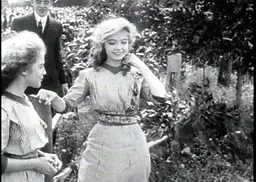
Dorothy Gish and Lillian Gish in D. W. Griffith's An Unseen Enemy (1912)
The scene they rehearsed appeared in An Unseen Enemy, their first film for the director. It was a loose remake of The Lonely Villa, an adaptation of a French play, Au Téléphone, by André de Lorde that Pickford made for Griffith in 1909. They play sisters grieving the loss of their father, whose brother (Elmer Booth) sells part of their estate to relieve their financial worries. However, he can’t bank the proceeds from the sale until the following day and so secures them in a safe in the house before leaving for his office. The family’s ‘slattern maid’ (Grace Henderson) locks the two girls in a room and phones an accomplice (Harry Carey) to crack it open. While he works on the safe, the maid terrorises the girls by pointing a gun into the room through a disused stovepipe cutout in the wall. She can’t see through the hole to aim the gun but uses it to deter the sisters from calling for help on the telephone.
Griffith considered Lillian Gish his ideal heroine, more perfect even than Mary Pickford, with whom he had a difficult relationship. In the film’s early scenes, there is a calm serenity about Lillian even as she grieves. Dorothy’s less contained performance reflects the sisters’ real-life differing personalities. The two often move in unison, holding hands, as if they are two sides of the same person. While Lillian initially appears dominant, Dorothy shows greater courage under pressure. It is she who braves the gun to call for help, setting in motion an expertly edited race against time.
Both sisters give convincing debut performances. In the film’s calmer moments, their acting is very much in the Griffith style of understated naturalism, and they don’t overplay the more dramatic scenes. Carey, another recent recruit to the company, would win fame as a western hero in the silent era. Here, he is unrecognisable behind heavy stubble and makes a persuasively menacing villain.
Moving Picture World praised the movie, but not without reservations, opining that “the little girls are charming; they are not yet actresses, but in a good place to learn acting. The photography in many scenes is not up to standard.” While An Unseen Enemy may not be one of Griffith’s greatest works, it’s undeserving of such harsh judgment, especially regarding both Gish sister’s performances.
Sources: D. W. Griffith: An American Life, Richard Schickel; The Man Who Invented Hollywood, D. W. Griffith; The Movies, Mr. Griffith and Me, Lillian Gish.