The Cheat (1915)
released 13th December 1915
Cast:

Sessue Hayakawa
Jack Dean

Fannie Ward

James Neill

Yutaka Abe

Dana Ong
The Cheat (1915)
Drama
59m
Jesse L. Lasky Feature Play Company
Director:
Writer:
Hector Turnbull, Jeanie Macpherson

"Fannie Ward, the star, will, in this picture, take her place as one of the few great emotional actresses of the screen"
Upon completing Carmen (1915), Cecil B. DeMille rattled off the comedy Chimmie Fadden Out West, starring Victor Moore. It was a sequel to Chimmie Fadden, in which Moore played a Bowery hoodlum, finding favour with critics and audiences alike. Out West was just as successful as its predecessor, recording a 250 per cent profit.
By now, the thirty-four-year-old producer and director was indispensable to Jesse L. Lasky and his Feature Play company. DeMille’s prolific output and the consistent quality of his work had not gone unnoticed. In March 1915, Moving Picture World, in a special feature, reported, “such a series of extraordinary hits, all produced within a brief period of time, stamps Mr. De Mille as the foremost photo-dramatic producer in the world.” It was to DeMille that Lasky turned in the autumn of 1915, when the company was suffering a shortage of releasable films. Lasky was feeling the pressure of competing with Harry Aitken’s newly formed Triangle company, which had attracted the services of the prestigious triumvirate of D. W. Griffith, Thomas H. Ince and Mack Sennett.
Lasky had two properties he wanted made into pictures by the end of 1915. His other directors, George Melford and Frank Reicher, were already working flat out, so in a meeting with Lasky in October 1915, DeMille agreed to make two pictures at the same time. According to DeMille, his brother William described his decision as “something which no other director, even partially sane, would have attempted.” DeMille saw it as an ideal way to quiet the complaints the studio’s other directors were making about being overworked.
He began shooting The Cheat on 20th October 1915 and The Golden Chance on 26th October. Hector Turnbull, a former critic for the New York Tribune, who joined his sister Margaret as a writer, at Lasky in May 1915, wrote The Cheat, with regular DeMille collaborator Jeanie Macpherson adding the finishing touches. Scott Eyman, in his biography, Cecil B. DeMille: Empire of Dreams, suggests the director was unsure of Turnbull’s ability to deliver: “When Hector talked to me about that I was a little leery of it at that time—whether he could do it.” The studio felt that Turnbull’s first piece,Temptation, which he wrote for Geraldine Farrar, was weak enough to delay releasing until after Carmen. Perhaps the fact that Lasky had offered his staff writers $250 for original stories to avoid the high cost of buying the rights to a dwindling supply of plays, inspired Turnbull to turn in a scenario that DeMille later considered far superior to Temptation, and “a landmark in the development of the cinema.” A real-life incident in which a married white woman named Mabel Smith was found not guilty of shooting her Japanese lover to death on the grounds of self-defence may have provided the source for Turnbull’s plot.
For his leading lady, DeMille chose Fannie Ward, a star of the stage since 1890, who, at forty-three, was renowned for her youthful appearance as much as her acting. Everyone called her the “Wonder Girl”, and Geraldine Farrar recalled her as “dainty and petite, with a laughing face framed in auburn curls, she carried the inevitable parasol to shade her baby-like complexion, which she candidly confessed ‘took hours to fix up.’” In fact, Ward injected paraffin into her cheeks to keep them tight and smooth and had to apply ice packs to prevent her jowls from sagging under the heat from the studio lights.
In 1915, white actors usually played Oriental roles with their eyelids pinned back, but DeMille took the unusual step of awarding the inflammatory role of ivory trader Hishiru Tori to Japanese actor Sessue Hayakawa. Born into a wealthy family in Chiba Prefecture, the 21-year-old Hayakawa moved to America in 1907 to study at the University of Chicago. After leaving university, he appeared in theatrical dramas staged for Japanese immigrants while working in menial jobs. Thomas Ince saw him at one of these performances and signed him for the New York Motion Picture Company. His performances of The Wrath of the Gods (1914) and The Typhoon (1914) brought him to Jesse Lasky’s attention. The Cheat was to be Hayakawa’s second film for Lasky.
The part of Ward’s screen husband went to Jack Dean, the man who, a year later, would become her real-life husband, and to whom she would be married until his death in 1950. They met while appearing in the stage play Madame President and appeared in several films together over the next three years.
With the cast assembled, shooting of The Cheat began on 20th October 1915; work on The Golden Chance started on the 26th, with production overlapping for at least two weeks. During this time, DeMille directed The Cheat from 9am to 5pm. Then, after eating dinner at his office desk and resting until 8pm he would work on The Golden Chance for six hours, until 2am. He would usually sleep in his office between shifts, only occasionally going home to his wife, Constance. He completed filming The Cheat on 10th November 1915, at a budget of $17,311.29.
The film’s plot revolves around Edith Hardy (Fannie Ward), the wife of stockbroker Richard (Jack Dean). Edith has a taste for the finer things in life, so when a friend gives her a tip for a copper company, she invests $10,000 from a Red Cross fund entrusted to her in her role as treasurer. The company collapses, and a panicked Edith appeals to the Japanese ivory trader Hishuru Tori (Sessue Hayakawa), a casual acquaintance and admirer, for help, agreeing to spend a night with him in return. Richard, however, informs his wife that his investments have capitalised, and she persuades him to give her the $10,000 she needs to repay Tori. The enraged Tori refuses to accept the money and brands her with an iron. Edith escapes after shooting her attacker, but Richard is charged with Tori’s murder…
The Cheat drew enormous crowds, earning the film $137,364 at the box office. Much of this was thanks to Hayakawa’s playing of the villain, which tapped into widespread hostility towards the Japanese in early 20th Century America. Japanese immigrants were often portrayed as the “yellow peril”, taking white workers’ jobs. The situation was particularly bad in the west of the country; in San Francisco, authorities tried to segregate Japanese children into special schools. This move sparked the Gentlemen’s Agreement of 1907-08, whereby the Japanese government agreed to stop issuing passports to labourers heading for the US in return for the US government accepting existing Japanese residents and foregoing segregation. California banned Asian immigrants from owning land. Amid fears that Japanese immigration would “degrade” the white racial stock, America saw Japan’s rapid modernisation and economic growth as a threat.
The character of Tori encapsulated all these fears while the film dismissed the concept of successful assimilation with such intertitles as “East is East and West is West and never the twain shall meet.” While Tori faces a lynching before the film’s end, the selfish and deceitful Edith Hardy emerges unpunished, her brand a symbol not of her crime but of Tori’s barbarousness. In contrast to Tori, Richard Hardy is the epitome of white masculine honour, forgiving and protecting his wife, willing to sacrifice himself for her and placing his faith in the American legal system.

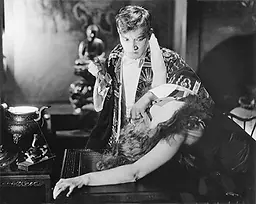
Sessue Hayakawa and Fannie Ward in Cecil B. DeMille's The Cheat (1915)
Despite—or perhaps because of—the despicable character he played, Hayakawa became a major star (and sex symbol) when The Cheat was released on 13th December 1915. DeMille later described the role as, “Sessue Hayakawa’s first giant stride on the road that made him within two years the peer of such contemporary bright stars as Douglas Fairbanks, William S. Hart, and Mary Pickford.”
He wasn’t only a hit in America; the French raved over both the film and Hayakawa’s performance. Writing in Excelsior on 7th August 1916, the poet Colette gushed, “To the genius of an oriental actor is added that of a director probably without equal. . . . We cry “Miracle!” . . . Is it only a combination of felicitous effects that brings us to this film and keeps us there? Or is it the more profound and less clear pleasure of seeing the crude ciné groping toward perfection, the pleasure of divining what the future of the cinema must be when its makers will want that future . . . ? . . . This Asiatic artist whose powerful immobility is eloquence itself. Let our aspiring ciné-actors go to see how, when his face is mute, his hand carries on the flow of his thought. Let them take to heart the menace and disdain in a motion of his eyebrow and how, in that his life is running out with his blood, without shuddering, without convulsively grimacing, with merely the progressive petrifaction of his Buddha’s mask and the ecstatic darkening of his eyes.”
Speaking of his performance to Harry Carr for a Motion Picture Magazine article in 1924, Hayakawa said, “I was always taught that it was disgraceful to show emotion. Consequently… I tried to show nothing in my face. But in my heart I thought, “God, how I hate you.” And of course it got over to the audience with far greater force than any facial expression could.”
Critics were not so taken with Fannie Ward’s performance, with Variety’s critic stating that she, “does not create any too good an impression… the work of Sessue Hayakawa is so far above the acting of Miss Ward and Jack Dean that he really should be the star in the billing for the film.” The New York Times felt the same way: “Miss Ward might learn something to help her fulfil her destiny as a great tragedienne of the screen by observing the man who acted the Japanese villain.”
DeMille received praise for his use of a technique known as ‘Rembrandt lighting,’ in which part of an actor’s face is in darkness to heighten the dramatic and psychological impact of a shot. He first used the technique in The Warrens of Virginia earlier in 1915, and recalled in his autobiography that, “a very disturbed Sam Goldfish wired me to ask what we were doing. Didn’t we know that if we showed only half an actor’s face, the exhibitors would want to only pay half the usual price for the picture? … Jesse [Lasky] and I wired back to Sam that if the exhibitors did not know Rembrandt lighting when they saw it, so much for the worse for them. Sam’s reply was jubilant with relief: for Rembrandt lighting, the exhibitors would pay double!”
In James Card’s celebration of silent film, Seductive Cinema, the film historian praised all aspects of the film’s lighting, saying, “The low-key, atmospheric lighting is sophisticated and effective far ahead of its time. The Japanese screens used to silhouette players, who are ripped apart in violence behind them, the screens suddenly spattered with blood, make the film look as though it could have been made by Kurosawa rather than the unappreciated DeMille.” Kevin Brownlow, in his The Parade’s Gone By, agreed while acknowledging the contributions of art director Wilfred Buckland and cinematographer Alvin Wyckoff: “Tautly constructed and excellently played . . . The branding sequence, and the subsequent shooting, are lit in a way that ignites the imagination; the scenes are as powerful as ever today.” Of Buckland’s art direction, Kenneth MacGowan, writing in Photoplay in 1921, said, “Because Buckland had worked with the master realist of the stage he brought something besides the Belasco plays to Lasky. He brought tasteful richness of setting. Under the flat lighting of most movies… it would have bored and distracted with quite the force that it does on the stage. But made over by “Lasky Lighting”—as it is today in most of the Famous-Players-Lasky productions—it has a splendid and satisfying richness.”
While The Cheat might have been well-received by most moviegoers, its racist storyline outraged many among the Japanese-American community, just as the same year’s The Birth of a Nation had angered the black community. When the film opened at the Tally Theater in Los Angeles, the LA-based Japanese-language newspaper Rafu Shimpo launched a protest campaign. It also carried a report about the lynching of a Japanese noodle shop owner outside the theatre, although no other national or local newspapers carried a report of the alleged incident.
The newspaper singled Hayakawa out for criticism, demanding in an article, “Sessue Hayakawa, who do you think you are? Don’t you have any blood of the Japanese race? Being used as a tool by anti-Japanese exhibitors and leaving a brutal impression on Japanese people, you are either foolish or insane. I have no idea what to think of you, you traitor to your country!” The news even reached Japan, where the actor was condemned for promoting anti-Japanese sentiment (although the film was never released there). Newspapers labelled him a “traitor” for appearing in “insults to the nation.”
Hayakawa issued an apology in Rafu Shimpo on 29th December 1915, saying, “Sincere Notice: It is regrettable that the film The Cheat, which was exhibited at the Tally Theater on Broadway in Los Angeles, unintentionally offended the feelings of the Japanese people in the United States. From now on, I will be very careful not to harm Japanese communities.”
When Paramount re-issued The Cheat in 1918, when Japan was America’s ally in World War I, they changed the nationality of Hayakawa’s character to Burmese. As Simon Louvish pointed out in his biography, Cecil B. DeMille: a Life in Art, “Burmese nationals were not thick on the ground in America at that time and presumably could be offended with impunity.”
The Cheat became the first film to be adapted for the stage when the Opéra-Comique staged an opera, La Forfaiture, written by André de Lorde of the Théatre du Grand Guignol and Paul Milliet, with music provided by Camille Erlanger, that was based on the film. The show was not a success and closed after just three performances.
George Fitzmaurice remade The Cheat for Paramount in 1923 with Pola Negri as the embezzling socialite and Charles de Rochefort’s Indian prince replacing Hayakawa’s Asian trader. Paramount again revisited the tale in 1931, with Tallulah Bankhead and Irving Pichel in the leads. This time, the cad was American. Finally, Marcel l’Herbier made a French version, Forfaiture, in 1937, with Hayakawa reprising his role, this time as a Mongolian prince. The images behind the film’s opening credits comprised a compilation of the Japanese actor’s scenes from DeMille’s 1915 version – a testament to the esteem with which the original was still remembered.
Sources: Cecil B. DeMille: Empire of Dreams, Scott Eyman; Cecil B. DeMille: a Life in Art, Simon Louvish; The Autobiography of Cecil B. DeMille, Cecil B. DeMille; Golden Images, Eve Golden; Such Sweet Compulsion, Geraldine Farrar; Sessue Hayakawa, Daisuke Miyao; Cecilbdemille.com; Seductive Cinema, James Card; The Parade’s Gone By, Kevin Brownlow.