Intolerance (1916)
released 5th September 1916
Cast:

Lillian Gish

Robert Harron

Mae Marsh

Howard Gaye

Constance Talmadge

Tully Marshall
Intolerance (1916)
Drama
163m
Wark Producing Corporation
Director:
D. W. Griffith
Writer:
D. W. Griffith, Anita Loos
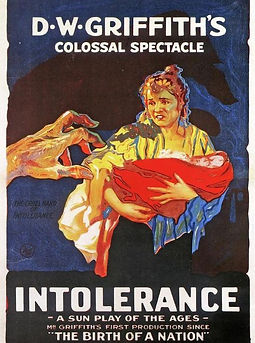
"D. W. Griffith's Colossal Spectacle...A Sun Play of the Ages"
“I've always said I would rebuild Babylon for you. Now I'm going to do it and make it part of a new story I have planned, showing man's inhumanity to man for the last 2,500 years.”
D. W. Griffith to Lillian Gish, as quoted in The Movies, Mr. Griffith and Me.
In February 1915, the nation’s critics heaped rapturous praise on D. W. Griffith. For many, his spectacular film, The Birth of a Nation (1915), represented an enormous artistic and technological stride forward in the evolution of cinema. Others, however, found it a deeply offensive, demonising depiction of black people. The director appeared genuinely surprised and hurt by the accusations of racism levelled at him; his film, he argued, was a faithful rendering of historical events. As late as 1947, he argued that “I am not now and never have been "anti-Negro" or "anti" any other race. My attitude towards the Negroes has always been one of affection and brotherly feeling. I was partly raised by a lovable old Negress down in old Kentucky and I have always gotten along extremely well with the Negro people.”
Faced with ongoing criticism following the film’s release, he claimed that the accusations against him were an example of bigotry from critics who were intolerant of his artistic vision. And amid this controversy, he wrestled with the question all celebrated artists encounter after creating a work of art that has, to that date, proven to be their crowning achievement: what next?
Many have claimed Griffith intended Intolerance at least in part, as an apology for the racism in The Birth of a Nation. However, Griffith’s 1947 argument suggests that even as his life was nearing its end, he still felt accusations of racism were unjustified. In a 1916 interview with Photoplay magazine, the director insisted Intolerance would be his last picture: “intolerance that I have met with and fought with in my other picture makes it impossible to ask investment of the tremendous sums of money required for a real feature film with the result dependent on the whim or lack of brains of a captain of police,” he complained. It is fair to assume, then, that he intended Intolerance to serve more as a rebuke to the criticism he received for The Birth of a Nation than an apology for its content.
Before the release of The Birth of a Nation, Griffith filmed a short called The Mother and the Law, a modern-day tale of social injustice starring Mae Marsh and Robert Harron. He later claimed the tale was inspired by the real-life Stielow case in New York, in which German immigrant Charlie Stielow was sentenced to death for the murder of his employer, only for his execution to be halted when the actual killer confessed. To prepare for the film, Griffith, cameraman Billy Bitzer, and his assistant, Karl Brown, visited San Quentin prison for research so that the film’s prison scenes would be a faithful reproduction of actual conditions. However, after he completed filming, and following the Civil War drama’s stupendous success, Griffith felt that a film such a small-scale film would disappoint audiences who now associated him with grandiose spectacle.
On the drive back from San Francisco, the three men glimpsed the Tower of Jewels, the 433-foot centrepiece of the San Francisco Exposition. Covered in 100,000 pieces of cut-glass crystals, the tower sparkled in the sunlight. Griffith had Bitzer pull over and capture some images. The cameraman captured a sequence of matted shots in which the image showed only in the top corner of the frame. Perhaps even then, Griffith was imagining a vast Babylonian set and a tale that not only matched the scale of his last picture but also the grandeur of Giovanni Pastrone’s Cabiria (1914), an enormous box-office hit that had won praise from critics around the world.
By now, Griffith was part of the creative triumvirate Harry Aitken assembled under his new Triangle Film Corporation (the other two were Mack Sennett and Thomas H. Ince). Griffith was head of the Fine Arts production unit. His daily duties involved supervising the rehearsal, shooting and editing of the directors working under him. He also watched the daily rushes of each production, planned the following day’s shooting schedule, and developed story outlines credited under his pen name, Granville Warwick. In his spare time, at night in his hotel room, he pored over books about greed and intolerance, of the fall of Babylon and the massacre of Huguenots on St. Bartholomew’s Eve. He also searched for tales of social injustice in the daily newspapers, finding reports on a blameless mother parted from her infant and of striking protestors gunned down and beaten to death during a chemical plant strike.
These incidents he adapted and fashioned into a plot composed of four interweaving tales from different periods of history: ancient Babylon, which fell to the Persians; the treachery of Judas Iscariot; the persecution of the Huguenots in 16th Century France, and a story of deceit and love in modern day America. These strands he enjoined under the recurring symbolic motif of a mother rocking a cradle. Why he chose these historical periods to illustrate his message is unknown, although in an interview for Pictures and Picturegoer he revealed, “A few years ago…I produced a picture for Biograph called The Reformers. In that two-reel subject I gave vent to some of my feelings on the matter of bigotry and carelessness of the true wellbeing of one’s fellow-creatures. The picture did not in any way resemble Intolerance except in basic principles, but if you want the history of my new production you must go right back there, for ever since then I have been consciously and unconsciously collecting material for a portrayal, on as comprehensive a scale as possible, of the evil of intolerance.”
The astounding box office returns from The Birth of a Nation meant Griffith no longer struggled to raise finance for his extraordinary vision. Wall Street institutions were keen to back him, as were fellow filmmakers. Harry Aitken set aside $200,000 for the new super-production he expected to outshine The Birth of a Nation in every way, and Griffith could plan sets and costumes, and to hire staff almost as soon as he had pitched his idea.
Building the Sets for Intolerance

Karl Brown recalled that the set designers on Intolerance used Tissot’s Illustrated Bible as their reference for recreating the Judean period, much as Sidney Olcott had for his 1912 religious epic From the Manger to the Cross. Soon after production was under way, Griffith selected key members of the crew for a Sunday screening of the original version of The Mother and the Law. Assistant director Joseph Henabery was the only member to offer criticism. Waiting until everyone else had left the screening room, he pointed out that the prison priest was wearing the outfit of a French cleric, something that would be immediately apparent to Catholic members of the audience. Under Griffith’s instruction, Henabery found a priest who had worked at San Quentin and who not only offered to loan his outfit but to stay on as technical advisor for the gallows scene. A delighted Griffith consequently placed Henabery in charge of all research for the picture.
Henabery was so conscientious he would frequently sleep on piles of extras’ costumes to ensure he was ready for work early the following morning. He ransacked second-hand bookstores, buying so many books he needed a car to transport them to the studio, much to studio comptroller J. C. Epping’s distress. Henabery purchased two copies of every reference book so that he could cut the illustrations from one and paste them, categorised by subject matter, into a scrapbook for quick reference. Eventually, a thirteen-feet long bookshelf strained under the weight of books on “Babylon and Assyria, Jerusalem and France.” After initial doubts, Griffith found the scrapbook indispensable and carried it around with him. It now resides at the Museum of Modern Art in New York.
Remembering the pause to admire the Tower of Jewels during the journey home after visiting San Quentin, Griffith despatched the ever-eager Henabery to San Francisco to find the men who had helped build the monumental construction—particularly those who worked in plaster of paris—and the painters who had created the impressive aged effect. Henabery tracked one of the men down after learning of his whereabouts from the staff of a small shop that made plaster of paris models. Not only was this man willing to go to Hollywood for $35 a week, but he also knew two other men skilled in working with the material, and one of the painters who had worked on the tower. The next day, Henabery brought them all to Griffith’s set.
The man responsible for providing the drawings from which carpenter Frank ‘Huck’ Wortman would construct the staggering Babylonian sets was the enigmatic Walter L. Hall, an English theatrical designer whose sole film credit this was. Remarkably, Karl Brown’s recollections of Hall appear to be the only information available on the man responsible for designing arguably cinema’s most famous, instantly recognisable set.
Brown describes him as something of a tortured soul. Resembling a young Winston Churchill, Hall had two obsessions: the science of perspective (which earned him the nickname “Spec”) and protecting the virtue of his teenage daughter from the rogues that wandered around film sets. He worked in an office with windows at one end of the stage, from where he could see his designs come to life—and keep an ever-watchful eye on his daughter. He possessed, according to Brown, “the great gift of an imaginative creative artist with the needlepoint accuracy of a fine architect,” and the ability to draw to scale freehand and at speed. “He could look at a pictured fragment of a recently unearthed archaeological find,” Brown reminisced, “and from it reconstruct the entire subject…A partial remnant of a stairway at Persepolis became the entire great stairway to the great palace of Belshazzar.”
Brown’s remark to Hall that he must receive great satisfaction from so easily doing something so wonderful met with an unexpected response. “Satisfaction? Humpf!” Hall responded. “Chained to a drawing board hand and foot, day in and day out, when I ought to be out looking after my daughter? It’s a dog’s life, Brown—a dog’s life.”
“Then why do you do it?”
“Because I must, can’t you see that? Because I must!”
“Don’t you like drawing?”
“I hate it,” Hall said vehemently. “It’s the most demanding, the most merciless work a man can do.”
Working from the drawings and designs provided by the tormented Englishman, Huck Wortman and his men slowly constructed Intolerance’s magnificent sets on an empty lot across from the studio. The Walls of Babylon thrust skyward, transforming the skyline on the corner of Sunset and Hollywood Boulevard and mystifying locals until hoardings revealed the film’s title—still The Mother and the Law at this stage—and the name of its director.
As a practical joke, Bitzer asked Wortman if it would be possible to construct runways and platforms on the walls and to reinforce the structure to allow galloping horses to tow chariots on it. When Griffith heard about the suggestion, he thought it an excellent idea, and much to Bitzer’s later regret, instructed Wortman to make it happen. To protect these towering sets from the harsh Santa Ana winds, workmen had to lash thick, sturdy rope to the top of each set and anchor it to the ground with railroad ties buried in the earth.
Eventually, the winds passed, and the skies calmed. The time had at last arrived for filming to begin…

D. W. Griffith

D. W. Griffith (left) directs Miriam Cooper in Intolerance while Dorthy Gish looks on. Billy Bitzer is behind the camera with Karl Brown to his left
Filming Intolerance
Griffith began shooting The Mother and the Law while production of The Birth of a Nation (or The Clansman, as it was then known) was still ongoing. To avoid confusion, he gave each story a code: The Clansman was F (for feature) 1, The Mother and the Law was F2, the French story F3, and so on. This led many studio workers to believe that he was working on separate projects simultaneously.
For the prison scenes in The Mother and the Law, Griffith built a replica of the grimy cells he encountered while visiting the squalid San Francisco city jail rather than the lighter, cleaner ones found in San Quentin. While visiting the set, Lillian Gish turned away from the foul cell without speaking when Griffith asked her what she thought of it. “Well, that’s life,” Griffith solemnly intoned.
He shot the rest of The Mother and the Law in the same downbeat manner. Brown recalled encountering a raid on a brothel, a U-shaped building designed for a special purpose with cells not unlike those in the San Francisco prisons. Here, though, the doors were made of wood and emblazoned with the name of their occupant: Frisco Kate, Minnesota Minnie, etc. The crew also witnessed uniformed troops mowing down charging strikers in a hail of gunfire.
Filming on the city streets attracted the curiosity of onlookers who followed the crew as they filmed. Brown recalled one of them, a Mexican woman who wheeled her small, paralysed daughter around in a home-made cot. Griffith paid her no heed but instructed his assistant, George Siegmann, to fetch a small bag. When the director thought he was unobserved, he approached the cot and placed silver dollars from the bag around the girl’s body. Then, without words, he handed the bag with the rest of the dollars to the tearful mother and turned away.
He shot the film out of sequence, organising the schedule by the availability of sets and crowds, or simply by which scene he felt like shooting next. First was the marriage scene at Cana. Although Griffith wasn’t slavishly devoted to historical authenticity, insisting that “people believe only what they already know,” he consulted once again with the Catholic priest who had helped him out on The Mother and the Law’s jail scenes. He also called upon the services of Rabbi Isidore Myers, the father of Carmel Myers, who would become a successful silent screen actress. However, to capture the look of those attending the wedding at which Jesus turned water into wine, he drew on well-known academic paintings of the scene. For extras in these scenes, he engaged Orthodox Jews from Boyle Heights who wore the same style of hair and beards as their ancestors. Other extras he furnished with fake beards made from crepe paper attached to wires that hooked over their ears. Between shots, the extras would push the simple device onto their foreheads to serve as makeshift visors.
Because of the immense, time-consuming effort needed to construct its set, Griffith filmed the Babylonian sequences last. To film a sequence as complex as the battle scene, he employed several assistants, including future director W. S. Van Dyke and actor Monte Blue. On each hip, Blue wore a revolver loaded with blanks for signalling; he also carried coloured flags for the same purpose. Lead actors such as Elmer Clifton, George Siegmann and Joe Henabery would each lead a small group of extras.
Huck Wortman had constructed mobile attack towers that were to be pushed by elephants towards the walls of Babylon during the battle scenes. The shot proceeded smoothly at first, but then the towers stopped amid growing agitation amongst the massive creatures. Griffith despatched George Siegmann to find out why and discovered that the elephants were a mix of male and female. The male elephants, it seemed, were more interested in acquainting themselves with their female counterparts than pushing towers. They were therefore summarily dismissed, leaving the females to do all the pushing.
Griffith ordered the battle scene to be shot repeatedly from various angles as different ideas came to him. He decided one tower should crash to the ground, so had Wortman rig it so that the wooden construction would look like crumbling stone and mortar as it collapsed. When Brown asked Wortman why he was paying such meticulous attention to measuring and remeasuring everything, the carpenter informed him it was so the cameraman wouldn’t be killed while capturing the shot. Griffith also demanded a night shot of the battle. ‘Fireworks’ Wilson, who had worked with him on The Birth of a Nation, had to place three-minute magnesium flares in strategic locations so that the set concealed them from Bitzer’s cameras.
To film Belshazzar marshalling his troops by golden chariot on the ninety-foot-high battlements, horses needed to be coaxed up a zigzag ramp one at a time. A team of men lifted the chariot by hand and hitched it with some difficulty to the skittish horses on a platform the animals sensed was not stable. Here was where Bitzer came to regret his practical joke on Wortman. To capture the shot that Griffith desired, he and Brown had to lean far out from an unstable tower and shoot down on the wall while the battle raged on the ground below.
At Griffith’s signal, the charioteer urged the horses to gallop straight towards the tower. The structure, already weakened by the Santa Ana winds, swayed perilously beneath their weight and movement. Griffith, ignoring Wortman’s breathless warning that the structure wouldn’t withstand such use, ordered the shot to be retaken. While the wranglers returned the chariot and terrified horses to their starting positions, Brown noticed Griffith observing them. “He was leaning casually against a parapet, his cheap straw hat shoved back on his head, his mouth slightly open in a grin of purest delight.” Thankfully, the director demanded only two takes of the sequence, and Bitzer and Brown descended gratefully to terra firma.
However, it wasn’t just epic battle scenes and elaborate sets Griffith had to manage. He also had a large cast to oversee. For the role of Princess Beloved in the Babylon story, he cast Seena Owen over Alma Rubens. Owen was an incredibly beautiful woman, but a mediocre actress prone to putting on weight, which could be a serious problem on a film with a long shoot. Griffith brought her to the attention of an actor called George Walsh. He was Raoul Walsh’s older brother, whom Griffith signed when he travelled west to visit his sibling, and who was a hit with the ladies. In casual conversation with Walsh, Griffith mentioned Owen’s stunning looks and kind nature. He then did the same with Owen, and soon the couple were in a loving relationship which Griffith hoped would help the actress bring more emotion to her role. When, in the throes of contentment, Owen began piling on the pounds, Griffith told Walsh she was too fat for her part. To Owen, he mentioned she was wasting his time with Walsh, who was merely toying with her affections. The couple split, and the inconsolable actress’s excess weight melted away.

Griffith also had to coax an acceptable performance from actress Marguerite Marsh. One scene called for her to smile in recognition when she saw her lover across a crowded ballroom. Griffith noticed the actress, who was Mae Marsh’s older sister, wilting after a punishing morning before the camera. To perk her up, he joked, “Just think, you’re going to have a nice lunch presently paid for by the firm.” Marsh smiled at his encouragement, and he urged her, “Save that for the picture. That is exactly the expression I want when you see your lover coming to ask you for a dance.” As the camera rolled, Griffith shouted “Steak!” at the vital moment to induce the smile he was after.
One young actress named Juanita Horton talked herself into a role when Griffith overheard her being interviewed by Frank Wood. “Mama said I wasn’t trained to do anything,” the naïve eighteen-year-old confessed, “so there was nothing left for me but acting.” Amused by her candour, Griffith gave her a screen test which she passed with flying colours. Although Intolerance provided her with her first acting role, eight other films she subsequently made were released before it reached the screen. By then, audiences already knew her as Bessie Love, the screen name given to her by the studio. Love would become a major star of the silent screen and was still appearing in movies in the 1980s.
Once Griffith completed filming the battle scene, he ordered the Walls of Babylon to be torn down to make way for the monumental Belshazzar set. While that was being constructed, filming moved to the Dominguez Slough, a body of freshwater that wound its way to the San Pedro mudflats, and which was to double for the Euphrates River. Each day, George Siegmann oversaw the making up and costuming of an army of extras at the studio before transporting them several miles by electric train to the Slough. Once there, they often had to wait for the fog to lift before any shooting could take place. Some days, the fog didn’t lift at all, and an entire day’s work would be lost.
The shoot dragged on: week after week; month after month; until more than a year had passed. Each day cost thousands of dollars—more than most big studios spent in a week. On several occasions, despite the generous initial financial backing, Griffith would have to delay the shooting of elaborate scenes and film smaller ones instead. When he overheard someone wonder out loud whether the shoot would ever end, he simply said, “I don’t see why everybody is in such a hurry to get through. We’d only start another one.”
Rather than level the ground before building the set for Belshazzar’s court, Wortman simply built it on timber stilts. First to go up was the stairway, then the flooring, followed by the columns. Bordered by the unforgettable elephant-surmounted columns, the platform at the top of the steps stretched back around 300 feet. To one side sat an enormous effigy of the goddess Ishtar, a full-grown man clutched to her naked breast. The entire set could comfortably accommodate five thousand people. “The set glittered with gold and glowed with colour,” Brown recalled. “Everything everywhere was richly carved, richly decorated, richly draped.” Using an extra shutter wheel, he captured alternate shots using red and green filters and showed Griffith how colour could transform the already wondrous set. The director turned down his suggestion: either every scene of the picture was in colour, or none at all, and he had come too far to reshoot the entire picture.
The set was so large that shooting it presented another problem to be solved. Initially, Bitzer and Brown tried filming it from a balloon as it was slowly winched down, but were unhappy with the result. For once, the solution proved to be relatively simple. The crew built a two-floor lift into a tower constructed in such a way that half-a-dozen men could easily roll it smoothly forwards and backwards along rail tracks. The lift allowed Bitzer and Brown to film from any level up to fifty feet. Thus was one of the most iconic establishing shots in cinema history captured.
After more than a year’s filming, Griffith was at last ready to start the monumental task of editing Intolerance and adding intertitles. To help him with the titles he chose Anita Loos, a precocious talent who, at the age of twenty-six, already had more than fifty screen credits to her name. Loos had sought Griffith out on the Babylonian set of Intolerance, where he had offered her a job writing titles for $75 per week plus a bonus each time one of her scripts went into production. After some minor rewriting duties, she was given the job of writing an adaptation of Macbeth, which Fine Arts-Triangle were planning to film with Sir Herbert Beerbohm Tree in the lead role. For this task she received a credit of “Macbeth by William Shakespeare and Anita Loos.”
Soon after that, Griffith invited her to work with him on the titles for Intolerance. One evening, he showed her a first cut of the picture. She later described believing the director had ‘lost his mind’ after watching it. “I sat a moment in stony silence, which I could only explain to the Great Man by telling him that I had been moved beyond words. Actually, he was so absorbed in his film I doubt he realized my bewilderment.”
Editing some 200,000 feet* would prove to be a far more arduous task. Griffith closeted himself in a cutting room with his regular editors, Jimmy and Rose Smith. Lillian Gish, who had earned herself a reputation as a ‘Goody Two-Shoes’ around Griffith among some of the other female cast members, also provided assistance. In the midst of editing, the couple requested time off to be married, fully expecting the director to refuse, but Griffith agreed on the proviso their honeymoon lasted only one weekend.
The first rough cut ran for eight hours, and while Griffith accepted the film would have to be half that long, he toyed with the idea of running it over two nights. However, trials with a few carefully selected exhibitors showed there was no interest even in a four-hour film. Somehow, he managed to cut it to approximately 13,000 feet. Rather than tell each story in sequence, Griffith adopted the then-revolutionary technique of interweaving the four plots—a device familiar to modern audiences, but which many in 1916 found confusing.
Each strand explored an example of intolerance from four different historical periods. In modern America poverty, labour conflict and crime result in the wrongful conviction of a young family man who is sentenced to hang; in Judea, Jesus is crucified after people reject or wilfully misinterpret his message of love; in 16th Century Renaissance France, a young Huguenot couple is caught up in the St. Bartholomew Day massacre; and in Ancient Babylon, the mighty city falls as a consequence of religious and political conflict. Joseph Carl Breil, working under Griffith’s close supervision, assembled a score to accompany this mammoth cinematic tapestry.
Critical reception

On 6th August 1916, Griffith’s chauffeur-driven Fiat carried the director, Lillian Gish, Bobby Harron, Joseph Henabery and Mae Marsh to see the preview at an out-of-the-way theatre. Most historians state this sneak preview took place at Riverside, California, although in his autobiography, Henabery insisted the preview was held at the town of Pomona, thirty-five miles west of Riverside. While filming was going on, Henabery had harboured doubts that even a director as accomplished as Griffith could weave together all its strands in a way a 1916 audience could understand, and the version shown that night simply confirmed his doubts had been correct. “In his efforts to carry four parallel lines of action…Griffith, in many cases, used extremely short cuts, mere flashes of what had been fine, understandable scenes,” Henabery wrote. “…I know this proved confusing to the audience. I fear many were disappointed; they expected something surpassing The Birth of a Nation.”
Henabery went on to say that when Griffith asked him what he thought of the film the following day, he criticised only the titles, complaining that they assumed a level of knowledge about the historical incidents depicted that the average audience wouldn’t possess. Griffith initially rejected his criticism but changed his mind later the same day and had Henabery collaborate with Frank Wood and screenwriters Mary O’Connor and Hettie Grey Baker to improve the titles.
Less than a month later, on 5th September 1916, Intolerance premiered at the Liberty Theatre in New York, the same theatre at which The Birth of a Nation received its East Coast premiere. Those in attendance found in the programme notes a message from the director which read, “The purpose of the production is to trace a universal theme through various periods of the race’s history. Ancient, sacred, medieval and modern times are considered. Events are not set forth in their historical sequence, or according to the accepted forms of dramatic construction, but as they might flash across a mind seeking to parallel the life of the different ages.”
This excerpt was sandwiched between The New York Times’ review of Griffith’s latest film. “Ever since the remarkable film “The Birth of a Nation,” was unreeled before an amazed public more than a year ago, the question of whether it was an accident or whether D. W. Griffith, the man who directed the film, was really a new master of the cinema, has interested those who follow the personalities that manipulate the puppets of stage and studio. The answer came last night when D. W. Griffith’s second big picture, “Intolerance,” was exhibited in the Liberty Theatre before an audience that might have gathered to witness the premiere of some favorite dramatist’s latest work, so dotted was it with prominent folk of the theatre…The verdict “Intolerance” renders in the controversy concerning its maker is that he is a real wizard of lens and screen.”
However, the unnamed reviewer tempered their favourable verdict in the very next sentence: “For in spite of its utter incoherence, the questionable taste of some of its scenes and the cheap banalities into which it sometimes lapses, “Intolerance” is an interesting and unusual picture.”
Alexander Woolcott’s review in the Times struck a similar note: “Unprecedented and indescribable splendor of pageantry is combined with grotesque incoherence of design and utter fatuity of thought to make the long-awaited new Griffith picture at the Liberty an extraordinary mixture of good and bad…”
Vachel Lindsay provided an alternative perspective, arguing that the structure some critics found so terrible in fact enhanced the significance of each story. “Babylon is shown signalling across the ages to Judea,” he wrote, “And in like manner the days of St Bartholomew and of the crucifixion signal back to Babylon sharp or vague or subtle messages…The ages make a resonance behind their simple plans and terrible perplexities. The usual shallowness of appeal of private griefs and loves as shown in the most painstaking intimate films, their inability to arouse complete responding passion in the audience, is thus remedied.”
The Film Daily review, however, showed no reticence about throwing superlatives Griffith’s way: “Stupendous, revolutionary, intense, thrilling…Mr. Griffith has put on the screen what is, without question, the most stirring human experience that has ever been presented in the world.”
Most reviews fell within one of two camps: either a curious brand of reserved praise from those who compared it to contemporary and preceding works, or fulsome praise from more progressive critics who considered Griffith’s film a step forward in the development of narrative cinema.
Estimates of just how much Intolerance cost vary wildly. Articles dating back to the time of its release have quoted figures around $2,000,000. The Birth of a Nation came in at just over $100,000, and while the spectacular Babylon sets must have cost a fortune, it seems unlikely that Intolerance would have cost twenty times more. Richard Schickel, in his biography D. W. Griffith: An American Life, suggests a far more realistic—and precise—figure of $385,906.77 culled from an accountant’s statement found among Griffith’s papers.
Whatever the cost, the steeply declining customer footfall that followed a short period of strong box-office returns must have been a worrying development for all involved in the production. While no-one has provided conclusive evidence for its ultimate failure at the box-office, perhaps Julian Johnson, in his review for Photoplay magazine, called it correctly when he wrote, “Still, we wish to follow, undisturbed the adventures of a single set of characters, or to thrill with a single pair of lovers. Verily, when the game is hearts, two’s company, and the lovers of four ages an awful crowd.” However, the fact that Intolerance out-performed The Birth of a Nation for months before dropping off calamitously suggests otherwise.
Some have blamed America’s entry into the Great War for its sudden downturn. They argue that the film’s pacifist message no longer chimed with a nation preparing itself for conflict. And yet, Intolerance’s returns began to dip months before the United States broke off diplomatic relations with Germany in late-February 1917 and finally declared war in April. Only in Russia did the film enjoy enduring success, running continuously for ten years. Iris Barry points to the ‘sociological implications’ of the modern story for its success there, where it profoundly influenced a future generation of celebrated filmmakers, including Sergei Eisenstein, Vsevolod Pudovkin, Leonid Trauberg, and Grigori Kozintsev.
Historians in the past have erroneously emphasised the huge financial blow Griffith suffered because of the film’s ultimate box-office failure. In fact, the director suffered no debilitating loss to either his wallet or his reputation. Nevertheless, in a letter to Lillian Gish, Griffith dolefully described barking his shins on empty seats as he wandered through darkened theatres. “I don’t know where to go or where to turn since my great failure,” he wrote.
However, the Great War, which may have played a part in Intolerance’s commercial failure, also provided Griffith with his next adventure. Sometime in the winter of 1916-17, the British War Office Cinematograph Committee had invited him to produce a feature about the war. Griffith accepted, and on 17th March 1917 set sail for England to start work on Hearts of the World (1918).
With the passing of the years and the increasing sophistication of narrative cinema, Intolerance has come to be recognised for the groundbreaking masterpiece it always was, surpassing even The Birth of a Nation.
To Griffith biographer Iris Barry, Intolerance represented the “end and justification of that whole school of American cinematography based on the terse cutting and disjunctive assembly of lengths of film, which began with The Great Train Robbery and culminated in The Birth of a Nation and this… All the old and many new technical devices are employed in it—brief, enormous close-ups not only of faces but of hands and of objects; the “eye-opener” focus to introduce vast panoramas; the use of only part of the screen’s area for certain shots; camera angles and tracking shots such as are commonly supposed to have been introduced by German producers years later; and rapid cross-cutting the like of which was not seen again until POTEMKIN.”
Film historian Theodore Huff proclaimed it “the greatest motion picture ever produced. In its original form and properly presented, it is a masterpiece of creative conception and execution which ranks with such works of art as Beethoven’s Ninth Symphony, Rembrandt’s ‘Descent from the Cross,’ Da Vinci’s ‘Mona Lisa,’ the sculptures of the Parthenon, or with works of literature such as Tolstoy’s War and Peace, the poetry of Walt Whitman or Shakespeare’s Hamlet.”
Intolerance was among the first batch of films to be added to the United States’ National Film Preservation Board’s National Film Registry in 1989. In 1995, it was included in the Vatican’s list of 45 Alcuni film Importanti (some Important Films), under the category ‘Values’.
*At least one contemporary source claims Griffith shot 300,000 feet.
Sources: Sight and Sound, 12th February 1947; D. W. Griffith and the Banks: A Case Study in Film Financing, Janet Wasko; A Silent Siren Song: The Aitken Brothers' Hollywood Odyssey, 1905-1926, Al P. Nelson; D. W. Griffith: An American Life, Richard Schickel; D.W. Griffith Interviews, Anthony Slide; Adventures with D. W. Griffith, Karl Brown; D. W. Griffith: His Life and Work, Robert M. Henderson; Before, In, and After Hollywood, Joseph Henabery; Anita Loos: a Biography, Gary Carey; A Girl Like I, Anita Loos; D. W. Griffith: American Film Master, Iris Barry; The Films of D. W. Griffith, Edward Wagenknecht; The Man Who Invented Hollywood: the Autobiography of D. W. Griffith; The Movies, Mr. Griffith, and Me, Lillian Gish; Billy Bitzer: His Story, G. W. Bitzer.