Douglas Fairbanks

Douglas Fairbanks
"Success is not measured by what you have, but by what you have given."
Douglas Fairbanks
Birth name:
Douglas Elton Thomas Ulman
Born:
23rd May 1883, Denver, Colorado, USA
Died:
12th December 1939, Santa Monica, California, USA
Years active:
1915 - 1934
Douglas Fairbanks’ natural charisma ensured a rapid rise to screen stardom after success on Broadway. His sunny temperament and spry athleticism saw him quickly become one of early cinema’s brightest stars. In the 1920s, he kept his position among Hollywood’s elite by redefining his screen persona, seamlessly transitioning from comedy to action hero. Throughout the 1920s, he enjoyed enduring success as the King of Hollywood.
Early Life
Fairbanks was born Douglas Elton Thomas Ulman on 23rd May 1883 in Denver, Colorado, one year after his brother, Robert. He also had two half-brothers, John and Norris, and it is possible that his father, Hezekiah Charles Ulman, was still married when he wed Fairbanks’ mother, Ella, in 1881. He was a mischievous child, forced to learn Shakespeare, according to his niece, by his teachers as punishment for misbehaviour.
Hezekiah deserted his family when Fairbanks was around five years old, leaving Ella to care for their children unaided. In 1889, she changed her and her son’s surname to Fairbanks. Receiving financial support from her older brother, John, Ella sent her sons to Jarvis Hall Military Academy in Montclair. By 1896, Fairbanks’ interest in theatre prompted him to appear in an amateur production of The Man from the Mountain. By 1898, he was attending the Tabor School of Acting. The New York Dramatic Mirror, in an article on the school, described Fairbanks as “a clever youth whose naturalness is particularly to be commended.”
In September 1899, Fairbanks won a place with the actor Frederick Warde’s theatrical company. The 16-year-old Fairbanks travelled with the company for two years, becoming assistant stage manager for the second season.
With touring experience under his belt, Fairbanks decided to take a crack at Broadway in 1901, and almost immediately won a part in Her Lord and Master, which premiered in February 1902. Fairbanks signed with William Brady, and in 1906, won positive reviews for his role as the heroine’s brother in Man of the Hour.
Broadway Success
In June 1907, Fairbanks married Anna Beth Sully, the daughter of a Rhode Island cotton baron. The following year, Brady’s play All for a Girl, while only mildly successful, made Fairbanks a Broadway star. His next play, A Gentleman from Mississippi, was a smash hit and toured extensively. In December 1909, Anna gave birth to a son, Douglas Jr. Broadway success proved intermittent, however, with lay-offs in the summer because packed theatres became unbearably hot, and periodic returns to vaudeville to earn money.
In 1915, Fairbanks, like most of the country, saw D. W. Griffith’s The Birth of a Nation and knew he wanted a movie career. So, when Griffith offered him a ten-week contract, he accepted without hesitation.
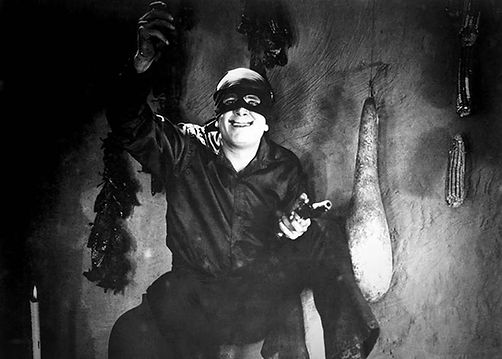
Douglas Fairbanks in The Mark of Zorro (1920)
Film Stardom
Fairbanks’ screen success was almost instant. He won rave reviews for his performance in his first film, The Lamb (1915). While his second film, Double Trouble (1915), received less favourable reviews, critics still praised Fairbanks’ performance, while moviegoers responded to his athletic stunts and positive persona. In 1917, he was the industry’s top money-making star and had already founded the Douglas Fairbanks Film Corporation. He had also begun a relationship with actress Mary Pickford. Their marriage in 1920 saw them elevated to the status of “Hollywood Royalty.” The year before, the couple had joined with Charlie Chaplin and D. W. Griffith to form United Artists to allow them greater creative control over their films.
Fairbanks the Swashbuckler
Having established himself as “Everybody’s Hero” in a string of romantic comedies, Fairbanks defied contemporary opinion that the public wasn’t interested in costume pictures by releasing The Mark of Zorro (1920), his most successful film to date, and a picture that redefined the action genre. Similar films followed: The Three Musketeers (1921), Robin Hood (1922), The Thief of Bagdad (1924), The Black Pirate (1926), and The Gaucho (1927). All boasted lavish stunts that showed off Fairbanks’s athleticism, and all were box-office hits.
On 30th April 1927, Fairbanks and Pickford became the first stars to place their hand and footprints in cement outside the newly opened Grauman’s Chinese Theatre. That same year, Fairbanks was voted the first president of the Motion Picture Academy of Arts and Sciences and presented the first Academy Awards at the Roosevelt Hotel.
Decline and Retirement
By the late 1920s, Fairbanks’ health and athletic ability were declining due, in part, to years of heavy smoking. He turned 46 in 1929 and had little appetite for playing the youthful hero. His first talkie, The Taming of the Shrew (1929), a joint venture with Mary Pickford, fared poorly at the box office. His following two films were also poorly received, and he made his last movie, The Private Life of Don Juan (1934), in Britain. By then he had separated from Pickford after starting an affair with Sylvia, Lady Ashley, whom he married in Paris in 1936.
Fairbanks’ health continued to decline, and he suffered a fatal heart attack on 12th December 1939 at his Santa Monica home. His body was originally interred at Forest Lawn Memorial Park Cemetery, but in 1941, his widow moved it to Hollywood Forever Cemetery.
In 1940, Fairbanks became the first posthumous recipient of an Honorary Academy Award.
Sources: The First King of Hollywood: The Life of Douglas Fairbanks, Tracy Goessel; Douglas Fairbanks and the American Century, John C. Tibbetts and James Welsh; Douglas Fairbanks, Jeffrey Vance; Mary Pickford and Douglas Fairbanks: The Most Popular Couple the World Has Ever Known, Booton Herndon.
Douglas Fairbanks Filmography
The Lamb (1915), 56m, Fine Arts Film Company, Dir: Christy Cabanne. With Seena Owen, Alfred Paget, Kate Toncray. Fairbanks’s screen debut; Martyrs of the Alamo (1915), 50-70m, Fine Arts Film Company, Dir: Christy Cabanne. With Sam De Grasse, Allan Sears, Walter Long. Fairbanks allegedly appears uncredited as a Texan soldier; Double Trouble (1915), 50m, Fine Arts Film Company, Dir: Christy Cabanne. With Margery Wilson, Richard Cummings, Gladys Brockwell. Fairbanks plays a dual role; His Picture in the Papers (1916), 62m, Fine Arts Film Company, Dir: John Emerson. With Loretta Blake, Clarence Handyside, Erich von Stroheim. Key early Fairbanks/Emerson/Loos comedy that helped establish his energetic modern-American screen persona; The Habit of Happiness (1916), 5 reels, Fine Arts Film Company, Dir: Allan Dwan. With Dorothy West, George Fawcett, Grace Rankin; The Good Bad-Man (1916), 50m, Fine Arts Film Company, Dir: Allan Dwan. With Sam De Grasse, Pomeroy Cannon, Bessie Love. First film on which Fairbanks received or supplied story/scenario credit; Reggie Mixes In (1916), 50m, Fine Arts Film Company, Dir: Christy Cabanne. With Bessie Love, Alma Rubens, Joseph Singleton; The Mystery of the Leaping Fish (1916), short; 2 reels, Fine Arts Film Company, Dir: John Emerson and Christy Cabanne. With Bessie Love, Alma Rubens, Allan Sears. Fairbanks plays Coke Ennyday, a detective parodying Professor Craig Kennedy, a popular fictional detective of the time; Flirting with Fate (1916), 50-57m, Fine Arts Film Company, Dir: Christy Cabanne. With Jewel Carmen, W. E. Lawrence, George Beranger. Working title The Assassin; alternate title Flirting with Faith; The Half-Breed (1916), 73m, Fine Arts Film Company, Dir: Allan Dwan. With Alma Rubens, Sam De Grasse, Tom Wilson; Intolerance (1916), feature; version lengths vary, Triangle/Wark Producing Corporation, Dir: D. W. Griffith. With Lillian Gish, Mae Marsh, Constance Talmadge. Fairbanks allegedly appears as the Man on White Horse in the French story. The Library of Congress lists Intolerance in the National Film Registry; Manhattan Madness (1916), 50m, Fine Arts Film Company, Dir: Allan Dwan. With Jewel Carmen, Norman Kerry, Adolphe Menjou. Fairbanks plays Steve O’Dare; American Aristocracy (1916), 52m, Fine Arts Film Company, Dir: Lloyd Ingraham. With Jewel Carmen, Charles DeLima, Albert Parker; The Matrimaniac (1916), 46m, Fine Arts Film Company, Dir: Paul Powell. With Constance Talmadge, Wilbur Higby, Fred Warren. Director is sometimes misidentified as John Emerson; The Americano (1916), 61m, Fine Arts Film Company, Dir: John Emerson. With Alma Rubens, Spottiswoode Aitken, Carl Stockdale. Considered by some the peak of Fairbanks’s first full screen year; In Again, Out Again (1917), 50m, Douglas Fairbanks Film Corporation, Dir: John Emerson. With Arline Pretty, Walter Walker, Arnold Lucy. First film from Douglas Fairbanks Film Corporation following Fairbanks’ signing with Artcraft; Wild and Woolly (1917), 72m, Douglas Fairbanks Film Corporation, Dir: John Emerson. With Eileen Percy, Walter Bytell, Joseph Singleton. A key western-comedy often used to describe the start of Fairbanks’ transition from drawing-room comedy toward athletic adventure; Down to Earth (1917), c. 71m, Douglas Fairbanks Film Corporation, Dir: John Emerson. With Eileen Percy, Gustav von Seyffertitz, Charles P. McHugh; The Man from Painted Post (1917), 58m, Douglas Fairbanks Film Corporation, Dir: Joseph Henabery. With Eileen Percy, Frank Campeau, Frank Clark; All-Star Production of Patriotic Episodes for the Second Liberty Loan (1917). Promotional wartime film. Fairbanks appears as himself alongside Mary Pickford, William S. Hart, Julian Eltinge, and others; Reaching for the Moon (1917), 69m, Douglas Fairbanks Film Corporation, Dir: John Emerson. With Eileen Percy, Richard Cummings, Millard Webb. The first of two unrelated films Fairbanks made with the same title (the second was released in 1930); A Modern Musketeer (1917), 68m, Douglas Fairbanks Film Corporation, Dir: Allan Dwan. With Marjorie Daw, Kathleen Kirkham, Eugene Ormonde. A transitional title framing modern Western comedy through Dumas and musketeer imagery; Headin’ South (1918), 50m, Douglas Fairbanks Film Corporation, Dir: Arthur Rosson, with Allan Dwan supervision. With Katherine MacDonald, Frank Campeau, James Mason. Generally considered a lost film; Mr. Fix-It (1918), 54m, Douglas Fairbanks Film Corporation, Dir: Allan Dwan. With Wanda Hawley, Marjorie Daw, Leslie Stuart; Say! Young Fellow (1918), 50m, Douglas Fairbanks Film Corporation, Dir: Joseph Henabery. With Marjorie Daw, Frank Campeau, Edythe Chapman. A lost film; Bound in Morocco (1918), 50m, Douglas Fairbanks Film Corporation, Dir: Allan Dwan. With Pauline Curley, Edythe Chapman, Tully Marshall. A lost film; Sic ’Em, Sam (1918). Fourth Liberty Loan short directed by Albert Parker. Fairbanks is listed as Democracy, with Sara Mason as Liberty and Bull Montana as Prussianism; He Comes Up Smiling (1918), 50m, Douglas Fairbanks Film Corporation, Dir: Allan Dwan. With Marjorie Daw, Herbert Standing, Bull Montana. Survives; Arizona (1918), 50m, Douglas Fairbanks Film Corporation, Dir: Albert Parker; Douglas Fairbanks also credited in some filmographies. With Theodore Roberts, Kate Price, Frederick Burton. A lost film; The Knickerbocker Buckaroo (1919), 60m, Douglas Fairbanks Film Corporation, Dir: Albert Parker. With Marjorie Daw, William A. Wellman, Frank Campeau. Frairbanks received writer/scenario contributor credit under the name of Elton. A lost film; His Majesty, the American (1919), 96m, Douglas Fairbanks Pictures Corp., Dir: Joseph Henabery. With Marjorie Daw, Frank Campeau, Sam Sothern. Fairbanks receives writer/scenario contributor credit under the name of Elton Banks. The first Fairbanks feature released through United Artists; When the Clouds Roll By (1919), 85m, Douglas Fairbanks Pictures Corp., Dir: Victor Fleming. With Kathleen Clifford, Ralph Lewis, Frank Campeau. Described by San Francisco Silent Film Festival as one of his last and best romantic comedies before the move into larger adventure productions; The Mollycoddle (1920), 86m, Douglas Fairbanks Pictures Corp., Dir: Victor Fleming. With Ruth Renick, Wallace Beery, Paul Burns. One of the last modern-comedy vehicles before The Mark of Zorro changed the direction of Fairbanks’ career; The Mark of Zorro (1920), 91-107m, Douglas Fairbanks Pictures Corp., Dir: Fred Niblo. With Marguerite De La Motte, Noah Beery, Robert McKim. The Library of Congress lists The Mark of Zorro in the National Film Registry, inducted in 2015; The Nut (1921), 74m, Douglas Fairbanks Pictures Corp, Dir: Theodore Reed. With Marguerite De La Motte, William Lowery, Gerald Pring. A return to modern comedy before Fairbanks commits fully to costume adventure; The Three Musketeers (1921), 119-120m, Douglas Fairbanks Pictures Corp., Dir: Fred Niblo. With Leon Bary, George Siegmann, Eugene Pallette. The first of Fairbanks’ large-scale Dumas productions and the precursor to The Iron Mask. He plays d’Artagnan; Robin Hood (1922), 133m, Douglas Fairbanks Pictures Corp, Dir: Allan Dwan. With Wallace Beery, Enid Bennett, Sam De Grasse. Released and copyrighted under the fuller title Douglas Fairbanks in Robin Hood; Hollywood (1923). Paramount comedy with extensive star cameos. Fairbanks appears as himself; the film is lost; The Thief of Bagdad (1924), 139-140m, Douglas Fairbanks Pictures, Dir: Raoul Walsh. With Julanne Johnston, Snitz Edwards, Anna May Wong. Inducted into the Library of Congress National Film Registry in 1996; Don Q, Son of Zorro (1925), 111m, Douglas Fairbanks Pictures Corp., Dir: Donald Crisp. With Mary Astor, Jack McDonald, Warner Oland. A Zorro sequel vehicle, with Fairbanks playing both the son and the elder Zorro; Ben-Hur: A Tale of the Christ (1925). MGM feature. Fairbanks is generally listed as an uncredited crowd extra or chariot-race spectator; inducted into the Library of Congress National Film Registry in 1997; The Black Pirate (1926), 94m, Douglas Fairbanks Pictures, Dir: Albert Parker. With Billie Dove, Donald Crisp, Sam De Grasse. Inducted into the Library of Congress National Film Registry in 1993; The Gaucho (1927), 102m, Elton Corporation, Dir: F. Richard Jones. With Lupe Vélez, Eve Southern, Geraine Greear. Mary Pickford appears uncredited in a small role; Show People (1928). MGM comedy directed by King Vidor. Fairbanks appears as himself in a cameo; other star cameos include Charlie Chaplin and Marion Davies; The Iron Mask (1929), 95m, Elton Corporation, Dir: Allan Dwan. With Belle Bennett, Marguerite De La Motte, Dorothy Revier. Fairbanks’ last silent feature; some versions include him giving a spoken prologue; The Taming of the Shrew (1929), 63-66m, Pickford Corporation, Dir: Sam Taylor. With Mary Pickford, Edwin Maxwell, Joseph Cawthorn. Fairbanks and Pickford’s first sound feature together; Reaching for the Moon (1930), 90m, Feature Productions Inc., Dir: Edmund Goulding. With Bebe Daniels, Edward Everett Horton, Claude Allister. An unrelated sound feature sharing the title of Fairbanks’ 1917 silent film; Mr. Robinson Crusoe (1932), 70-76m, Elton Corporation, Dir: A. Edward Sutherland. With William Farnum, Earle Browne, Maria Alba. Fairbanks’ final United Artists star vehicles; The Private Life of Don Juan (1934), 89m, London Films, Dir: Alexander Korda. With Merle Oberon, Bruce Winston, Binnie Barnes. Fairbanks’ final screen role.