Independent Moving Pictures Co. (IMP)
Although German immigrant Carl Laemmle’s Independent Moving Picture Company (IMP) existed for only three years (1909-1912), it holds an important place in the history of the American cinema.
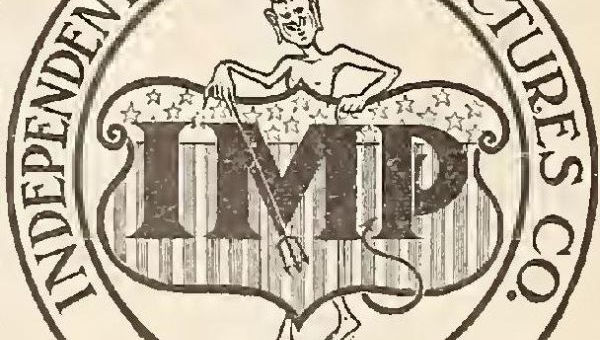
The Independent Moving Pictures Company logo
Founder(s):
Years Active:
1909 - 1912
Key Films:
Hiawatha (1909), The Awakening of Bess (1909), The Broken Oath (1910).
Origins: Exhibitor to producer
In 1906, 39-year-old Carl Laemmle resigned from a position he had held with the Continental Clothing Company for twelve years when it refused his request for a pay rise. Noting the boom in nickelodeons, he converted vacant premises at 909 Milwaukee Avenue in Chicago into a five-cent picture house at a cost of around $400. Business was so good that within two months he opened a second theatre later in 1906. In October of the same year, he established the Laemmle Film Service to ensure continuity and quality of supply to his own theatres and to distribute films to other exhibitors.
By 1909, thanks to the excellent service Laemmle and his partner Robert Cochrane offered their customers, the Laemmle Film Service was America’s largest distributor. That year, however, the newly formed Motion Picture Patents Company, whose members held the key patents for the production and exhibition of films, imposed strict rules which clamped down on filmmakers and exhibitors who refused to pay a monthly licence fee. A fee also applied to any company wishing to distribute films made by filmmakers who operated under an MPPC licence, meaning that failure to pay resulted in their supply being cut off.
As the company’s largest distributor, Laemmle expected to be invited to join the MPPC. It would have been wise for them to do so: with Laemmle among their ranks, the course of film history may well have followed a very different path. While he believed entry to their exclusive club was possible, Laemmle fired off letters to exhibitors urging them to comply with the MPPC’s diktats. Only after he realised that there would be no place for him did he perform an about-face and place advertisements in trade papers attacking the MPPC.
Fighting the Trust
Once Laemmle realised he was in the same position as the other distributors and exhibitors, he decided he must become a producer. In the Moving Picture World dated 5th June 1909, he placed an advertisement which read, “EXTRA. Carl Laemmle Becomes a Film Manufacturer. Organizes a New Company To Be Totally Separate from the Laemmle Film Service. Will Make a Tremendous Specialty of American Subjects.”
He named his new business the Yankee Film Company, but changed its name to the Independent Moving Picture Company of America (IMP). The name was a declaration of purpose; an insistence that films could be produced and marketed outside the MPPC’s licenced structure despite the sustained pressure the Trust placed on independents. Laemmle became such a thorn in the Trust’s side that it filed an extraordinary 289 legal actions against him.
IMP released its first production, Hiawatha, adapted from Longfellow’s The Song of Hiawatha and starring Gladys Hulette, under the direction of William Ranous, in the autumn of 1909. Laemmle had lured Ranous from Vitagraph, a founding member of the MPPC, a feat he would repeat with various technical staff and stars.
The film won fulsome praise from the Moving Picture World, which reported, “It is stamped all over with the signs of success. The photography is good, the acting of the story is well sustained all through, and, barring a few minor blemishes of a technical nature, inseparable from the haste of a first production, this film of Hiawatha is quite entitled right away to take rank as a first-class specimen of American-made film of an American subject by American labor.”
Soon, IMP was producing one short film a week, and Laemmle embarked on a campaign to win public support while pouring scorn and ridicule on the MPPC at every opportunity. In April 1910, he formed the Motion Picture Distributing and Sales Company with fellow independents Adam Kessel and Charles Baumann of the New York Motion Picture Company. The Sales Company, as it became known, was intended to co-ordinate the marketing and distribution of independent films. This combined strength of the independents not only provided serious competition to the Trust, but provided its members with reliable distribution.
The Sales Company provided an important alternative structure for production and distribution for the independents, but IMP’s most important cultural innovation was probably its contribution towards the development of the star system.
Florence Lawrence and the star system
Details of how Florence Lawrence joined IMP in 1909 are unclear: some claim Laemmle enticed her away from Biograph, while others insist Biograph had already fired and blacklisted their star actress after she tried to negotiate an improved contract with Essanay. Lawrence had become popular amongst audiences, but as the studio refused to name its players, fearing they would demand higher wages, she was known only as “The Biograph Girl.”
Whatever the circumstances behind Lawrence’s recruitment, Laemmle exploited his new signing after a rumour circulated in 1910 that the Biograph Girl had died after she was struck down by an automobile by placing an ad proclaiming “We Nail a Lie,” naming Lawrence as the Biograph Girl, and revealing that not only was she alive and well, but she was now “The IMP Girl.” When IMP announced that Lawrence would visit St. Louis to prove all was well, a huge crowd gathered at the train station to greet her. The crowd allegedly mobbed the bewildered actress when she appeared on the train’s steps, ripping buttons from her clothes and snatching the hat from her head, heralding with their frenzied actions the dawn of the star system. Lawrence may not have been the first actor to be named—records suggest Max Linder beat her by a matter of weeks—but she was the first to attract a legion of adoring fans.
It’s entirely possible that Robert Cochrane and Laemmle were responsible for circulating the rumour of Lawrence’s demise—or that they fabricated its very existence so that they could publicly denounce it. What is certain is that by skilfully exploiting the situation, they further undermined the objectives of the MPPC.
IMP often starred Lawrence opposite King Baggot, the son of Irish immigrants from St. Louis who became one of early cinema’s biggest stars. The Awakening of Bess (1909), his screen debut, marked the first of more than forty films the couple made together in two years before Lawrence left IMP in 1911. Laemmle replaced her with Mary Pickford, another defector from Biograph, who made fourteen films with Baggot during her brief stay. Many of these were filmed in Cuba, to where IMP decamped early in 1911 to escape the unwelcome attention of the Trust, which wasn’t above engaging thugs to enforce its will if legal means failed. Among the crew members was director Thomas H. Ince, who would become a major Hollywood producer before his untimely death in 1924.
Legal challenges to the Trust diverted its attention from pursuing the independents to such a degree that Laemmle felt able to recall the unit from Cuba. Around the same time, Eastman Kodak withdrew from an agreement to sell its film stock exclusively to Trust members, triggering a boom in independent production.
From IMP to Universal
Laemmle had largely succeeded in his aim of building a production company that could compete with the major companies operating under the protection of the MPPC. However, he realised that to ensure its survival he needed to strengthen his position. On 8th June 1912, Laemmle merged IMP with Powers Motion Picture Company, Baumann and Kessel’s New York Motion Picture Company, William Swanson’s Rex Motion Picture Company, Mark Dintenfass’s Champion Film Company, and David Horsley’s Nestor Film Company. A week later, they were joined by the American Eclair Co.
Legend has it that the partners in this new company struggled to think of a suitable name for it until Laemmle spotted a truck pass in the street outside with the lettering Universal Piping Company on its side.
“Gentlemen,” he said. “Why not call ourselves the Universal Film Company?”
Sources: Picture Personalities: the Emergence of the Star System in America, Richard DeCordova; The Biograph Girl, William J. Mann; Early American Cinema, Anthony Slide; Women Who Made a Difference, Malcolm S. Forbes; Big U: Universal in the Silent Days, I. G. Edmonds; The Universal Story, Clive Hirschorn; Mary Pickford, America’s Sweetheart, Scott Eyman; Florence Lawrence, the Biograph Girl: America’s First Movie Star, Kelly R. Brown; The Life and Adventures of Carl Laemmle, John Drinkwater.
Independent Moving Picture Company (IMP) Timeline
June 1909 – Carl Laemmle forms the Yankee Company after his distribution company is refused entry into the Motion Picture Patents Company.
Mid-1909 – Laemmle changes the company name to the Independent Moving Picture Company.
1909 – IMP establishes operations in New York, with production facilities at Fort Lee, New Jersey.
Late 1909 – Laemmle hires Florence Lawrence—the familiar but anonymously billed “Biograph Girl”—and her husband, director Harry Solter.
25th Oct. 1909 – IMP releases Hiawatha, adapted from Longfellow’s poem.
Late 1909 – Stage actor King Baggot joins IMP; his early films include The Awakening of Bess (1909), directed by Harry Solter.
Early 1910 - Reports circulate that Florence Lawrence has been killed in a streetcar accident.
12th March 1910 – IMP places an advertisement in Moving Picture World declaring “We Nail a Lie.” The ad denies Lawrence’s alleged death and states that “Miss Lawrence” is alive and working for IMP.
14th March 1910 – Lawrence receives a screen credit in IMP’s The Broken Oath, directed by Harry Solter.
Spring 1910 - Lawrence makes a heavily publicised personal appearance at Frank Talbot’s Gem Theater in St. Louis.
December 1910 – Mary Pickford signs with IMP for $175 per week and appears with King Baggot in a series of short films.
Jan 1911 – Florence Lawrence and Harry Solter leave IMP.
April 1911 – Thomas H. Ince directs Pickford in The Stampede.
1911 – IMP produces a high-volume programme of short dramas, comedies, romances, action pictures and Westerns.
8th June 1912 - The Universal Film Manufacturing Company is incorporated in New York. The new organisation combines IMP with firms owned by fellow independent producers Pat Powers, Mark Dintenfass, William Swanson, David Horsley, Charles Baumann and Adam Kessel.