Carl Laemmle

Carl Laemmle with the Best Picture Oscar for All Quiet on the Western Front (1930)
"He treated people fairly, 'liked intelligent women'... and was not a lech — which does make him somewhat of a rarity in Hollywood."
Anonymous quote recalled by family member
Birth name:
Karl Lämmle
Born:
17th January 1867, Laupheim, Germany
Died:
24th September 1939, Los Angeles, California, USA
Years active:
1906 - 1930
“Uncle Carl Laemmle
Has a very large faemmle”
Because of Ogden Nash’s famous rhyme, many people only know Carl Laemmle for his well-known tendency for nepotism as head of Universal Studios. However, his stubborn resistance to the Motion Picture Patents Company’s attempted stranglehold on rival filmmakers changed the course of early American cinema…
Karl Lämmle (pronounced Lem-lee), the tenth of thirteen children, was born in Laupheim, Germany on 17th January 1867 to Julius Baruch and Rebekka. Eight of his siblings died while he was a child, the victims of scarlet fever. Karl left school at thirteen to become an apprentice and errand boy for a wholesaler in the nearby village of Ichenhausen. He remained with the company for four years, rising to the position of office manager and bookkeeper.
His brother Joseph had emigrated to America, and the letters he sent home awoke in Karl an ambition to live in the ‘land of the free.’ The only obstacle to his doing so was the promise he made to his mother that he would not leave Germany while she was alive. However, after she died unexpectedly in September 1883, his father purchased for his son on his seventeenth birthday a ticket for the SS Neckar, bound for America. He also gave him $50 for the journey. Not being a wealthy man, Julius borrowed both this sum and the price of the ticket.
Karl left Laupheim on 28th January 1884. The ship sailed from Bremerhaven three days later and arrived at the Castle Garden Emigrant Depot in New York on 14th February. He found a job in a drugstore on 38th Street but disliked the work and the owner, so each morning he would rise at four a.m. to be among the first to buy the German-language newspaper that advertised vacancies in the city. With his funds depleted, Carl traced his brother, Joseph, who sent him ten dollars and a ticket to Chicago, where they were reunited.
Laemmle spent the next twenty years toiling in various occupations, showing little evidence that he would one day become a titan of one of America’s biggest industries. In 1894, he moved to Oshkosh, Wisconsin, where he found work as a bookkeeper with the Continental Clothing Company. By 1898, he was the store manager and married to owner Sam Stern’s niece, Recha. The store thrived under Laemmle’s managership thanks to his intuitive understanding of the importance of effective advertising. However, Stern was not so enamoured of Laemmle’s achievements that he would accede to his request for a raise in 1906. Stung by this refusal, Laemmle resigned from Continental, despite having a young family to support.
With what little money he had saved, Laemmle planned to open a chain of five and ten cent stores, but, observing how popular the ‘flickers’ were becoming, and the rapid boom in nickelodeons—the cheap converted stores in which the short films were shown—he chose instead to convert vacant premises at 909 Milwaukee Avenue in Chicago into a five-cent picture house at a cost of around $400. Painted white, he called it The White Front and presented his first program on 24th February 1906. Business was so good that within two months he had opened a second nickelodeon at 1233 Halstead Street, which he named The Family Theatre. To advertise the business, he enlisted his friend Robert H. Cochrane, whose services he had used while at the Continental Clothing Company. In October of the same year, he opened The Laemmle Film Service to ensure continuity and quality of supply to his own theatres and to distribute films to other exhibitors.
By 1909, the Laemmle Film Service was the largest distributor in America. Its success was built on a reputation for excellent service and its expansion assured, thanks to a $2,500 investment by Cochrane in return for a ten per cent interest in the business. However, an agreement made by a cabal of the industry’s biggest producers in December 1908 seriously threatened to derail Laemmle’s thriving business. Led by Thomas Edison, the self-proclaimed father of cinema, the group established the Motion Picture Patents Company. Its members held the key patents to film production and demanded that all other producers, distributors, and exhibitors pay a licence fee to use their patented equipment and distribute or exhibit their films. Licensed exchanges were prohibited from renting films to unlicensed exhibitors.
While most exchange owners felt compelled to comply with the demands of Edison’s ‘Trust,’ Laemmle decided to fight an organisation that was clearly established to stifle competition in the motion picture industry. Confident that any legal action the Trust might take against those who defied its rules could be dragged out for years, Laemmle decided to produce his own films and sell them to independent exhibitors.
On 12th April 1909, he withdrew from the agreement into which the Trust had forced him. Realising that if his rebellion was to succeed, he would need public support, he launched an advertising campaign in which he mocked and ridiculed the Trust while highlighting every mistake it made. The Trust retaliated by threatening to fine or exclude any exhibitor who showed one of Laemmle’s films. Laemmle responded by promising to pay the damages for any customer who delivered “one swift, speedy kick in the seating capacity” to anyone seeking to punish them.
To produce his films, he hired William Ranous and sent him off to Minneapolis, far from the Trust’s spies, to make Hiawatha (1909). He held a competition to decide on the name of his new production company and settled on The Independent Moving Pictures Company (IMP). Soon, Laemmle’s company was producing one picture a week. In 1910, that number doubled, despite the constant threat from heavies hired by the Trust to disrupt shooting and having to evade process servers attempting to deliver new lawsuits on behalf of the MPPC.
1910 also saw Laemmle pull off a major coup by enticing Florence Lawrence, known only to her admiring audience as the Biograph Girl, from that studio—which also happened to be a member of the MPPC. Robert Cochrane circulated a story that the Biograph Girl had been struck down and killed by a vehicle in St. Louis, then created an advertisement which famously proclaimed, “We Nail a lie” before revealing that the Biograph Girl was alive and well and had signed with IMP. He then proved his claim by having Lawrence accompany King Baggott, IMP’s first leading man, for personal appearances in St. Louis, where they were mobbed by adoring fans. By revealing Lawrence’s name, Laemmle created the star system that would become an integral component of Hollywood’s promotional strategy and result in stratospheric wages for the top stars.
Soon, cracks appeared in the resolve of the Trust. George Eastman, fearing his company was in violation of anti-trust laws, withdrew from an agreement to sell his film stock only to its members. The lifting of this embargo resulted in a boom in independent production. When legal means proved too slow, Jeremiah J. Kennedy of the MPPC hired thugs to disrupt independent film sets by shooting at cameras and hurling rocks at actors. To escape the Trust’s harassment, independents fled across the country to California. Laemmle sent his crew, which now included Mary Pickford and Thomas H. Ince, to Cuba.
In June 1912, to strengthen his position against the Trust, Laemmle joined a combine of independent filmmakers whose other members were Pat Powers, Mark Dintenfass, David Horsley, Adam Kessel, Charles Baumann, Fred Balshofer, and Bill Swanson. Internecine warfare in the Universal Film Manufacturing Company immediately broke out, and all but Powers sold out to Laemmle the same year.
The political climate in the USA changed with the election of Woodrow Wilson in 1912. He disapproved of trusts, and the MPPC found itself fighting a legal battle against the government’s charge that it had created a monopoly in violation of the Sherman Antitrust Law. The Trust’s preoccupation with fighting this charge left Universal free of the harassment that had forced it to flee, and production increased significantly. Initially, Laemmle was against the production of feature films, despite the success of Universal’s first feature, the exploitative slave traffic movie Traffic in Souls (1913).
However, he was an astute businessman, and quickly adapted to the production of features when it became clear they had won the approval of the public. He was also quick to order the production of a serial following the unprecedented success of Selig’s The Adventures of Kathlyn (1913). Lucille Love, the Girl of Mystery (1914), starring Grace Cunard and Francis Ford, reached cinemas just one week ahead of the definitive silent serial, The Perils of Pauline (1914). It was successful enough to make stars of its two leads.
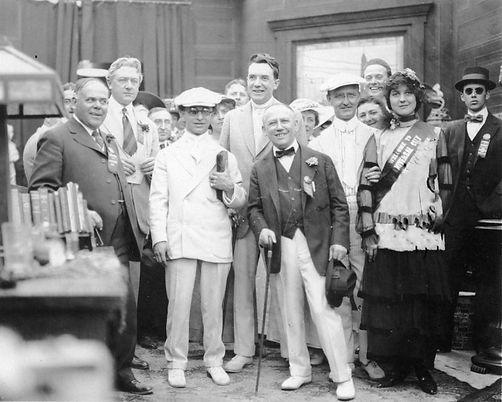
Carl Laemmle with Robert H. Cochrane (to Laemmle's right) at the opening of Universal City
Early in 1914, Laemmle began winding down production on the East Coast and instructed West Coast manager Isidore Bernstein to purchase the Taylor ranch in the San Fernando Valley. The price was $165,000 with a down-payment of $3,500, and it expanded Universal City by 230 acres. The land that would provide the backdrop for hundreds of movies over the following decades had rolling hills dotted with trees, a stream, and even some arid scrubland. It was also where Mexico signed the contract ceding California to the United States. The construction of new stages, film labs, administration units, and animal pens began in June 1914 under William Horsley’s supervision—although before he could erect buildings, he had to build the roads to reach their locations.
Horsley worked on a schedule that ensured all would be ready for a grand opening in March 1915, although film production began at the site long before then. Thousands of curious movie fans turned up for Universal City’s official opening on 15th March 1915. In fact, it was so successful that Laemmle continued tours of the studio, during which visitors could sit on bleachers and watch films being shot. Over 250 films were produced at the studio in 1915.
As the studio expanded, the number of staff grew. Among them was a 19-year-old youth named Irving Thalberg, who joined the New York office as an office boy in 1918. Laemmle, who was always quick to notice talent within his ranks, made him general manager in charge of production in 1920.
Laemmle was the first studio chief to commission a woman to direct a feature film, when in 1914 Lois Weber co-directed Universal’s The Merchant of Venice with her husband Phillips Smalley. Ida May Park, a forgotten female movie pioneer, wrote and directed The Flashlight for the studio in 1917. Many future stars served their apprenticeships at Universal, including Harold Lloyd, Herbert Brenon, Lew Cody, Betty Compson, Rex Ingram, Mae Murray, Carmel Myers, Rudolph Valentino, Erich von Stroheim, and Pearl White. Future Columbia founder Harry Cohn and his brother Jack even worked for Laemmle for a while. Its stars were a who’s who of silent screen icons: Wallace Reid, Harry Carey, Hoot Gibson, Jack Hoxie, Annette Kellerman, Conrad Veidt and Lon Chaney.
In 1920, Laemmle and Cochrane bought out Pat Powers to become sole owners of the studio. Perhaps, feeling sympathy for a fellow émigré, Laemmle allowed Erich von Stroheim to direct his first film. The success of Blind Husbands (1919) led to a second, equally successful film, The Devil’s Passkey (1920). However, Stroheim’s meticulous attention to detail and extravagance resulted in his third picture, Foolish Wives (1922), costing four times its original budget. With typical guile, Laemmle used the crippling cost as a major selling point in the film’s publicity campaign. Thalberg, however, was less forgiving, and Stroheim’s next film, Merry-Go-Round (1923) was his last for Universal.

Paul Leni, another immigrant given his chance by Laemmle, proved to be more reliable. Among the three horror films he directed for Universal, his The Man Who Laughs (1928), in which Conrad Veidt plays a clown with a disfiguring smile carved into his face, is widely acknowledged as a masterpiece of silent cinema.
It wasn’t only friends and fellow countrymen who received a helping hand from “Uncle Carl.” He reputedly promoted stuntman John Ford to director, declaring, ‘That Jack Ford, he yells real loud. He’d make a good director.’
Laemmle negotiated the transition to sound with typical professionalism, releasing the big-budget musicals Show Boat and Broadway in 1929. He also oversaw the making of the Technicolor revue picture, King of Jazz (1930). His most prestigious picture from the early sound era, was Lewis Milestone’s harrowing anti-war epic All Quiet on the Western Front (1930), the haunting tale of a group of school friends who enlist in the German army at the outbreak of the Great War, little realising the relentless horrors that await them. The film won the 1930 Academy Award for Best Picture, and while this no doubt pleased Laemmle, it has been suggested he financed the movie in the hope of winning an even greater award: the Nobel Peace Prize.
In 1930, Laemmle made his son, Carl Laemmle Jr., the studio’s general manager in charge of production, giving rise to Nash’s acerbic quip. Inspired by the success of All Quiet, Laemmle Jr. cut production of routine pictures by 40 percent to finance the making of quality pictures he hoped would rival the kind of films MGM and Paramount produced. Laemmle’s son wasn’t without talent and oversaw the production of several highlights during the early thirties. Universal enjoyed unparalleled success in the horror genre, beginning with its adaptations of Dracula (1931) and Frankenstein (1931) and with women’s movies such as Imitation of Life (1934) and Magnificent Obsession (1935). However, the return on expenditure was too low to satisfy the studio’s stockholders, and matters came to a head with the costly gold strike biopic, Sutter’s Gold (1936).
In November 1935, Laemmle Sr. had to borrow $750,000 from an investment firm, offering his controlling interest in the studio as security. He hoped that a remake of their 1929 hit Show Boat would earn enough to solve their financial problems, but the film only incurred greater debts due to delays. On 14th March 1936, Cowdin’s Standard Capital, the group that had loaned Laemmle the money, called in its option. Laemmle sold his interest in the studio for an estimated $5,500,000 and no longer had any connection with the studio he founded.
Laemmle was among the first to recognise the threat that the rise of Nazism posed to his fellow Jews. In January 1932, before Hitler even came to power, he wrote to William Randolph Hearst of his ‘great concern over the danger to his own race and gentiles around the world should Hitler rise to power’. In retirement, he devoted much of his time to aiding refugees from the Nazi regime, employing two secretaries to help him secure American citizenship for more than 300 refugees. He also worked tirelessly on behalf of the Hollywood Anti-Nazi League, drawing public attention to the tyranny of Nazism.
Laemmle also provided help to those refugees he helped to find a home in America. To one woman, he wrote, “If [your relative] doesn’t give you sufficient money to get along on, I will give you what you are short of. I know you will not ask for anything unless you actually need it. But you can absolutely depend on me to stand by you until you get on your feet.”
On 24th September 1939, two weeks after writing the letter, Laemmle died of a heart attack. He was 72 years old. Hollywood united in its grief over his passing, and those who had known him rushed to pay tribute. Joseph M. Schenck, the chairman of Twentieth-Century-Fox, encapsulated their warm feelings towards ‘Uncle Carl’ and their deep sense of loss when he wrote, “Laemmle was a friendly man, and it is in that character even more than in his leadership that Hollywood will remember him, for he never turned a deaf ear to misfortune and his benign generosities will never be forgotten in this generation because they were so widespread.”
Laemmle’s funeral service took place at the Temple B’nai B’rith, Los Angeles, on 26th September 1939. Rabbi Edgar Magnin, delivering his eulogy, said, “He was little in stature, but he was big in spirit; a man whom to know was to love.”
Sources: The Life and Adventures of Carl Laemmle, John Drinkwater; Big U: Universal in the Silent Days, I. G. Edmonds; Remembering the Hollywood Mogul Who Rescued Hundreds of Jews, Thomas Doherty, Hollywood Reporter, 29th December 2015; The City of Dreams and Nightmares, David Robinson, The Movie Partwork; Motion Picture Daily, 26th & 27th September 1939.
Carl Laemmle Filmography (key films only)
Hiawatha (1909); The Broken Oath (1910); Their First Misunderstanding (1911); Traffic in Souls (1913); Ivanhoe (1913); Dr. Jekyll and Mr. Hyde (1913); Lucille Love: The Girl of Mystery (serial) (1914); The Master Key (serial) (1914); Shoes (1916); Where Are My Children? (1916); The Dumb Girl of Portici (1916); Idle Wives (1916); The Tornado (1917); The Piper’s Price (1917); The Craving (1918); A Society Sensation (1918); The Wicked Darling (1919); Blind Husbands (1919); The Devil’s Passkey (1921); Foolish Wives (1922); The Storm (1922); The Hunchback of Notre Dame (1923); Merry-Go-Round (1923); The Shock (1923); The Wild Party (1923); The Phantom of the Opera (1925); The Goose Woman (1925); The Cohens and Kellys (1926); The Cat and the Canary (1927); Uncle Tom’s Cabin (1927); The Man Who Laughs (1928); Lonesome (1928); Show Boat (1929); Broadway (1929); The Last Warning (1929); All Quiet on the Western Front (1930); The King of Jazz (1930); The Cat Creeps (1930).