Siegmund Lubin

Siegmund Lubin
"When a man takes pleasure in his work, the best is not too good."
Siegmund Lubin
Birth name:
Siegmund Lubszynski
Born:
April 1851
Died:
11th September 1923, Ventnor, New Jersey, USA
Years active:
1896 - 1916
Early life
Siegmund Lubin was born in Berlin on April 20, 1851. Or perhaps it was in Hamburg on April 21, 1854. It might even have been Breslau in 1856. All these dates and places he claimed as the circumstances of his birth at various times. Nobody seems to know for sure; Lubin liked to change the details of his origins to suit his audience. What we do know is that he was born Siegmund Lubszynski to Samuel, a successful optician, and Rebecca. Samuel died when Lubin was young, so after school he worked in a chemical factory on the outskirts of Berlin. An accident on the job cost young Siegmund the sight in his right eye, and over time the eyeball sunk in its socket.
At home, Lubin and his brothers manufactured and sold ink. The money he earned enabled him to attend Heidelberg University, from where he graduated with a degree in ophthalmology. It also paid for him to follow his cousin Joseph to America in 1868. In the ‘New World,’ he journeyed by train from New York to San Francisco intending to sell “tin pins and earrings” to the Native Americans. It was a doomed venture that ended in failure and a boat trip back to Germany.
He returned to America in 1876, where Cousin Joseph once again welcomed him and took him to his lodgings in New Haven, Connecticut. There he met his wife to be, Annie Abrams, the daughter of Joseph’s landlady. The couple married in October 1882 and went on the road together. Lubin sold eyeglasses at fairs and expositions around the country until Annie fell pregnant. Times were so hard that at one point he had to sell his trousers to a Native American to raise the money for a bed for the night.
Annie gave birth to a daughter, Edith Southern, while Lubin was at the Louisville Exposition of 1883. When Annie insisted they settle down now that they had a child, they chose Philadelphia. They lived in a single boarding-house room, and Lubin sold his glasses on the street, offering a complete service for $1. He saved what he could, and the young family moved into a small apartment above Lubin’s first optical shop at 237 North Eighth Street. Once established, he hired an assistant, John J. Frawley, who remained with him for the next thirty years. A gifted technician, Frawley registered several patents in his employer’s name, including pivoting nose pads for spectacles.
Lubin returned to his itinerant lifestyle, travelling the country to sell his wares at fairs and expositions while Annie looked after the shop. On one of these expeditions, he became interested in the emerging technology of moving pictures. Noting the skyrocketing popularity of song slides in vaudeville theatres, Lubin began producing magic lantern and song slides for local theatres. This expansion of his activities called for larger premises, so around 1890, he moved his operation to a three-storey property at 21 South Eighth Street.

Early film career
At the 1893 World’s Colombian Exposition in Chicago, Lubin encountered Eadweard Muybridge’s demonstration of ‘animal locomotion’ in his ‘Zoopraxographical Hall.’ Muybridge’s sequences of projected images fired Lubin’s imagination. “He showed a horse walking by stereopticon pictures shown rapidly one after the other,” Lubin later remembered. “I started to experiment with the idea then.” For the next two years, he endeavoured to invent a motion picture camera without success until he met C. Francis Jenkins at the Cotton States and International Exposition in Atlanta in the summer of 1895.
In December of that year, Jenkins demonstrated the projecting machine he called the ‘Projecting Phantoscope’ at the Franklin Institute in Philadelphia, just a block from Lubin’s shop. Jenkins lost his rights to the Phantoscope after its co-inventor, Thomas Armat, bought him out. With a few minor modifications, the machine was now being marketed as the Vitascope by Edison himself, a situation which left Jenkins embittered against his former partner. He agreed to Lubin’s offer to buy the camera he had used to make the films and even worked with him as a technical consultant.
Lubin made his first short films with Jenkins’ camera in 1896 and projected them for his neighbours. In the late summer, while on a sales trip to New Orleans, he saw William T. Rock exhibiting motion pictures and appreciated for the first time their enormous commercial potential. With renewed vigour and with the faithful Frawley’s assistance, he built a projector he called the Cineograph. He advertised his invention, marketed by his new company, Life Motion Pictures, in the trade paper the New York Clipper, pursuing an aggressive practice of mass marketing. More than any of his competitors, Lubin understood how important effective advertising was to the success of a business. He could also offer exhibitors a wider variety of subjects than his rivals, thanks to his habit of buying every film they made and passing them off as his own—a practice known as ‘duping.’ To deflect suspicion, he would, like his competitors, insert a message in adverts warning clients against buying copies of ‘his’ films.
These tactics earned Lubin a reputation as a dishonest and unethical businessman—a perception he reinforced by advertising a re-enactment of the championship fight between ‘Gentleman Jim’ Corbett and Bob Fitzsimmons as the real thing. Much to his neighbours consternation, he filmed the staged bout, as well as many other films, in his backyard. To benefit from the war fever whipped up by the ‘yellow press’ during the Spanish-American War he needed to find a larger stage in which to stage his re-enactments of the battles; with typical audacity, he selected Philadelphia’s Fairmount Park for his arena.
Around this time, Thomas Edison, who considered himself the inventor of the motion picture and therefore believed he owned the sole right to exploit it, started pursuing Lubin and others for patent infringement. Lubin indignantly informed his lawyer, “I want nothing to do with that man.” “Well, Mr Lubin,” his lawyer famously replied, “He wants something to do with you!”
In 1899, the complaints of his neighbours grew so vociferous that Lubin moved his studio to the roof of 912 Arch Street in the city's red-light district, correctly assuming its residents were less likely to complain about the sometimes off-colour scenes he shot. In 1899, he also became the first American manufacturer to market his product in Germany.
Battles with Edison
Lubin’s legal battle with Edison rumbled on for nine years. Despite his claims against Lubin, Edison wasn’t above a few infringements of his own, entering into an agreement with Vitagraph in which they bought Lubin’s films on Edison’s behalf so that he could dupe them. The future looked grim for Lubin when Edison won a legal action against the American Mutoscope and Biograph Company which appeared to give him full control of the motion picture industry. Instructed by his legal team to leave the business or face serious repercussions, Lubin moved his entire operation to Germany, beyond even Edison’s reach, as the Wizard of Menlo Park had neglected to apply for patents beyond the United States’ shores. Lubin’s self-imposed exile was short-lived: the moment the court overturned Edison’s victory on appeal, he returned to America and resumed his activities.
Soon after his return, Lubin established the first of what would become a chain of movie theatres at 926 Market Street, possibly as something to fall back on should Edison relentless legal action meet with more permanent success. In 1903, he also established the Philadelphia Film Exchange, offering to rent “one million feet of film on 1,000-foot reels, changed weekly.” By 1905, it would be one of the largest exchanges in the country, with offices in Philadelphia, Cincinnati, and Norfolk.
Lubin’s business expanded rapidly over the next two years despite renewed legal action by Edison. He began making narrative films, often scene-for-scene remakes of popular films like The Great Train Robbery (1903) and Personal (1904) and scored a coup in 1906 by being the first producer to bring footage of the devastating San Francisco earthquake to East Coast screens (he would later include some of the footage in his 1913 three-reel drama When the Earth Trembled). However, in 1907, Edison’s continual legal challenges finally paid off when he won a decision against Biograph that was sure to pave the way for a similar lawsuit against Lubin. Realising he was defeated at last, Lubin accepted Edison’s recommendation that he take out a license to use his patented projector to spare them both the cost of a legal case.
Also in 1907, Lubin rented the entire five-storey building at 926 Market Street that was home to his theatre. He converted the floor above the theatre into a studio and the top floors into processing labs and offices. Once installed, he announced the release of “A New Film Every Week.” While he awaited Edison’s terms for becoming a licensee, he renovated and expanded existing theatres and opened new ones in Baltimore, Cincinnati, and Reading.
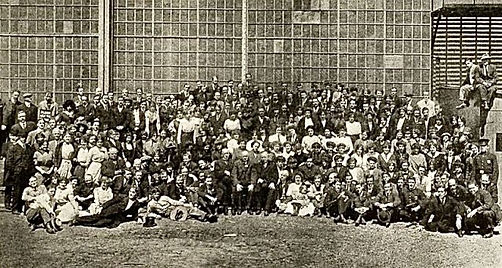
Siegmund "Pop" Lubin with his family of employees, 1912
Lubin became an Edison licensee in 1908 and undertook to no longer dupe other manufacturer’s work or sell second-hand films. By now he employed 150 people and was finding work for family members within his organisation wherever he could. He considered his workforce, most of whom called him “Pop”, an extended family and guaranteed many a position for life.
Lubin completed his assimilation into Edison’s autocratic dream of controlling the American film industry when he became a founder member of the Motion Picture Patents Company—otherwise known as the Edison ‘Trust’—in December 1908. Fellow members were among the most important operating in the industry: Edison, Biograph, Essanay, Kalem, Pathé, Selig, Méliès, Vitagraph, and George Kleine. However, his alliance was an uneasy one. He owned none of the patents considered essential and therefore had to pay royalties to the Trust even as he received a share of the royalties paid to the MPPC by other licensees.
Peak years
Lubin felt no particular allegiance to the MPPC; he took its rejection of his patents as a personal insult and wasn’t beyond selling film reserved for Trust members to Charles Baumann of the independent New York Motion Picture Company. He also aided the Trust’s nemeses, the independent filmmakers, if it made sound business sense to him. When Trust heavies repeatedly physically intimidated crews working for Mark Dintenfass, one of the future co-founders of Universal, Lubin offered him the use of his Arch Street studio and even distributed Dintenfass’s films under his own brand. He also came to the aid of a young Cecil B. DeMille, co-founder of the Jesse L. Lasky Feature Play Co., when he couldn’t get the studio’s - and Hollywood’s - first feature film, The Squaw Man (1914), to project properly (Lubin’s technician, Frank Haas, soon discovered DeMille’s technicians had spaced the sprockets incorrectly).
Confident now of his place within the industry, Lubin sold his chain of theatres to concentrate on production, distribution, and manufacturing. He built a new, state-of-the-art glass-housed studio—dubbed Lubinville by the press—at 20th Street and Indiana Avenue, North Philadelphia, after first filing an application to incorporate the Lubin Manufacturing Company. The complex employed modern artificial lighting for filming during cloudy weather and comprised dressing rooms, areas for prop storage and set construction, film processing labs and nitrate storage vaults, and a staff cafeteria. It also had an open tank beneath the studio floor which could be flooded if a scene required it.
With Lubinville operational from 1911, Lubin next concentrated on improving the quality of his films, which some considered inferior to the industry standard. It was a criticism that grew louder in 1910 while he was devoting all his time and energy to the construction of his new studio. In late 1910, he signed Florence Lawrence, the industry’s first movie star, and her husband, director Harry Solter, to the studio. To appear opposite Lawrence, Lubin hired Biograph leading man Arthur V. Johnson. Other stars he brought to the studio included Ormi Hawley, John Halliday, and Pearl White. John Barrymore, Lillian Russell, and Alla Nazimova also briefly worked for him.
By September 1912, Lubin was producing four reels a week and at the peak of his success. He embarked on an ambitious expansion program, purchasing the huge Betzwood estate in the suburbs of Philadelphia where he constructed a studio, and establishing yet another in Jacksonville, Florida. Fearing the standard of his films was dropping below that of the more progressive of his fellow MPPC members, he began producing multi-reel pictures. He also made his twenty-three-year-old son-in-law, Ira Lowry, general manager of the business. Despite his youth and relative inexperience, Lowry proved more than capable of managing one of the country’s largest movie companies.

Decline and death
In May 1914, the 63-year-old Lubin had every reason to believe the future was bright. The Betzwood studio had become the hub of his movie empire, which now included production facilities in Los Angeles and had more than tripled the company’s processing capacity. However, within two years he would be bankrupt, and his empire just a memory.
On June 13, 1914, shortly after 10am, disaster struck. An enormous explosion ripped through the east side of the Lubinville studios in Philadelphia. A fire spread, igniting millions of feet of film stock. Lubin lost his catalogue of films dating back to the company’s inception in a matter of hours. The emotional and financial cost was devastating to him.
The fire at Lubinville left the studio in dire financial peril. Lubin had been unable to obtain fire insurance because of the notorious volatility of nitrate film stock. The loss was valued at $500,000, and the cost to repair the damage wrought by the fire was $10,000. To add to his problems, Lubin had invested heavily in producing feature-length movies, using his own and borrowed money. Legal fees incurred by the Motion Picture Patents Company had depleted his reserves even further.
He might have survived had another catastrophe beyond his control not occurred in Sarajevo on June 28, 1914. The assassination of Archduke Franz Ferdinand during a state visit to Serbia triggered the Great War. The conflict prompted the closure of many European distribution offices, a vital source of income for Lubin. War drove up the price of chemicals used in processing film. The increased production costs, the move into producing feature films, and reduced overseas distribution combined to send Lubin spiralling into ever-deeper debt. His studios in Los Angeles and Coronado closed in May 1916, and production at Betzwood virtually ground to a halt. Lubin’s health declined, forcing him to recuperate at his daughter’s home in Atlantic City. In mid-August, the creditors seized control and demoted Lubin to vice president, but he was never again involved in producing movies.
With his money gone and in failing health, Lubin moved into a modest bungalow in Ventnor. He returned to the optical profession and the shop on South Eighth Street in Philadelphia that he had never relinquished.
He often spoke of making a comeback, but his resurrection never materialised. His health continued to worsen in the 1920s, and he spent much of the last year of his life bedridden, suffering from heart disease and diabetes. He died at his home in Ventnor at one o’clock in the morning of September 11, 1923.
In 1924, Thomas Edison established a fund for Annie, his old enemy’s now impoverished widow. D.W. Griffith, Louis B. Mayer, Sam Goldwyn, Adolph Zukor, Jesse Lasky, Marcus Loew, William Fox, Harry Warner, Joseph Schenck, Thomas Ince, Carl Laemmle, Mary Pickford, and Douglas Fairbanks were among those who contributed.
Sources: The King of the Movies: Film Pioneer Siegmund Lubin, Joseph P. Eckhardt.
Siegmund Lubin filmography
(selected titles)
Horse Eating Hay (1896).
Daughters’ Pillow Fight (1897), Unveiling the Washington Monument (1897).
Passion Play (1898), Sappho’s Kiss (1898), Spanish-American War Films (1898).
The Tramp’s Dream (1899), A Trip to the Moon, A (1899).
Couchee Dance on the Midway (1901), Panoramas of the Exposition (1901), The Stud Farm, #1 and #3 (1901).