Before Hollywood: the 1900s
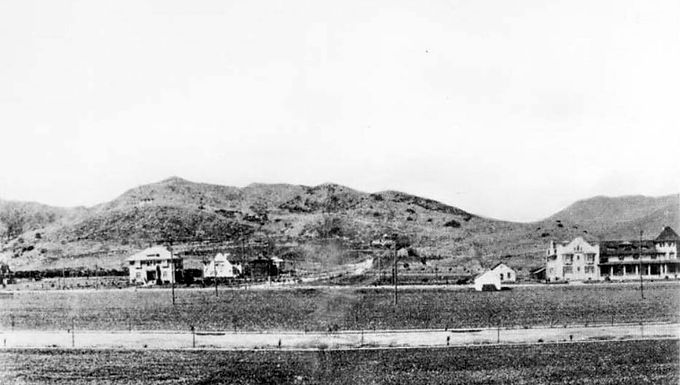
Hollywood in the 1900s
The American film industry of 1900 was not so much an industry as a fragmented assortment of pioneers working independently of one another. Anyone who could afford to buy—or build—a primitive camera could make a film, and they were shown in vaudeville theatres, music halls, and in fairground tents. Movies were entertainment for the working classes, particularly immigrants who spoke no English but who might, while watching simple films that could not yet talk and needed no intertitles, enjoy a sense of community with their fellow audience members. A typical programme might include actualities, comic scenes, trick films, travel pictures, illustrated songs, sound effects, and live performers.
But cinema was in the doldrums by 1902. Audiences had grown tired of the ‘flickers’, which were relegated to the status of ‘chasers’ shown at the end of a vaudeville program to drive away stragglers so that the next show could begin. Edwin S. Porter’s The Great Train Robbery (1903), with its 14-scene tale of a daring western hold-up, reinvigorated the industry. Narrative films quickly superseded the actualities that had long outstayed their welcome.
Porter's groundbreaking film was the debut screening at the nation's first nickelodeon, opened by John P. Harris and Harry Davis in Pittsburgh in 1905. By 1908, there were an estimated 8,000 in the United States. By the end of the decade up to 26 million Americans were paying a weekly visit to these theatres, which were often just a converted store with wooden seats or benches facing a white sheet draped over a line or tacked to a wall. These crude picture halls raised concerns that they exposed children and audiences to crime, violence, and supposedly immoral conduct.
Edison, the self-proclaimed ‘father of cinema’, still led the way in production, even though he saw little future in the business. His main competitors were Vitagraph, founded in 1896 by J. Stuart Blackton and Albert E. Smith, and Biograph. W.K.L. Dickson, one of Biograph's co-founders, was a disaffected former Edison employee who, more than any other, could lay claim to being cinema’s true father. Other prominent studios in the first decade of the twentieth century included Kalem, noted for its location photography; Selig Polyscope, founded in 1896 by William Selig; the Lubin Manufacturing Company, also founded in 1896 by Siegmund Lubin; and Essanay, co-founded by George Spoor and the future ‘Broncho Billy,’ Gilbert M. Anderson.
1908 saw D.W. Griffith enter the film industry. Hired by Biograph as an actor, Griffith soon became the studio’s chief director when his predecessor, Wallace McCutcheon, fell ill. With Griffith at the helm, refining various techniques such as close-ups and cross-cutting, Biograph became one of the most successful of the early American studios. His notable early films include his directing debut, Adventures of Dollie (1908), A Corner in Wheat (1909), and The Lonely Villa (1909). The stars of these pictures remained anonymous; some preferred not to be identified, as many ‘legitimate’ theatre actors considered the ‘flickers’ to be disreputable, but studios also feared actors would demand wage increases should their names become known to the public. The press would often identify the most popular players by the studio they worked for; they dubbed Florence Lawrence the Biograph Girl, Florence Turner the Vitagraph Girl, and Mary Pickford the Girl with the Golden Curls.

Hollywood was not yet a hub for American filmmaking; in fact, no films were made there until the 1910s. Lubin was based in Philadelphia, and Selig was in Chicago; many film companies were clustered around New York and Fort Lee, New Jersey. Their studios were often on city rooftops or enclosed within glass walls and ceilings to make the most of natural daylight, as powerful lights to aid filming were not yet available.
It’s likely that all these companies engaged in piracy and duping, which became endemic with the introduction of film exchanges that rented films to exhibitors. Under the old sales system, a small exhibitor might have to buy a print and recover the expense through local ticket sales. Under the exchange system, that exhibitor could rent several recent films, change the programme more often, and return the prints for circulation elsewhere.
The industry was a battlefield of litigation, and the litigator-in-chief was Thomas Edison, who sought to protect what he considered his invention from all interlopers. In 1908, he formed the Motion Picture Patents Company, which brought together nine organisations that held the key patents for the production, distribution, and exhibition of moving pictures. The MPPC tried to claim a stranglehold on the industry by forcing all producers, distributors, and exhibitors to pay a licence fee to use their patented devices.
The MPPC, or Edison’s Trust, as it was commonly known, met stiff resistance from such independent filmmakers and distributors as William Fox, Adolph Zukor, and most of all, Carl Laemmle, who seemed to delight in being a constant thorn in the MPPC’s side. Laemmle, who owned one of the largest film exchanges in the country, vowed to buy product from any independent filmmaker and supply it to all-comers. In 1909, to ensure he had adequate material, he began his own production company, the Independent Moving Picture Company (IMP).
Many historians portray the MPPC as a villainous monopoly imposed on a helpless industry, but others argue it responded to genuine disorder and attempted to put an end to costly litigation and unbridled piracy. Whatever the motivation behind its formation, the Trust brought order to a chaotic business and planted the seeds for future development by coordinating its strategy and forcing the independents to team together to survive. By the end of the decade, those spearheading the industry, believing they had won the internecine warfare that had raged for much of the 1900s, now sought to appeal to the middle classes with artistic adaptations of stage plays and literature.

1900s Movies
Edwin S. Porter transforms cinema with The Great Train Robbery (1903), Kalem get into trouble over their adaptation of Lew Wallace's Ben Hur (1907), and D.W. Griffith begins refining the technical aspects of film-making...